
HSE Home Support Statistics Ireland 2026: 26.7 Million Hours Targeted for Older People

Sources last reviewed: 11 September 2026 | Estimated read time: 11 minutes | Human written and fact checked against each named source.
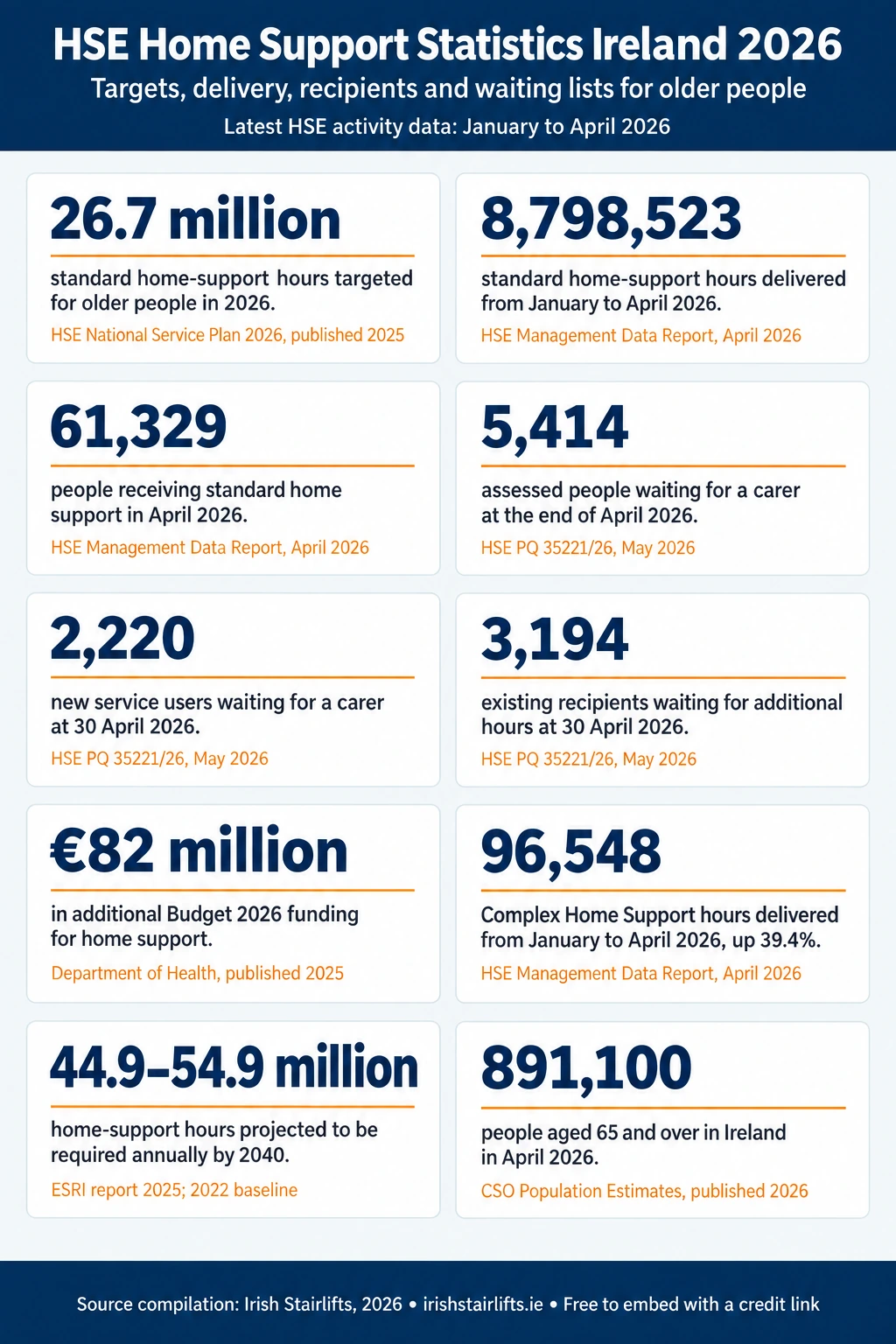
Home support enables tens of thousands of people in Ireland to receive practical or personal assistance while continuing to live at home. Demand is increasing as the population ages, and the HSE has set a target of 26.7 million standard home-support hours for older people in 2026.
This page distinguishes that full-year target from the latest reported activity. The newest HSE management data available when this article was prepared covers January to April 2026 and remains preliminary, while the longer-term ESRI figures use a 2022 baseline to project possible requirements to 2040.
Key HSE home support statistics at a glance
- The HSE plans to deliver 26.7 million standard home-support hours for older people in 2026, which the National Service Plan describes as a 5% increase.
- The same plan sets a target of 62,000 people receiving standard home support during 2026, excluding recipients supported through the separate Complex Home Support programme.
- The HSE delivered 8,798,523 standard home-support hours from January to April 2026, according to its April 2026 Management Data Report.
- Delivery in the first four months was 0.2% above the year-to-date target and 8.9% higher than during the same period of 2025, the HSE performance data shows.
- 61,329 people were receiving standard home support in April 2026, which was 4.6% more than a year earlier, based on the HSE’s monthly recipient measure.
- 5,414 assessed people were waiting for a carer at the end of April 2026, even though the HSE reported that nobody was waiting for funding to be allocated.
- The April waiting list included 2,220 new service users and 3,194 existing recipients waiting for additional hours, according to the HSE’s May 2026 parliamentary response.
- Budget 2026 included €82 million in additional home-support funding, intended to provide 1.7 million extra hours, the Department of Health announced.
- The HSE delivered 96,548 Complex Home Support hours from January to April 2026, up 39.4% on the same period of 2025, as recorded in the April management report.
- The ESRI projects that combined public and privately purchased home-support requirements could reach 44.9 million to 54.9 million hours a year by 2040, depending on the assumptions used in its Hippocrates model.
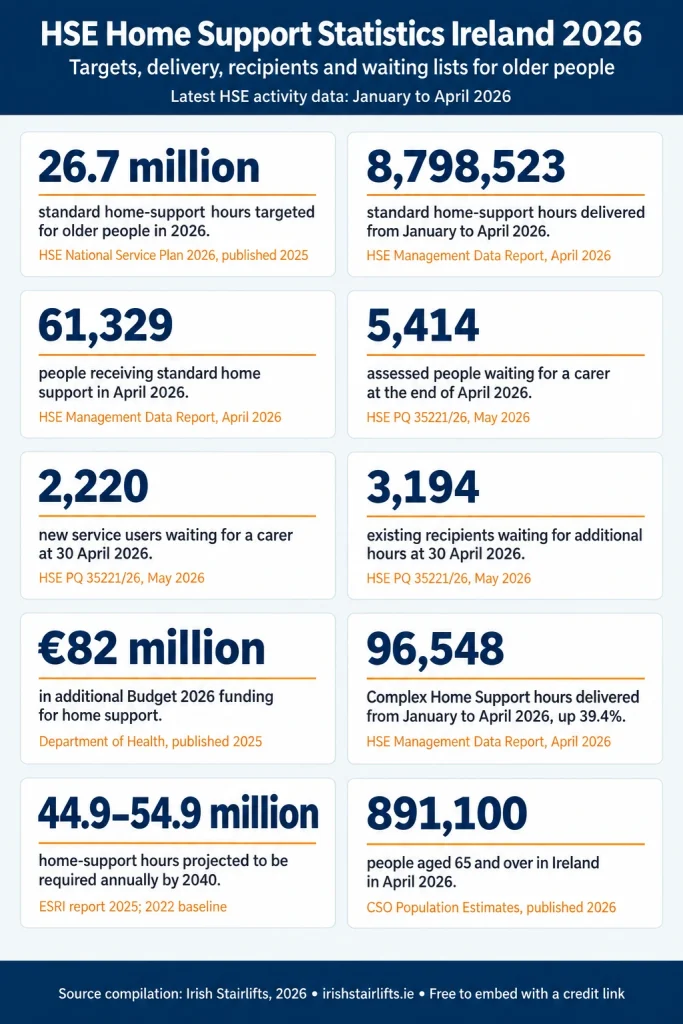
HSE Home Support Statistics Ireland 2026, compiled by Irish Stairlifts. Free to embed. Please credit Irish Stairlifts with a link to this page: https://irishstairlifts.ie/hse-home-support-statistics-ireland/
Ireland’s 26.7 million-hour target for 2026
The HSE National Service Plan 2026 sets a target of 26.7 million standard home-support hours for older people. The plan describes this as a 5% increase and places it within a broader commitment to provide more care closer to home.
This is an annual service target rather than a completed total. The distinction matters because a writer citing 26.7 million as the number of hours already delivered in 2026 would misstate the source.
The plan also targets 62,000 standard home-support recipients. The measure counts each person once and excludes people receiving support through the separate Complex Home Support funding stream. The most recent completed-year figures in the HSE’s April management report show that 25,546,797 standard hours were delivered in 2025 and that 60,463 people were receiving the service at the end of that year.
The Department of Health’s Budget 2026 announcement allocated an additional €82 million to home support. The department said this funding would provide 1.7 million additional hours and bring the 2026 provision to 26.7 million hours. The €82 million is an additional allocation, not the service’s total budget.
The 2026 plan also includes a waiting-list objective. It sets a target of 4,500 assessed people waiting for standard home support and commits the HSE to reducing the number waiting for home care by at least 1,000 during the year. Progress against these objectives must be judged using dated monthly figures because the waiting list changes throughout the year.
Home-support hours delivered through April 2026
The latest published HSE management report available for this compilation covers activity to the end of April 2026. It records 8,798,523 standard home-support hours delivered between January and April, compared with a year-to-date target of 8,778,087 hours.
That placed delivery 0.2% above the year-to-date target. It was also 8.9% higher than the 8,081,448 hours recorded during the corresponding four months of 2025. Both percentages are the HSE’s published performance measures rather than calculations from rounded headline totals.
Monthly activity reached 2,247,737 standard hours in April. This monthly figure forms part of the published January-April total.
The report classifies these figures as standard Older Persons home support and excludes hours funded under Complex Home Support. Keeping the two series separate prevents the smaller complex-care programme from being counted twice or presented as part of the standard-hours target.
How many people receive HSE home support?
The HSE recorded 61,329 people receiving standard home support in April 2026. This was slightly below the full-year target of 62,000, but it was 4.6% higher than the 58,625 recipients recorded in the comparable period of 2025.
The HSE specifies that each person is counted once in this monthly recipient KPI. It should therefore be read as a point-in-time measure of how many people were receiving the service.
These are point-in-time service-user counts rather than the number of unique people who received any amount of help during the whole year. They also do not show how many weekly hours each individual received. Two people counted as recipients may have very different assessed needs and packages.
For broader context, the ESRI’s 2025 capacity report estimated that 69,808 people received some form of public or privately financed home support in 2022. That modelled total included 56,162 publicly funded recipients, 235 recipients of Intensive Home Care Packages and an estimated 13,411 users of privately financed support. The ESRI warns that some people receiving both public and private support are included in the public recipient estimate, so those categories should not be added independently to create a new total.
The ESRI estimated that approximately 8.8% of people aged 65 and over received home support in 2022. This is an estimated participation rate across the broader public and private home-support picture, not an HSE administrative rate for 2026.
The home-support waiting list
At the end of April 2026, 5,414 assessed people were waiting for standard home support. The reported count remained above the HSE’s full-year target of 4,500.
The monthly count fell modestly during the first four months. It moved from 5,554 in January to 5,532 in February, 5,531 in March and 5,414 in April. The change from January to April was a reduction of 140 people, or 2.5% when calculated from the HSE’s published counts.
An HSE parliamentary response dated 26 May 2026 explains what the April total represents. Of the 5,414 people waiting for a carer to be assigned, 2,220 were new service users and 3,194 already received home support but were waiting for additional hours to begin.
The same response reported that nobody was waiting for funding to be allocated. This does not mean that nobody was waiting for a service. It means the recorded constraint at that date was assigning a carer rather than approving funding.
The HSE figures are preliminary and may be revised. They also do not provide a national breakdown of how long each person has waited, so the total cannot show whether a typical wait lasted days, weeks or months.
Direct HSE delivery and approved providers
The HSE uses both directly employed staff and approved external providers to deliver home support. In its response covering activity to 30 April 2026, the HSE reported a rounded national total of 8.79 million hours. Of these, 2.63 million were direct HSE hours and 6.15 million were delivered by approved providers appointed under the Home Support Authorisation Scheme.
The provider volumes were published in rounded millions. Their rounded sum is 8.78 million rather than the rounded national total of 8.79 million, so it would be misleading to convert them into exact percentage shares.
The longer-term ESRI analysis uses a different scope because it combines publicly funded and privately purchased care. For 2022, the ESRI estimated 28,688,449 home-support hours in total. This comprised 20,792,772 publicly funded hours, 225,096 Intensive Home Care Package hours and an estimated 7,670,581 privately financed hours.
Looking at who delivered all public and private hours, rather than who financed them, the ESRI estimated that voluntary and private agencies provided 71%, while HSE-employed carers delivered 29%. The report separately notes that voluntary and private providers delivered 61% of publicly funded HSE home-support hours in 2022.
Home-support hours and waiting lists by HSE Health Region
Dublin and North East recorded the largest raw volume of standard home-support activity in the first four months of 2026, with 2,189,983 hours delivered. Dublin and Midlands delivered 1,797,377 hours, Dublin and South East delivered 1,604,513, West and North West delivered 1,451,820, South West delivered 1,122,827 and Mid West delivered 632,003.
The six regional figures sum to the national total of 8,798,523. They are raw service volumes, however, so a region with more hours has not necessarily provided better access. Population size, age structure, assessed need, workforce availability and package intensity all affect the total.
The April waiting list was largest in West and North West, where 1,171 people were assessed and waiting. Dublin and South East had 1,147 people waiting, Dublin and North East had 1,137, South West had 902, Mid West had 780 and Dublin and Midlands had 277.
These six counts sum to the national waiting list of 5,414. They should not be interpreted as regional waiting rates because the HSE table does not adjust them for each region’s population, number of older residents or volume of assessed demand.
Complex Home Support and dementia commitments
Complex Home Support is reported separately from the standard home-support programme. The HSE delivered 96,548 complex hours from January to April 2026.
The January-April total was 39.4% higher than the 69,283 complex hours delivered during the same period of 2025.
There were 82 Complex Home Support recipients in April 2026, compared with the full-year target of 90. The HSE also reported that 100% of those recipients had a key worker assigned.
For the full year, the National Service Plan targets 275,000 Complex Home Support hours for 90 people. These targets must not be added casually to the 26.7 million standard hours because the two funding streams are reported through separate KPIs.
The plan also requires at least 22% of all new home-support hours to be provided to people with dementia or cognitive impairment. This is two percentage points above the 2025 commitment, according to the HSE’s dementia care action for 2026.
Why home-support demand is expected to grow
Ireland’s older population is growing in both number and share. The CSO estimated that 891,100 people were aged 65 and over in April 2026, representing 16.1% of the usually resident population.
The number aged 65 and over was 165,000 higher than in 2020, an increase of 22.7%. The CSO labels the 2026 estimate preliminary.
The ESRI’s Hippocrates analysis projects that combined public and privately purchased home-support requirements could grow from 28.7 million hours in 2022 to between 44.9 million and 54.9 million hours a year by 2040. The range represents average annual growth of 2.5% to 3.7% under different assumptions about population growth, healthy ageing, unmet demand and how care is organised.
The low-pressure scenario produces 44.9 million hours, while the high-pressure scenario reaches 54.9 million. The progress scenario, which includes expanded home support and reduced unmet demand, produces about 50 million hours, a 75% increase with average annual growth of 3.2%.
These numbers are scenario projections rather than forecasts of what the HSE will deliver. They also include privately purchased care, while the HSE’s 26.7 million target relates to its standard Older Persons service. The two figures illustrate different parts of the home-support system and should not be used as if their definitions were identical.
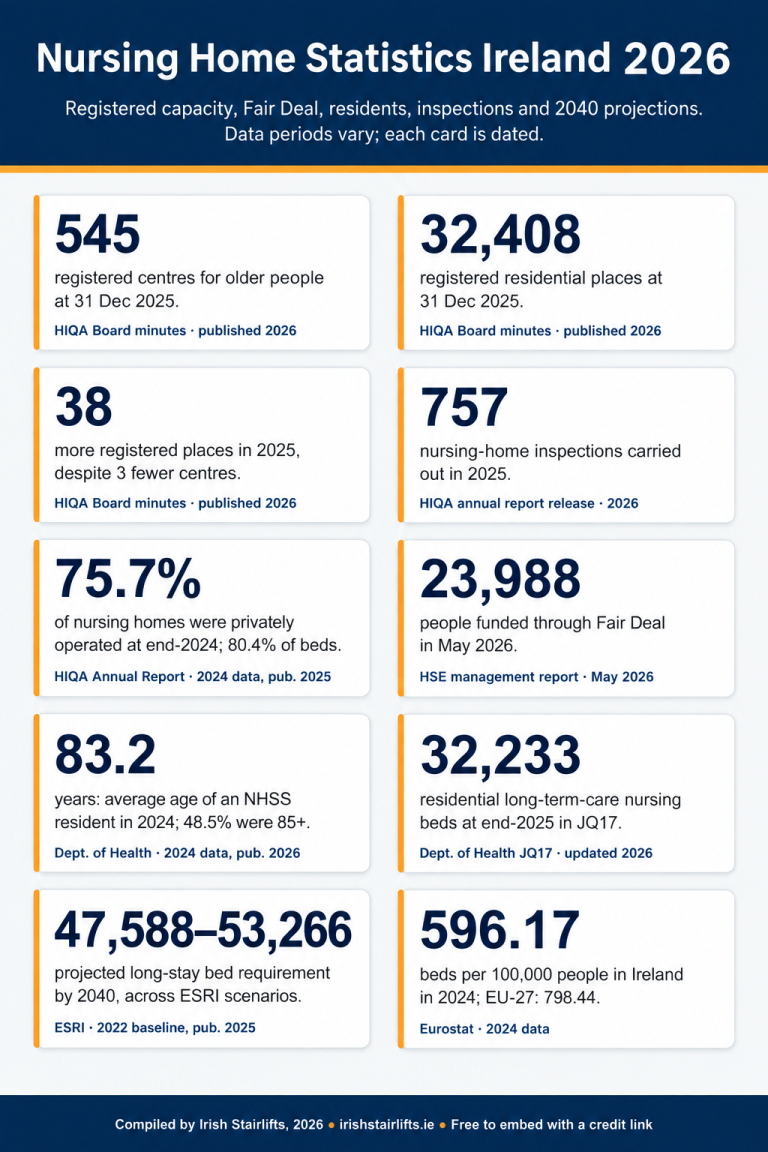
Home support is only one part of Ireland’s long-term-care system; our Irish nursing home statistics cover registered capacity, Fair Deal activity and projected residential bed requirements to 2040.
How we compiled these statistics
Irish Stairlifts compiled this reference from primary Irish sources reviewed on 11 September 2026. The main current source is the HSE Management Data Report for April 2026, supported by the HSE National Service Plan 2026, an HSE parliamentary response dated 26 May 2026, the Department of Health’s Budget 2026 announcement, the ESRI’s 2025 capacity report and the CSO’s April 2026 population estimates.
Targets, observed activity and projections are labelled separately. Standard Older Persons home support is kept separate from Complex Home Support, and the HSE’s publicly funded service measures are not treated as equivalent to the ESRI’s wider estimates of public and privately purchased care. Regional figures are presented as raw totals rather than population-adjusted rates. Preliminary HSE and CSO figures may change in later releases.
How Irish Stairlifts helps
Home support and home adaptations can play different but complementary roles in helping a person remain at home. A stairlift does not replace personal care, clinical services or an assessed HSE home-support package.
For someone who can transfer safely onto a seated lift but finds stairs difficult, Irish Stairlifts can assess the staircase, explain suitable options and provide installation and after-care information. You can explore the company’s straight and curved stairlift range or arrange a free site survey based on the property and the user’s needs.
Related Irish statistics
Home-support demand is closely connected with population ageing, disability, housing and the ability to remain independent. These related Irish Stairlifts resources provide additional primary-source statistics:
- Older people living alone in Ireland statistics examines household composition and how living arrangements change with age.
- Mobility disability statistics for Ireland covers Census disability counts and difficulties with basic physical activities.
- Falls among older people in Ireland statistics brings together fall prevalence, medical-attention, trauma and hip-fracture data.
- Housing adaptation grants statistics for Ireland covers funding, paid claims and the three private-house adaptation schemes.
Related Post
categories
- Accessible Bathrooms 20
- Grants & Funding 8
- ISB Mobility 6
- Mobility Aids 42
- Outdoor & Independence Solutions 44
- Seating Solutions 10
- Stairlifts & Home Lifts 36
- Statistics 9