
Home Accessibility Needs Statistics Ireland 2026: 516 Older People Assessed by ALONE Needed Adaptations in Q1 2026

Sources last reviewed: 21 September 2026 | Estimated read time: 11 minutes | Human written and fact checked against each named source.
An accessible home can mean different things to different people. One person may need an easier way into the shower, while another needs a ramp, handrail or mobility aid. Irish figures on these needs are scattered across service reports, so this roundup brings the relevant findings together while keeping each statistic tied to the people and period actually measured.
The newest figures here come from ALONE assessments in the first quarter of 2026. Earlier ALONE findings from 2024 and 2025 and an evaluation of a 2021–2023 Healthy Age Friendly Homes pilot add context. None of these service groups represents every older person in Ireland.
Key statistics at a glance
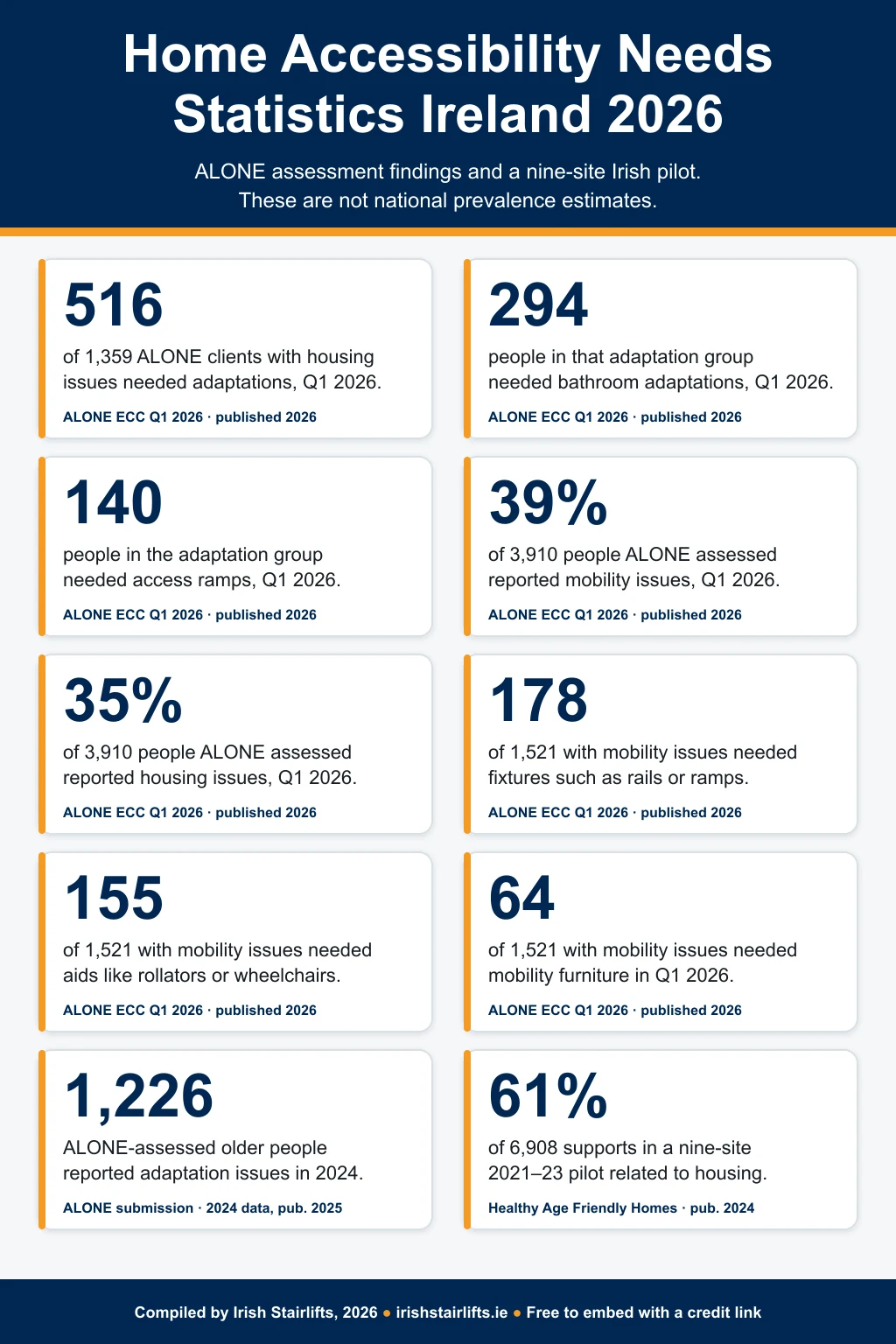
- 516 older people among the 1,359 assessed by ALONE with housing issues in Q1 2026 needed housing adaptations, its quarterly report found.
- 294 people in that Q1 adaptation group needed bathroom adaptations, according to the ALONE Q1 report.
- 140 people in the same Q1 group needed access ramps, the ALONE Q1 report recorded.
- 39% of the 3,910 older people ALONE assessed in Q1 2026 reported mobility issues in its quarterly report.
- 35% of that assessed group reported housing issues in the ALONE Q1 report. Housing issues are broader than adaptation needs.
- 178 people among the 1,521 assessed with mobility issues in Q1 2026 needed fixtures such as grab rails or ramps, the ALONE Q1 report says.
- 155 people in that mobility-issues group needed aids such as a rollator or wheelchair, according to the ALONE Q1 report.
- 1,226 older people assessed by ALONE during 2024 reported housing-adaptation issues, its pre-budget submission stated.
- 61% of supports delivered in a nine-site Healthy Age Friendly Homes pilot related to housing, according to the pilot evaluation. That is a share of supports, not a share of participants needing an adaptation.
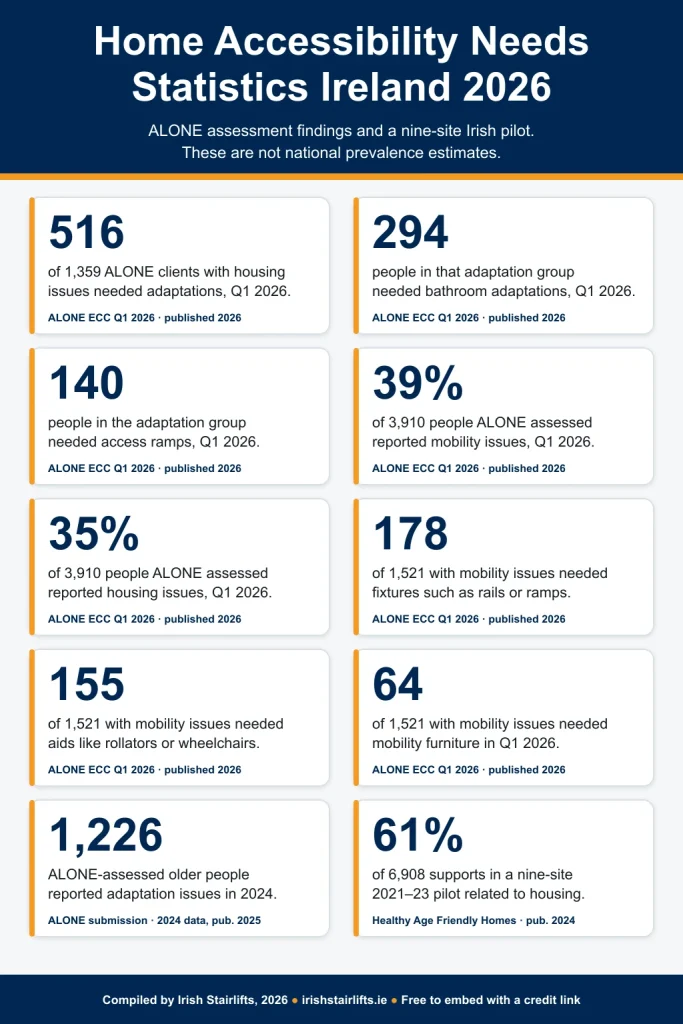
Home Accessibility Needs Statistics Ireland 2026, compiled by Irish Stairlifts. Free to embed. Please credit Irish Stairlifts with a link to this page: https://irishstairlifts.ie/home-accessibility-needs-statistics-ireland/
What the latest ALONE assessments show
ALONE’s figures describe older people who came into contact with its services and completed assessments. They reveal the mix of issues its teams encountered, not the prevalence of those issues across Ireland’s entire older population. The distinction matters because people seeking support may have more needs than a randomly selected household.
In the first quarter of 2026, ALONE assessed 3,910 older people, as its Q1 service report records. Mobility issues were reported by 1,521 people, or 39%, while 1,359 people, or 35%, reported housing issues in the same report. The categories can overlap: a person may face difficulty getting around and also have a problem with their home.
Neither broad percentage identifies a particular piece of equipment or a specific alteration. A mobility issue might relate to moving indoors or outside, while a housing issue could concern repairs or other living conditions. The Q1 report does provide a separate adaptation breakdown within the housing group, which is the basis for the headline below. Reading the 39% mobility rate as the proportion needing stairlifts would still go beyond the evidence.
For calendar 2025, ALONE’s annual findings reported mobility issues for 38% and housing concerns for 36% of its relevant service group. Those figures appeared in ALONE’s annual announcement, published in April 2026. The announcement does not state the exact assessment denominator for those percentages, so they should not be applied to everyone the organisation supported during the year.
ALONE’s 2024 report summary put mobility challenges at 34% and housing issues at 32% among its assessed older people that year. The sequence offers context about what ALONE has been seeing in its service work. It is not a clean measure of change in national need: the people assessed, the number entering services and the timing of reports can all change.
How many people reported a need for home adaptations?
The newest adaptation-specific count comes from Q1 2026. Of 1,359 ALONE clients with housing issues that quarter, 516, or 38% of that subgroup, needed housing adaptations, according to the ALONE Q1 report. The 38% does not use the 3,910 people assessed overall as its denominator. The 516 is an observed quarterly service count, not an estimate of all Irish households needing work.
The clearest full-year count in these sources comes from 2024. In a pre-budget submission published in 2025, ALONE said 1,226 older people it assessed in 2024 indicated issues with housing adaptations. ALONE named bathrooms, access ramps and stairlifts among the frequent types of issue, but it did not publish a separate count for any one of those products that year.
A separate ALONE submission, dated 2025 and uploaded in 2026, described the same year’s assessed needs another way. It said one third of older people newly assessed by ALONE in 2024 experienced housing difficulties. Within that housing-difficulties group, 35% required adaptations. This does not mean that 35% of all people ALONE assessed required an adaptation, still less that 35% of all older Irish households did.
The earlier Q3 2025 report offers a dated quarterly reference. ALONE assessed 3,430 older people in that quarter, its Q3 report says. Of those, 1,204 people, or 35%, reported housing-related issues in the housing section. Within that smaller housing group, 422 people, also reported as 35%, needed housing adaptations.
The repeated 35% is easy to misread. The first percentage concerns housing issues among everyone assessed in Q3 2025. The second concerns adaptation needs among the people who had housing issues. The 422 people are an observed ALONE service count for July to September 2025. The Q1 2026 figure is a separate quarter with a different group, so comparing the two raw counts does not establish a national trend. Neither is a record of works completed.
Bathrooms were the largest named adaptation need
Among the 516 people with housing-adaptation needs in the first quarter of 2026, 294 needed bathroom adaptations, according to the ALONE Q1 report. Bathrooms were the most common named adaptation category in that quarter. The report does not break the 294 into showers, baths, toilets, handrails or other bathroom work.
That distinction is important for someone using the figure in a news article or grant discussion. The number describes an assessed need. It does not show that 294 bathrooms were altered, that 294 walk-in showers were installed, or that those households applied for or received funding. One person might also need changes in another part of the home.
The earlier ALONE Q3 2025 report recorded 260 people needing bathroom adaptations among its 422 clients with adaptation needs that quarter. That finding is useful historical context, but the Q1 2026 figure is the newer quarterly observation. Neither count should be added to the other as a full-year total: the quarters differ, and the sources do not establish whether the same person might appear in both.
ALONE’s 2024 pre-budget submission also lists bathrooms among the frequent issues faced by the 1,226 assessed people with adaptation problems in that full year. It does not supply an individual bathroom count for 2024. Keeping the full-year and quarterly evidence separate avoids implying a product-specific estimate that ALONE did not publish.
Bathroom accessibility can involve getting into the room, entering a bathing area, standing or sitting comfortably, and leaving safely. The published ALONE categories do not say which of those barriers each person faced. They support a careful description of demand for bathroom adaptations, not a claim about the best solution for every household.
Access ramps and mobility fixtures meet different needs
The ALONE Q1 2026 report records 140 people with an access-ramp need among its housing-adaptation group. It does not specify whether those ramps were intended for a front entrance, rear entrance, internal level change or another location. The figure also does not show how many ramps were subsequently fitted. ALONE’s Q3 2025 report had recorded 100 people with this need in that earlier quarter, but the two observations are not a national time series.
ALONE measured mobility fixtures separately from housing adaptations. Among the 1,521 assessed people who reported mobility issues in Q1 2026, 178 needed fixtures such as grab rails or wheelchair ramps, according to the Q1 mobility section. The examples illustrate the category; they are not individual product counts. It would be incorrect to say that all 178 people needed ramps, or to add the fixture group to the 140 access-ramp needs as though they came from mutually exclusive groups.
The Q3 2025 report recorded 164 people needing mobility fixtures among 1,312 people with mobility issues in that earlier quarter. This is a separate service cohort rather than proof that fixture need rose nationally by the first quarter of 2026.
This distinction is useful when thinking about access from the street to the home and movement inside it. A rail may address one route, while a ramp may be relevant elsewhere. Some households may need several changes rather than one device. The ALONE data show that these types of need arose in assessment, but they do not include the measurements, layout or professional advice needed to specify a solution.
The ALONE pre-budget submission also names stairlifts among frequent housing-adaptation issues in 2024. It supplies no stairlift-specific total. A count of people reporting adaptation difficulties should never be converted into a count of stairlift users or installations.
Mobility aids and furniture form another part of the picture
Mobility aids are different from changes to the building itself. Among the 1,521 people in ALONE’s Q1 2026 mobility-issues group, 155 needed aids such as a new rollator or wheelchair, according to its quarterly findings. The report does not say how many of the 155 specifically needed wheelchairs or how many received an aid.
In that same Q1 2026 group, 64 people needed mobility furniture, with an orthopaedic chair and shower seat given as examples in the ALONE report. Again, the examples should not be presented as separate product totals. The source does not establish that each person needed only one item, or that the aid and furniture groups cannot overlap.
For a dated point of reference, the Q3 2025 report recorded 134 people needing mobility aids and 70 people needing mobility furniture among the 1,312 clients who reported mobility issues that quarter. These counts are not the 2026 totals, nor should the quarterly groups be added to estimate the number of unique people helped over a year.
These categories help explain why a home-accessibility conversation is wider than a single renovation. A person may need a change to an entrance, a more usable bathroom and a personal mobility aid. The report records those needs through ALONE’s support process. It does not rank the likely effectiveness of a ramp, chair, wheelchair or any other option for an individual.
Home ownership and living arrangements provide context
Of the 3,910 people who supplied home-ownership and living-arrangement information in ALONE’s Q1 2026 report, 3,007, or 77%, owned their homes, according to its participant profile. Another 2,561, or 66%, lived alone in that same profile. These figures describe respondents to ALONE, not the national distribution of ownership or living arrangements among older people.
Ownership can affect how a household approaches building work, but it says nothing by itself about whether the property is accessible. Living alone can make the practical process of arranging assessments and works different, yet the ALONE report does not establish that living alone caused a mobility or housing issue. The findings are most useful for describing the circumstances in which support is being sought.
The separate Healthy Age Friendly Homes pilot found that 74% of its participants owned their homes, according to the pilot evaluation published in 2024. That group came from a different programme and earlier years. Its ownership percentage should not be combined with ALONE’s or used to represent every older Irish household.
What the Healthy Age Friendly Homes pilot adds
The Healthy Age Friendly Homes Pilot Evaluation, published in 2024, covers a pilot that operated from June 2021 to March 2023 across nine local-authority sites. It recorded 2,133 participants and 3,273 home visits. A visit is an activity count; the same participant could receive more than one.
Across the pilot, coordinators recorded 6,908 supports, according to the evaluation overview. The evaluation classified 61% of those supports under housing in its theme breakdown. This is evidence about the work of the pilot programme, not evidence that 61% of participants required physical home adaptations.
The housing category covered a wide range of help, including identifying routes to grants and energy-related supports. The 6,908 total includes support across housing, health, technology and community themes. Neither number should be presented as completed building projects. The evaluation can show why housing came up often in a programme designed to help people remain at home, while ALONE’s assessments offer the more specific bathroom, ramp and mobility-aid breakdown used above.
These two sources also cover different people and periods. Their percentages are not rival estimates of one national measure. They answer different questions: ALONE records the issues its clients raised, and the pilot evaluation records the kinds of support a separate programme delivered.
How we compiled these statistics
This article draws on original material from ALONE, the Department of Health, Age Friendly Ireland and Maynooth University. The ALONE sources include a 2024 assessment summary and policy submissions, its Q3 2025 report, its 2025 annual findings published in 2026, and its Q1 2026 report. The Healthy Age Friendly Homes source is a pilot evaluation published in 2024 for activity during 2021–2023. Each named source and the figures attributed to it were checked again on 21 September 2026.
We kept assessment counts, percentages within assessed groups, programme participants, home visits and supports in their own categories. We did not add overlapping ALONE needs together, estimate a national total by applying service-user percentages to the wider population, or treat an identified need as a completed adaptation. The 2026 in the title describes when this roundup is being prepared, not the data period of every statistic.
We also looked for a comparable European Union figure on older people’s home-adaptation needs. Eurostat’s available housing-type figures measure where people of all ages live, not whether their homes need adaptations. A superficially similar comparison would mislead, so this article does not include an Ireland-versus-EU accessibility statistic.
How Irish Stairlifts helps
The figures show several kinds of access need, but they cannot determine what is suitable in any one home. Irish Stairlifts & Bathrooms offers options including stairlifts, ramps, rails, mobility aids and walk-in mobility showers. The right approach depends on the person, the layout of the property and any professional recommendations they have received.
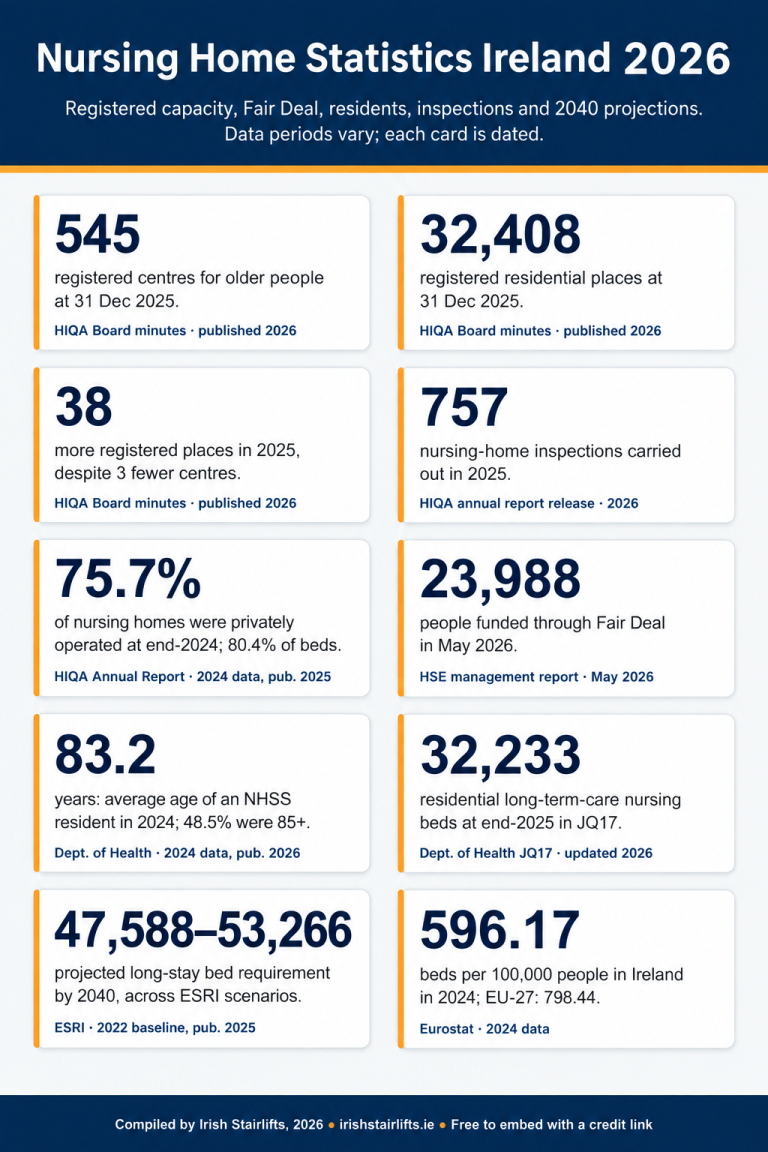
Home adaptations can help some people remain safely at home, while others require residential care; our residential care statistics summarise nursing-home capacity, Fair Deal activity and projected long-stay requirements.
For a separate explanation of public funding and actual grant payments, see our housing adaptation grant statistics.
Related Post
categories
- Accessible Bathrooms 20
- Grants & Funding 8
- ISB Mobility 6
- Mobility Aids 42
- Outdoor & Independence Solutions 44
- Seating Solutions 10
- Stairlifts & Home Lifts 36
- Statistics 9