
Nursing Home Statistics Ireland 2026: 545 Registered Centres and 32,408 Places

Sources last reviewed: 29 September 2026 | Estimated read time: 11 minutes | Human written and fact checked against each named source.
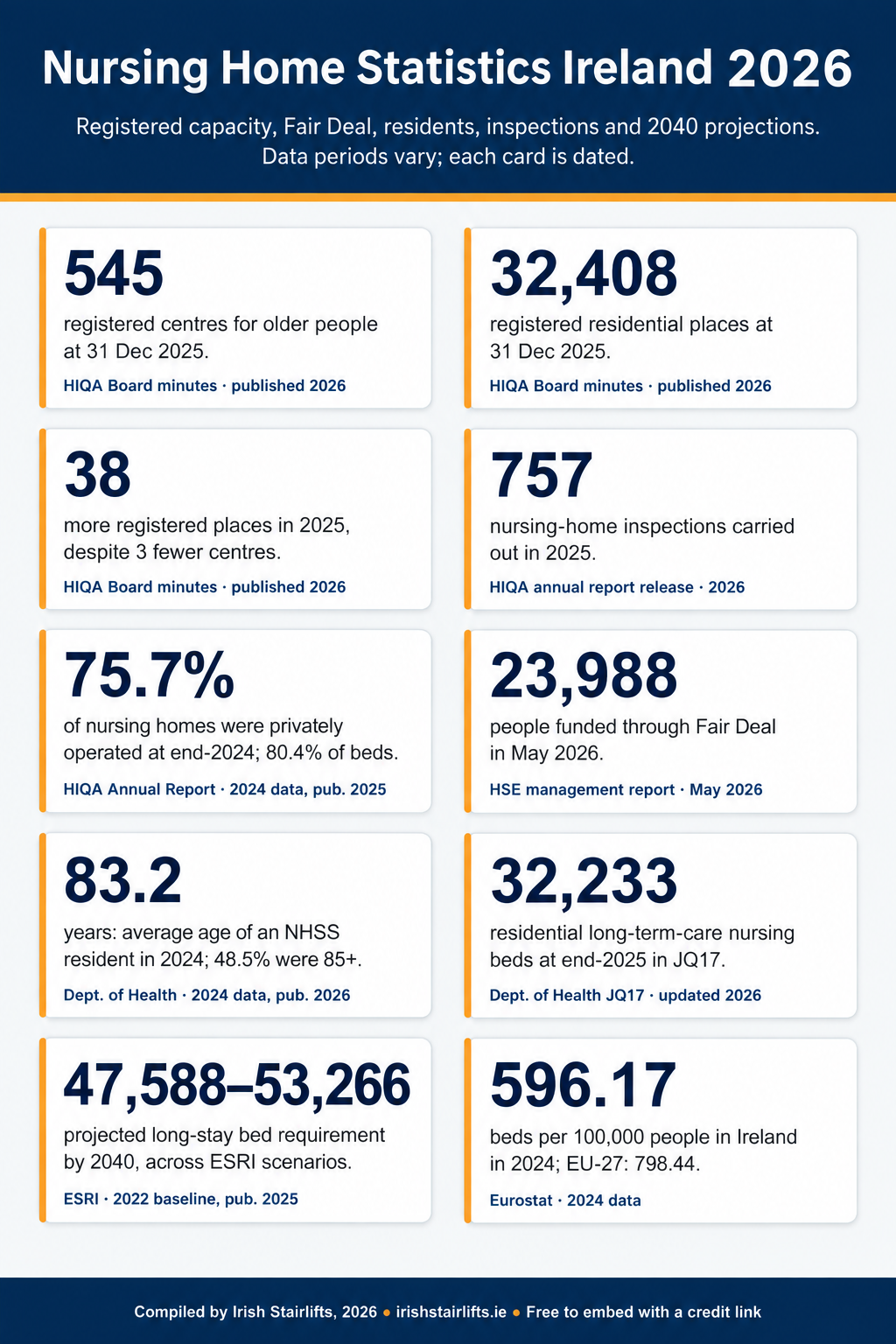
Ireland had 545 registered nursing homes providing 32,408 residential places at the end of 2025. Although the number of centres fell slightly during the year, registered capacity increased, continuing a shift towards fewer but larger centres.
This page was compiled in 2026, but its sources cover different periods. The newest national capacity figures are for 31 December 2025, current HSE Nursing Homes Support Scheme activity covers May 2026, the latest detailed ownership table is for 2024, and the long-term capacity projections use a 2022 baseline.
Key nursing home statistics at a glance
- Ireland had 545 registered designated centres for older people at the end of 2025, the HIQA Board minutes show.
- Those centres provided 32,408 registered residential places on 31 December 2025, based on the same HIQA capacity report.
- The number of nursing homes fell by 3 during 2025, while registered capacity increased by 38 places, indicating a move towards larger centres in the HIQA year-end figures.
- HIQA carried out 757 nursing-home inspections during 2025, its final annual-report release records.
- Private providers operated 75.7% of nursing homes and controlled 80.4% of registered beds at the end of 2024, according to the HIQA 2024 report.
- The HSE funded 23,988 people through Fair Deal, formally the Nursing Homes Support Scheme, in May 2026, the May management report shows.
- The average age of an NHSS resident was 83.2 years in 2024, while 48.5% were aged 85 or over, based on the Department health table.
- The internationally harmonised series recorded 32,233 residential long-term-care nursing beds at the end of 2025, according to the JQ17 bed series.
- ESRI scenarios project that Ireland could require 47,588 to 53,266 long-stay beds by 2040, compared with a modelled 2022 baseline of 29,579, the ESRI capacity report finds.
- Ireland reported 596.17 residential long-term-care beds per 100,000 people in 2024, compared with an EU-27 rate of 798.44 in the Eurostat bed dataset.
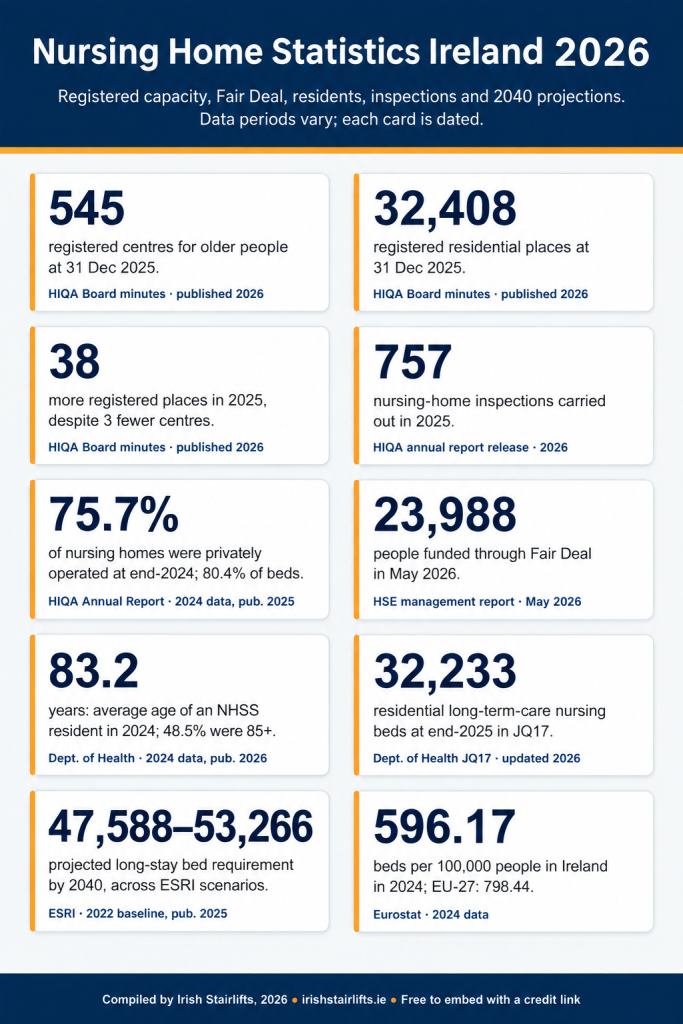
Nursing Home Statistics Ireland 2026, compiled by Irish Stairlifts. Free to embed. Please credit Irish Stairlifts with a link to this page: https://irishstairlifts.ie/nursing-home-statistics-ireland/
How many nursing homes are there in Ireland?
At 31 December 2025, Ireland had 545 registered centres for older people. HIQA uses the legal term “designated centres for older people,” while these services are commonly described as nursing homes.
The centres provided 32,408 registered places. These are places that the centres are registered to provide, not a count of occupied beds or individual residents. A centre may have an unoccupied place, and the total does not show how many residents are supported through Fair Deal.
There were three fewer centres but 38 more places than at the end of 2024. Dividing the same registered totals gives an average of about 59.5 places per centre. This calculated average describes registered capacity across the sector and does not mean that every nursing home has roughly 60 residents.
The direction of change was also visible in 2024. Six new homes provided 443 beds and extensions at 28 existing homes added another 385. At the same time, closures and reductions removed 672 registered beds. The resulting net increase was 156 beds, even though the number of registered homes declined by five during that year.
These figures show why openings alone are an incomplete measure of capacity. New buildings and extensions can add places while other providers close or reduce their registered capacity.
Who owns Ireland’s nursing homes?
The newest fully accessible national ownership breakdown is for 31 December 2024. Private providers operated 415 of 548 nursing homes, equal to 75.7% of centres. They held 26,016 of the 32,370 registered beds, or 80.4% of capacity.
The HIQA ownership table shows that the HSE directly operated 114 centres with 5,279 beds. That represented 20.8% of centres but 16.3% of registered capacity. A further 19 centres with 1,075 beds were operated by HSE-funded bodies under sections 38 and 39 of the Health Act 2004. These organisations accounted for 3.5% of centres and 3.3% of beds.
The difference between the private share of centres and beds indicates that private homes were larger on average than the public and HSE-funded categories in this table. It does not establish differences in occupancy, resident outcomes or quality.
Ownership also differs from funding. A person supported through the publicly funded Nursing Homes Support Scheme may live in a private, voluntary or public nursing home. The ownership of the building does not by itself identify how an individual resident’s care is financed.
How many people are supported through Fair Deal?
The HSE funded 23,988 people under the NHSS in long-term residential care during May 2026. The scheme is commonly known as Fair Deal.
The HSE performance table shows that May activity was 2.2% below the year-to-date target of 24,532 people. It was nevertheless 0.3% higher than the 23,919 funded during the same reporting period a year earlier. The full-year 2026 target was 24,729 people.
These are people funded during a reporting month. The figure should not be divided by HIQA’s 32,408 places to create a national occupancy rate. The two measures have different coverage and dates, while some nursing-home residents are not supported by the NHSS.
The HSE reported that 17.6% of NHSS clients received Ancillary State Support in May 2026. This optional component, sometimes called the nursing-home loan, allows a person’s contribution based on property or land to be deferred. It is not the percentage receiving ordinary Fair Deal support.
In the same month, 80.9% of assessment reports were processed within six weeks, below the 90% target. This performance measure covers the processing of a Common Summary Assessment Report, not the complete time from a person’s initial enquiry to admission into a nursing home.
NHSS-funded beds represented 3.0% of Ireland’s population aged 65 and over in May 2026. The percentage uses the older population as its denominator and is not directly comparable with Eurostat’s bed rate per 100,000 people of all ages.
How old are nursing-home residents?
The Department of Health’s national summary counted 24,370 NHSS residents in 2024. This was 3.4% more than the 23,579 residents recorded in 2023 and 6.7% more than the 22,831 recorded in 2020.
The average NHSS resident age was 83.2 years in 2024. Almost half, 48.5%, were aged 85 or over. A further 20.3% were aged 80 to 84, while 14.0% were aged 75 to 79.
The younger resident groups represented smaller shares. People aged 70 to 74 accounted for 7.8%, those aged 65 to 69 made up 4.3%, and residents under 65 represented 5.2%.
These percentages describe NHSS residents in December 2024. They do not cover every resident outside the scheme. The published age percentages total 100.1% because each category was rounded separately.
The figures nevertheless show how strongly residential long-term care is concentrated among the oldest published age groups.
Public long-stay and short-stay beds
In May 2026, the HSE reported 4,886 NHSS beds in public long-stay units. It separately reported 1,509 short-stay beds in public units.
Short-stay beds can support rehabilitation, convalescence, respite, transitional care or other time-limited needs. They should not be treated as a subset of permanent long-stay places without checking the relevant service definition.
Open public short-stay beds had 84.0% occupancy in May 2026, below the HSE target of 90%. This rate applies only to the open short-stay beds covered by the HSE indicator. It cannot be applied to private nursing homes or used as a national nursing-home occupancy rate.
The distinction is also important in capacity planning. Residential care is not a single uniform service. Long-stay places, rehabilitation beds and transitional beds respond to different needs and may have different patterns of turnover.
Nursing-home inspections and regulation
HIQA carried out 757 nursing-home inspections in 2025. Earlier Board reporting listed 759, a difference of two inspections, so this article uses the later final annual-release total.
The HIQA Board report recorded 1,325 inspection days and 674 published inspection reports during the year. An inspection can involve more than one inspector or take place over more than one day, while a report may be published after the inspection period. These units therefore should not be treated as interchangeable.
For comparison, HIQA completed 840 inspections in 2024, amounting to 1,407 inspection days. Every registered nursing home was inspected at least once that year, and 84.2% of inspections were unannounced.
HIQA also received 1,021 pieces of information relating to nursing homes in 2024, an 8% decrease from 2023. This unsolicited information can come from residents, relatives or members of the public, but each item is not automatically a substantiated complaint or a separate care failure.
At the end of 2024, 148 restrictive conditions were attached to the registrations of 120 nursing homes. One home can have more than one condition. Conditions may require a provider to take specified action or restrict activity, such as admitting new residents, until compliance improves.
Why official bed totals differ
The Department of Health’s internationally harmonised JQ17 dataset records 32,233 nursing beds in residential long-term-care facilities at the end of 2025. That is 175 fewer than the 32,408 residential places in HIQA’s year-end Board report.
The difference also appears in 2024, when the HIQA annual report recorded 32,370 registered beds and the JQ17 bed series recorded 32,169. The totals should not be averaged or substituted for one another.
JQ17 is prepared for the joint Eurostat, OECD and World Health Organization questionnaire. Its methodology document applies the international HP.2 definition for nursing and other residential long-term-care facilities. HIQA’s total describes residential places in registered designated centres for older people.
The JQ17 annual values rose by 64 beds, or 0.2%, between 2024 and 2025. They increased by 559 beds, or 1.8%, from the recent low of 31,674 in 2022. The series has documented methodological breaks in earlier years, including 2009, 2010 and 2014, so long-term trend comparisons must account for those changes.
How many long-term-care beds could Ireland need by 2040?
The ESRI’s Hippocrates model estimated 33,324 LTRC beds in December 2022. This baseline comprised 3,745 short-stay beds and 29,579 long-stay beds.
The baseline is a modelled composite using HIQA, HSE, Nursing Homes Ireland survey and population data. It is not another edition of the HIQA or JQ17 administrative series. The ESRI baseline analysis estimated that voluntary and private homes provided 80% of all LTRC beds.
Under the report’s scenarios, short-stay requirements reach 6,431 to 7,265 beds by 2040, an increase of 72% to 94%. Long-stay requirements reach 47,588 to 53,266 beds, an increase of 61% to 80%.
Adding the matching components in the ESRI scenario table produces a total requirement ranging from 54,082 beds in the progress scenario to 60,531 in the high-pressure scenario. That would be 20,758 to 27,207 more beds than the modelled 2022 baseline.
These are conditional projections, not commitments or exact forecasts. The scenarios vary assumptions about population growth, healthy ageing, unmet demand, occupancy and the extent to which expanded home support could substitute for residential care.
Population ageing was the largest modelled driver. The ESRI decomposition attributes 87% of projected short-stay growth and 84% of projected long-stay growth to it under the status quo. In a separate sensitivity test, expanded home support reduced the modelled 2040 requirement by 258 short-stay beds and 1,367 long-stay beds, or about 1,625 beds in total.
Home support can reduce some admissions in the model, but it does not remove the projected need for substantial residential capacity. The two services support different people and needs, and the result depends on whether sufficient home-care hours and community services are available.
Ireland compared with the EU
Eurostat reported 596.17 residential long-term-care beds per 100,000 people in Ireland in 2024. The EU-27 rate for the same measure and year was 798.44 per 100,000.
Ireland’s reported rate was therefore 25.3% below the EU-27 rate, calculated from the Eurostat country values. The Netherlands reported 1,389.81 beds per 100,000 people, Sweden 1,297.84 and Belgium 1,248.77.
This is a matched comparison of the year, measure and total-population denominator. It is not a ranking of care quality. Countries organise hospital care, residential long-term care, home support and informal care differently, while Eurostat notes that national administrative sources may not be fully comparable.
The EU comparison uses 2024 because it is the newest common year in the Eurostat series. Ireland’s 2025 national total should not be compared directly with the EU’s 2024 rate as if both covered the same period.
How we compiled these statistics
Irish Stairlifts compiled this reference from primary sources reviewed on 29 September 2026. The central capacity and regulation sources are the HIQA Board minutes, the final HIQA annual release and the HIQA 2024 report.
Fair Deal activity comes from the HSE May report. Resident totals and age groups come from the Department of Health’s long-stay care table. The internationally comparable nursing-bed series comes from JQ17 open data, while future requirements come from the ESRI projection report. EU context uses Eurostat’s matched dataset.
Registered capacity, scheme-funded people, residents and occupied beds are kept separate. Publication year, data period and projection horizon are stated independently. Calculated changes use compatible figures from the same source series and are rounded to one decimal place where appropriate.
The roundup year is 2026 because that is when this page was prepared. It does not mean that every statistic measures activity during 2026.
How Irish Stairlifts helps
Residential care is essential for people whose needs cannot be met safely at home. Other people may be able to remain at home with the right combination of personal support, clinical care and suitable adaptations.
A stairlift does not replace nursing care, professional assessment or an HSE support package. For a person who can transfer safely onto a seated lift but finds stairs difficult, Irish Stairlifts can assess the staircase, explain the available options and provide installation and after-care information. Explore the stairlift product range or request a site survey based on the home and the user’s needs.
Related Irish statistics
Nursing-home capacity sits within a wider picture of ageing, home care, disability and housing. These related Irish Stairlifts reference pages provide additional primary-source figures:
- HSE home-support statistics covers delivered hours, recipients, waiting lists and future demand for care at home.
- Older people living alone examines household composition and how living arrangements change with age.
- Mobility disability statistics covers Census disability counts and difficulties with basic physical activities.
- Housing adaptation grants covers allocations, paid claims and Ireland’s private-house adaptation schemes.
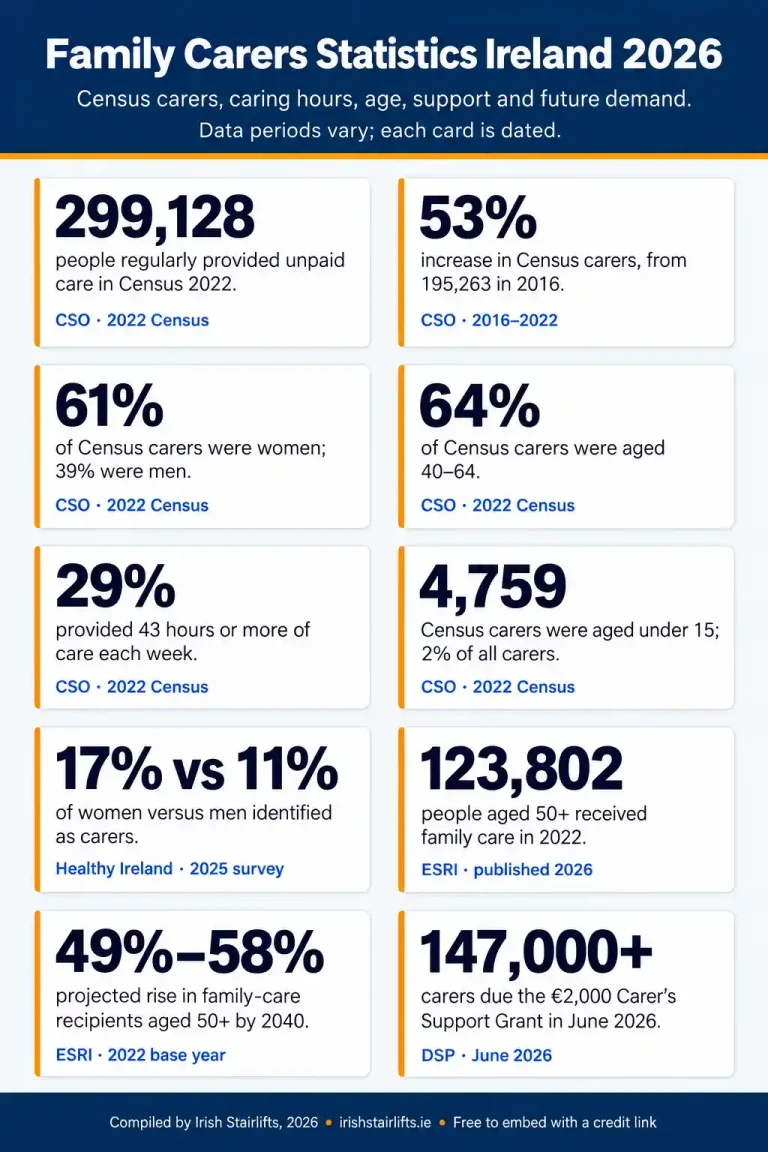
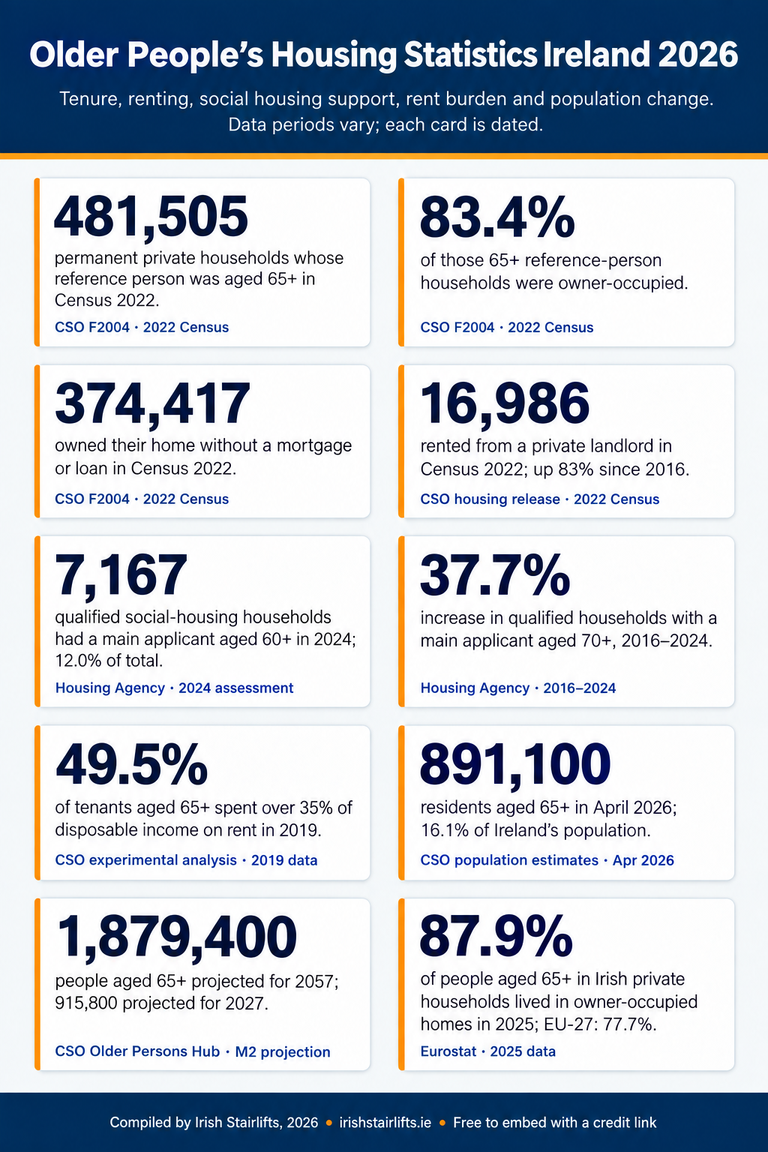
Related Post
categories
- Accessible Bathrooms 20
- Grants & Funding 8
- ISB Mobility 6
- Mobility Aids 42
- Outdoor & Independence Solutions 44
- Seating Solutions 10
- Stairlifts & Home Lifts 36
- Statistics 9