
Falls Among Older People in Ireland Statistics 2026: Almost One in Three Adults Aged 70+ Reported a Fall

Last updated 19 August 2026 · 12-minute read · Human written and fact checked against each named source.
Falls are a substantial health and independence issue for older people in Ireland. Recent national research shows that they affect far more people than hospital figures alone can capture, while Ireland’s growing older population means that demand for prevention, treatment and suitable home supports is likely to increase.
The 2026 title reflects when this roundup was updated. The newest national falls-prevalence paper was published in 2026 but measures outcomes in 2022, while the latest dedicated NOCA analysis of older adults covers 2017 to 2021.
Key statistics at a glance
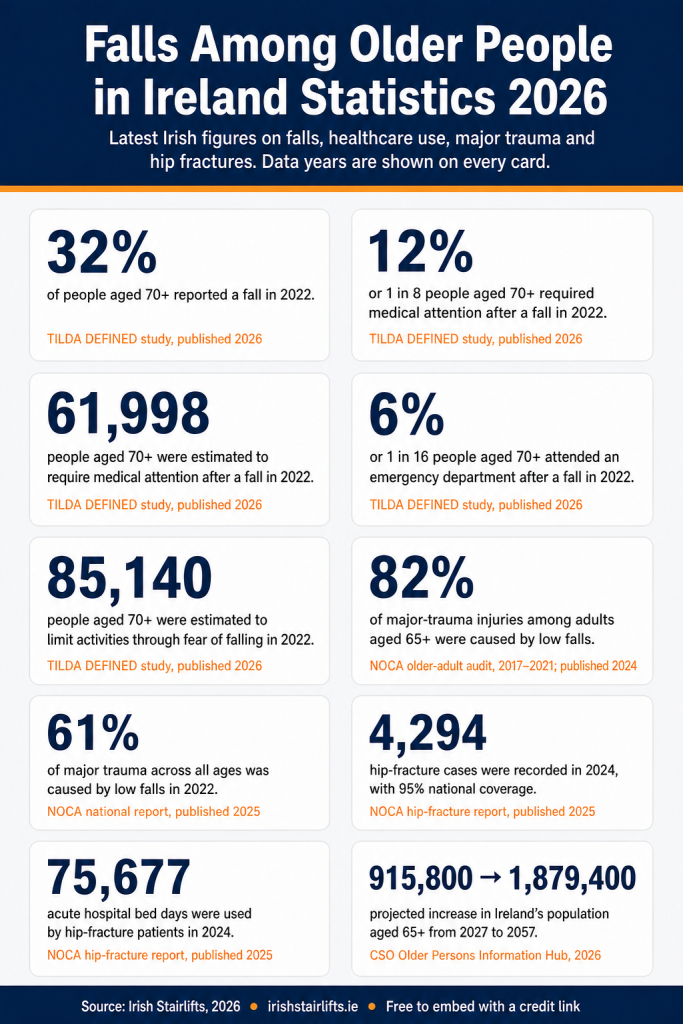
- TILDA’s 2022 analysis, published in 2026, found that almost 32% of people aged 70 and over reported a fall.
- Almost 12%, or one in eight people aged 70 and over, required medical attention after a fall in TILDA’s 2022 analysis.
- An estimated 61,998 people aged 70 and over required medical attention after a fall in 2022, according to TILDA.
- More than 6%, or one in 16 people aged 70 and over, attended an emergency department after a fall in TILDA’s 2022 analysis.
- An estimated 85,140 people aged 70 and over limited activities through fear of falling in 2022, according to TILDA.
- Low falls caused 82% of major-trauma injuries among adults aged 65 and over in the NOCA audit covering 2017 to 2021.
- Across all ages, low falls caused 61% of major trauma recorded in 2022, according to the latest NOCA national report, published in 2025.
- The Irish Hip Fracture Database recorded 4,294 hip-fracture cases in 2024, representing 95% national coverage in the NOCA national report published in 2025.
- Hip-fracture patients used 75,677 acute hospital bed days in 2024, according to the Irish Hip Fracture Database National Report.
- Ireland’s population aged 65 and over is projected to increase from 915,800 in 2027 to 1,879,400 in 2057, according to the CSO Older Persons Information Hub.
Free to embed. Please credit Irish Stairlifts with a link to this page: https://irishstairlifts.ie/falls-among-older-people-in-ireland-statistics/
The prevalence of falls among older people in Ireland
The most detailed recent national picture comes from the DEFINED study, published on 30 January 2026. It examined population-representative data from 2,299 community-dwelling people aged 70 and over, measuring outcomes during the 12 months of 2022 and using Census 2022 to estimate national burden.
Almost 32% of participants aged 70 and over reported at least one fall during 2022 in the DEFINED study published in 2026.
Almost 12% of participants aged 70 and over, or about one in eight, reported a fall serious enough to require medical attention in the same TILDA study.
The researchers estimated that 61,998 people aged 70 and over required medical attention after a fall in 2022, with a 95% confidence interval from 42,923 to 87,703, according to the DEFINED study. Women accounted for 59% of that estimate, the study reported.
More than 6% of participants aged 70 and over, or about one in 16, attended an emergency department because of a fall during 2022, according to the DEFINED study.
An estimated 32,207 people aged 70 and over attended an emergency department following a fall in 2022, with a 95% confidence interval from 20,326 to 54,631, according to the paper published in 2026. Women represented 70% of that estimate, the study found.
These are Census-weighted population estimates based on self-reported TILDA outcomes, not administrative hospital counts.
How fall rates change with age and sex
Among adults aged 50 and over, 7% of those aged 50 to 64, 9% of those aged 65 to 74, and 13% of those aged 75 and over reported a medically attended fall in the TILDA Wave 6 Key Findings Report published in 2025.
The same age pattern appeared in emergency care. Falls-related emergency department attendance was reported by 4% of people aged 50 to 64, 5% of people aged 65 to 74, and 7% of people aged 75 and over in the TILDA Wave 6 report.
Among participants aged 70 and over, 10% of men and 13% of women reported a fall that required medical attention in the DEFINED analysis of 2022, published in 2026. Falls-related emergency department attendance was also higher among women, at 8%, compared with 4% among men, according to the same study.
Fractures showed a similar difference. More than 3% of people aged 70 and over reported a hip, wrist or vertebral fracture during the previous year in the DEFINED study. The reported annual rate was 4% among women and 2% among men, according to the same research.
The researchers estimated that 17,288 people aged 70 and over sustained one of these three fracture types in 2022, with a 95% confidence interval from 9,237 to 34,031, according to the study published in 2026. Women accounted for 70% of this estimated fracture population, the study reported.
Fear of falling and its effect on independence
Fear of another fall can influence how an older person moves around the home, takes part in social activities and manages ordinary daily tasks.
Living arrangements can also shape what practical support is available at home. Our older people living alone in Ireland statistics roundup provides age, sex, housing, income and digital-access context.
More than 38% of participants aged 70 and over reported some fear of falling in the DEFINED analysis of 2022, published in 2026. More than 8%, or about one in 12, said they were very much afraid of falling, according to the same study.
The practical effect was visible in activity levels. More than 17% of participants aged 70 and over said they limited activities because they were afraid of falling in the DEFINED study. That is around one in six people in the age group.
When extrapolated to Ireland’s population, an estimated 41,366 people aged 70 and over were very much afraid of falling in 2022, according to the study published in 2026. Women accounted for 73% of that estimated group, the researchers found.
An estimated 85,140 people aged 70 and over limited activities because of fear of falling, with a 95% confidence interval from 65,242 to 109,687, according to the DEFINED study. Women represented 68% of this estimated population, the study reported.
Activity restriction can affect independence even when a fall has not resulted in hospital treatment, so the wider burden extends beyond recorded injuries.
Falls can both result from and contribute to reduced mobility. Our mobility disability statistics for Ireland provide wider Census context on difficulty with basic physical activities.
Repeat falls, medication and access to care
Among people reporting a medically attended fall at TILDA Wave 6, 52% had also reported a fall at Wave 5, according to the DEFINED study published in 2026. This compares survey waves, not repeat falls within one year.
53% of people who attended an emergency department after a fall were prescribed at least one falls-risk-increasing drug, according to the DEFINED study. 20% were prescribed at least two such medicines, the same study found.
These findings describe an association, not proof that medication caused an individual fall. Medication changes require professional advice.
An estimated 23% of people aged 70 and over needing medical attention after a fall lived in an area without a dedicated falls clinic, according to the DEFINED study. This represented 14,016 people in the same analysis.
An estimated 15% of people attending an emergency department after a fall lived in an area without a dedicated falls clinic, according to the DEFINED study. This represented 4,962 people, the researchers reported.
24% of people with a medically significant fall received physiotherapy during the previous year, while the rate was 19% among those aged 75 and over, according to the TILDA Wave 6 Key Findings Report.
Low falls and major trauma among older adults
NOCA’s newest national Major Trauma Audit report was published in September 2025 but covers 3,323 patients treated during 2022 in 20 of 26 hospitals, according to the Major Trauma Audit National Report 2022. The report states that coverage was below 80%, so its figures are incomplete.
Across patients of all ages, falls of less than two metres caused 61% of major-trauma injuries recorded in 2022, while 50% of major trauma happened in the home, according to the NOCA national report published in 2025.
The newest NOCA report dedicated specifically to older adults was published in 2024, but its data period is 2017 to 2021. It covered 11,145 major-trauma episodes involving adults aged 65 and over across 26 hospitals, according to the older-adult Major Trauma Audit. The median patient age was 79, the report found.
Within that older-adult dataset, falls of less than two metres caused 82%, or 9,170, of major-trauma injuries in the 2017 to 2021 NOCA report, which was published in 2024.
The share of major trauma caused by low falls rose from 66% among patients aged 65 to 69 to 95% among patients aged 90 and over in the 2017 to 2021 NOCA audit. 70%, or 7,771, of those low falls occurred in the home, according to the same historical audit.
Hip fractures and pressure on hospital care
The Irish Hip Fracture Database recorded 4,294 cases among patients aged 60 and over in 2024, representing 95% national coverage, according to the NOCA national report published in 2025. The database does not classify every case as fall-caused.
Women accounted for 67% of the hip-fracture cases recorded in 2024, according to the Irish Hip Fracture Database report. People aged 80 to 89 accounted for 42% of all cases, while people aged 90 and over accounted for a further 16%, the report found.
Hip-fracture patients used 75,677 acute hospital bed days during 2024, according to the NOCA report. Their mean acute stay was 19 days and the median was 12 days, the same report stated.
These hospital figures use a different population and method from TILDA’s annual falls estimates.
How the figures are changing over time
The long-running TILDA survey allows a broader comparison across waves. The share of adults aged 50 and over reporting any fall in the previous year increased from 24% at Wave 1 to 31% at Wave 6, according to the TILDA Wave 6 Key Findings Report.
This is a descriptive comparison between survey waves rather than an administrative count of every fall in Ireland. It nevertheless indicates that falls remained common across the study period and were reported by a larger share of participants at Wave 6.
Exposure to falls-risk-increasing medicines also changed. The proportion of TILDA participants aged 50 and over who were prescribed at least one such medicine increased from 29% at Wave 1 to 34% at Wave 6, according to the same TILDA report.
Ireland’s ageing population and future demand
Ireland’s demographic direction gives these falls statistics wider significance. The country had an estimated 861,100 people aged 65 and over in April 2025, equivalent to 15.8% of the total population, according to the CSO Population and Migration Estimates.
The number of people aged 65 and over increased by 159,700 between 2019 and 2025, according to the same CSO release. This does not mean the number of falls will rise at exactly the same rate, but it increases the population exposed to age-related mobility and fall risks.
The longer-term change is larger. The population aged 65 and over is projected to rise from 915,800 in 2027 to 1,879,400 in 2057, according to the CSO Older Persons Information Hub published in 2026. The old-age dependency ratio is projected to increase from 25.0% to 49.8% over the same period, the CSO stated.
These are population projections rather than observed future outcomes. They provide useful context for planning falls prevention, accessible housing, healthcare capacity and services that help people remain independent at home.
Our home accessibility needs statistics add context on adaptations reported in ALONE assessments, although they do not measure whether those changes prevent falls.
How we compiled these statistics
We compiled this page from primary Irish sources available as of 19 August 2026. The annual estimates come from TILDA’s DEFINED study, published in 2026, which measures 2022 outcomes and uses Census 2022 weighting.
Age trends come from the TILDA Wave 6 Key Findings Report. Serious injury figures come from NOCA’s national 2022 Major Trauma Audit, published in 2025, its older-adult audit covering 2017 to 2021, published in 2024, and the Irish Hip Fracture Database. Population figures come from the CSO.
Each statistic links directly to its primary source. Where sources use different age groups, time periods or definitions, those differences are stated in the surrounding text. The page does not treat survey estimates as hospital counts, a five-year audit total as an annual figure, or every hip fracture as a confirmed fall injury.
How Irish Stairlifts helps
Falls have many causes, and a stairlift is not a complete falls-prevention programme. For someone who can transfer safely into a seated lift but finds stairs difficult, however, a professionally assessed stairlift can remove the need to climb a staircase several times each day and can make more of the home accessible.
Irish Stairlifts has supplied mobility solutions across Ireland since 1999. Its range includes straight, curved and reconditioned stairlifts, with options suited to different staircase layouts, mobility needs and budgets. The team can assess the staircase, explain the available choices and arrange professional installation and aftercare.
Anyone experiencing falls, dizziness, sudden weakness or a change in mobility should also speak with a GP, physiotherapist, occupational therapist or another appropriate healthcare professional. A home mobility product should form part of a considered plan that reflects the individual’s health, transfer ability and living environment.
For ways to address barriers in different parts of a home, see our home mobility improvements guide.
Related Post
categories
- Accessible Bathrooms 20
- Grants & Funding 8
- ISB Mobility 6
- Mobility Aids 42
- Outdoor & Independence Solutions 44
- Seating Solutions 10
- Stairlifts & Home Lifts 36
- Statistics 9