
Hip Fracture Statistics Ireland 2026: 4,356 Cases Recorded in 2025

Sources reviewed 02 November 2026 · Estimated reading time: 11 minutes. Human written and fact checked against each named source.
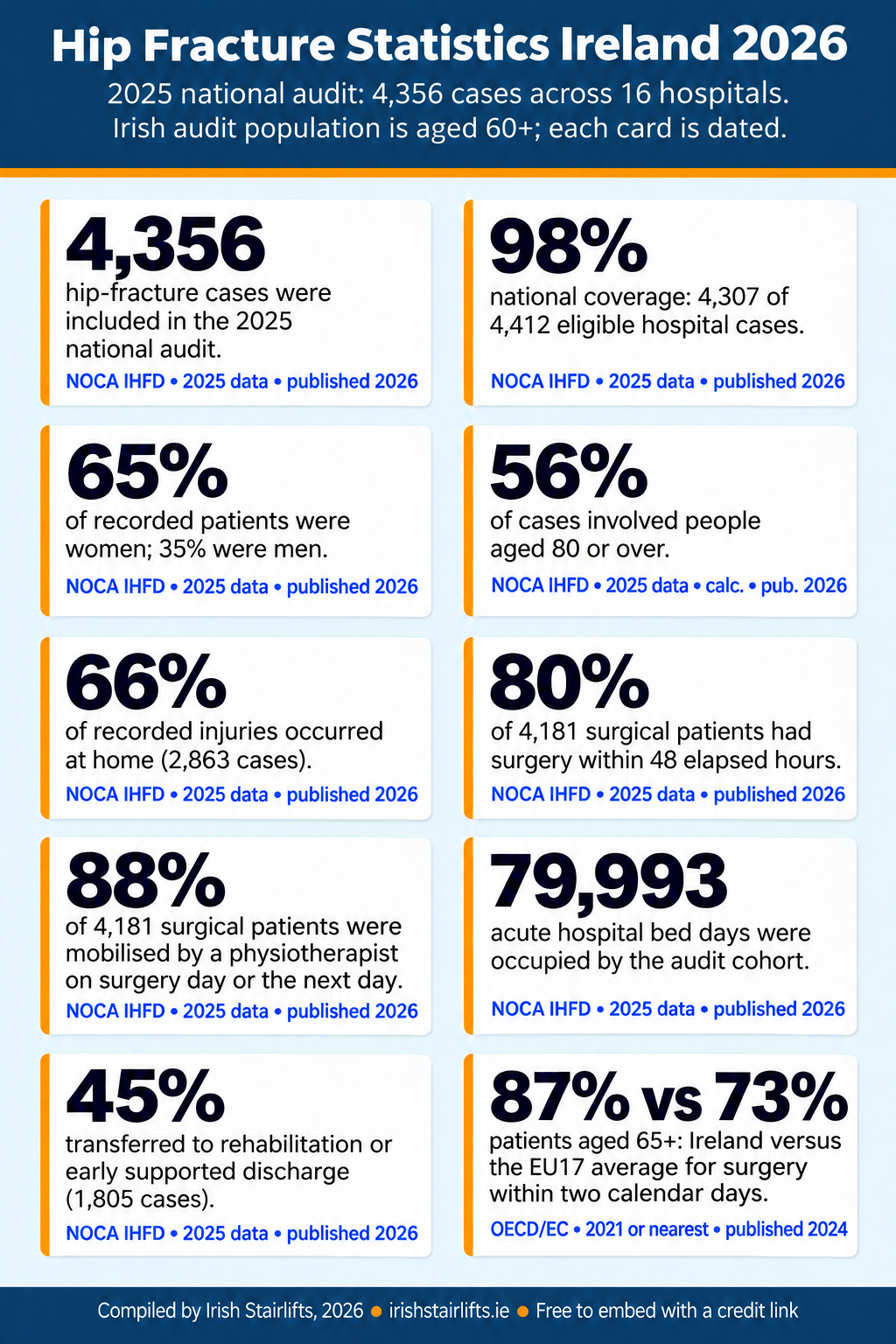
Hip fractures place substantial demands on patients, families and hospital services in Ireland. The newest national audit included 4,356 cases among people aged 60 and over who were discharged from 16 trauma-receiving hospitals during 2025.
This roundup was refreshed in 2026, while its newest national figures measure 2025. The main source is the 2025 national report from the National Office of Clinical Audit, published on 2 November 2026.
Key hip fracture statistics at a glance
- The national audit included 4,356 hip-fracture cases involving people aged 60 and over who were discharged during 2025, according to the 2025 national report.
- The coverage calculation captured 98% of eligible cases, based on 4,307 Irish Hip Fracture Database records among 4,412 eligible Hospital In-Patient Enquiry cases in the national coverage data.
- Women represented 65% of recorded cases, while men represented 35%, and the median age was 81 in the national case mix.
- People aged 80 and over accounted for a calculated 56% of cases, combining the published shares of 41% aged 80 to 89 and 15% aged 90 and over in the national case mix.
- 66% of recorded injuries occurred in the home, representing 2,863 cases in the patient pathway data.
- Among 4,181 surgical cases, 80% received surgery within 48 elapsed hours, while 79% met the narrower standard that also required surgery during normal working hours in the surgery timing figures.
- 88% of surgical patients were mobilised by a physiotherapist on the day of surgery or the following day in the Irish care standards.
- 61% of patients had a recorded delirium assessment on the day of admission, and 70% received an occupational therapy assessment during their stay in the multidisciplinary results.
- The 4,356 audit cases occupied 79,993 acute hospital bed days during 2025, according to the national report highlights.
- In a matched European measure for 2021 or the nearest year, 87% of Irish patients aged 65 and over received surgery within two calendar days, compared with an unweighted EU17 average of 73%, according to European health data.
Hip Fracture Statistics Ireland 2026 Infographic
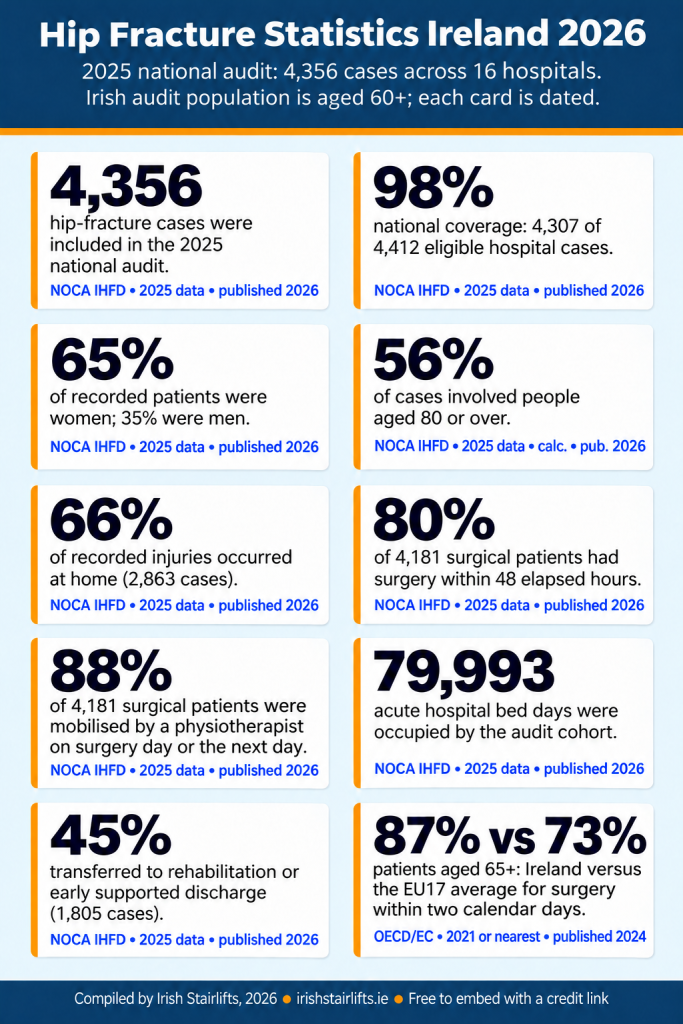
Hip Fracture Statistics Ireland 2026, compiled by Irish Stairlifts. Free to embed. Please credit Irish Stairlifts with a link to this page: https://irishstairlifts.ie/hip-fracture-statistics-ireland/
How many hip fractures were recorded in Ireland?
The Irish Hip Fracture Database included 4,356 cases among patients aged 60 and over who met its criteria and were discharged during 2025. The audit covered all 16 trauma-receiving hospitals in the Republic of Ireland, according to the national audit report.
That total should not be described as every hip fracture at every age. It is the number in the final audit dataset for the defined population. The separate coverage calculation found 4,307 linked audit records among 4,412 eligible hospital records, giving 98% coverage. The final dataset is slightly larger because IHFD cases can be recorded in addition to those identified through the hospital system used for the coverage calculation.
The previous national report estimated that acute hospital care for the 4,294 cases recorded in 2024 cost approximately €53 million. The 2024 cost estimate used the 2023 activity-based funding price list. The 2025 report does not publish a replacement estimate, so €53 million should not be relabelled as a 2025 cost.
Age and sex of recorded patients
Women accounted for 65% of the 4,356 cases and men for 35% in the 2025 case mix. The median age was 81. These are characteristics of recorded audit cases, not age-standardised fracture rates for women and men in the wider population.
The largest age group was 80 to 89, representing 41% of cases. People aged 90 and over represented a further 15%, so people aged at least 80 accounted for a calculated 56% of the audit dataset. The same age profile recorded 30% of cases among people aged 70 to 79 and 13% among those aged 60 to 69. The displayed shares may not total exactly 100% because of rounding.
These percentages describe the composition of patients treated, not an individual’s risk. Comparing risk between age groups would require age-specific population denominators that are not part of this audit table.
Where patients came from and where injuries occurred
Most patients, 83%, were admitted from home in 2025. A further 11% came from a nursing home or another long-stay facility, while 5% transferred from another hospital, according to the admission source data. Admission source and injury location are different measures and should not be treated as interchangeable.
The home was the most common recorded place of injury, accounting for 66% of the cohort, or 2,863 cases. Public areas and institutions each accounted for 14%, or 627 cases, in the 2025 pathway data. A further 72 hip fractures occurred in hospital, representing less than 2% of the cohort.
The home figure provides useful context alongside Ireland’s broader older-person falls statistics. It does not establish that every audited hip fracture resulted from a fall, and the hip-fracture audit remains the authority for the figures on this page.
Admission and time to surgery
The patient pathway analysis found that 95% of patients, or 4,131 cases, were brought directly to a hospital that performs hip-fracture surgery. This measures the route into hospital, not whether the patient ultimately received an operation.
Only 39% of patients, or 1,712 cases, reached an orthopaedic ward or operating theatre from the emergency department within four hours. This is the exact first Irish Hip Fracture Standard and should not be shortened to a claim that 39% were treated within four hours.
Surgical intervention was recorded for 4,181 cases, equal to 96% of the full audit dataset. Among those surgical cases, 1,944 patients, or 46%, received surgery within 24 hours. The cumulative share reached 64% within 36 hours and 80% within 48 elapsed hours in the surgery timing analysis.
The official second care standard uses a narrower definition. It counted surgery within 48 hours and during normal working hours, defined as 08:00 to 17:59 from Monday to Sunday. On that basis, 3,310 surgical patients, or 79%, met the standard. The cumulative 80% figure counted surgery within 48 elapsed hours regardless of that working-hours condition, so both percentages are correct for their separate definitions.
Before surgery, 86% of surgical patients, or 3,605 cases, received a nerve block for pain management, according to the care pathway results.
Clinical assessment and early recovery
During the acute stay, 88% of patients, or 3,815 cases, were reviewed by a geriatrician or an advanced nurse practitioner. This was a review at some point during admission, not a consultant-only measure, as defined by the fourth care standard.
Among the 4,171 patients discharged alive, 92% received a bone-health assessment and 90% received a specialist falls assessment. The respective counts were 3,850 and 3,755. An assessment does not necessarily mean that medication was prescribed or that a fall was confirmed as the cause of the fracture. The exclusions used for these measures are explained in the IHFD methodology.
Early mobilisation was recorded for 88% of the 4,181 surgical patients, equal to 3,672 cases. The seventh care standard defines this as mobilisation by a physiotherapist on the day of surgery or the following day, with standing out of bed as the minimum. The report explains that 100% compliance is neither expected nor appropriate because some patients are not medically fit to mobilise that soon.
Pressure ulcers of grade 2 or higher developed after admission in 3% of the 4,171 patients discharged alive, representing 120 cases. This was down from 4% in 2024 in the pressure-ulcer results.
Nutritional risk assessment was recorded for 75% of patients, or 3,255 cases. Among those assessed, 17% were at risk of malnutrition and 2% were identified as malnourished in the nutrition results. These are audit results from the assessed patients, not population prevalence estimates.
Delirium and occupational therapy assessments
The 2025 report adds useful detail on multidisciplinary care. A day-one 4AT delirium assessment was recorded for 61% of patients, or 2,661 cases. Among the 2,681 people with a recorded day-one score, 13%, or 352 people, screened positive for delirium in the delirium findings. A positive screening result is not the same as a confirmed diagnosis, and the percentage should not be applied to patients without a recorded score.
An occupational therapy assessment during the acute admission was recorded for 70% of patients, or 3,057 cases. The occupational therapy data show substantial variation between hospitals, with recorded assessment rates ranging from 22% to 98%.
Length of stay, discharge and inpatient outcomes
The 4,356 recorded cases accounted for 79,993 acute hospital bed days. Median length of stay was 12 days, with an interquartile range of 7 to 21 days, in the hospital outcomes data.
At the end of the acute episode, 22% of patients, or 942 cases, were discharged directly home. A further 45%, or 1,805 cases, transferred to a rehabilitation service or early supported discharge. This included 36% entering off-site inpatient rehabilitation, 7% entering on-site inpatient rehabilitation and 2% entering early supported discharge.
The audit recorded 185 inpatient deaths, equal to 4% of cases. This is mortality during the inpatient episode, not a national 30-day or one-year mortality rate. Among surgical patients, 67 people, or 2%, underwent reoperation within 30 days, according to the reported outcomes.
Twenty-one patients had a clinician-diagnosed surgical-site infection, equal to 0.6% of the 3,686 surgical patients included across 15 hospitals. Post-discharge surveillance was not yet consistently available across every participating hospital, so the infection finding should not be described as a complete national 90-day infection rate.
How care changed through 2025
A peer-reviewed analysis of 41,304 cases from 2013 to 2024 shows how several recorded care measures changed over the life of the audit. Geriatric review increased from 11% to 86%, bone-health assessment from 65% to 90%, and falls assessment from 62% to 87%, according to the longitudinal audit analysis.
Over the same period, the share meeting the surgery-within-48-hours standard rose from 70% to 77%, while discharge to rehabilitation increased from 29% to 36%. New admission to long-term care fell from 6% to 3%, inpatient mortality fell from 5% to 4%, and median length of stay changed from 13 to 12 days in the published trend study.
The newer annual report shows that all seven Irish Hip Fracture Standards improved again between 2024 and 2025. The share meeting the four-hour admission standard rose from 36% to 39%, the narrower surgery standard rose from 77% to 79%, geriatric review rose from 86% to 88%, bone-health assessment rose from 90% to 92%, falls assessment rose from 87% to 90%, and early mobilisation rose from 85% to 88%. Pressure-ulcer incidence fell from 4% to 3% in the 2025 comparison.
Almost one in four patients, or 24%, received care meeting all Best Practice Tariff criteria in 2025. National payments reached €1.071 million, exceeding €1 million for the first time. These are descriptive audit trends. They are not adjusted for patient characteristics and do not prove that the audit or any single intervention caused the changes.
Ireland in EU context
The joint OECD and European Commission comparison provides a matched European indicator for 2021 or the nearest year. In that series, 87% of Irish patients aged 65 and over who were admitted with an upper femur fracture had surgery initiated within two calendar days. The unweighted EU17 average was 73% in the same European comparison.
The European figures are age-sex standardised and use a population aged 65 and over. They should not be compared directly with the 79% or 80% figures from the 2025 Irish audit, which uses patients aged 60 and over and different operational definitions. The EU17 figure is an average of the 17 EU countries with usable data for the indicator, not an EU-wide ranking.
Methodology and sources
This roundup was refreshed on 3 November 2026 using the newest suitable primary sources available. The main Irish source was the National Office of Clinical Audit’s 2025 report, published on 2 November 2026 and covering qualifying patients aged 60 and over who were discharged from 1 January to 31 December 2025.
The audit compares Hospital In-Patient Enquiry data with clinical fields recorded through the Irish Hip Fracture Database portal. The current methodology explains the inclusion criteria and the exclusions used for individual care standards. Administrative audit figures do not have survey sampling margins of error.
Long-run changes come from the audit team’s 2013 to 2024 peer-reviewed analysis. European context comes from the harmonised OECD and European Commission series for 2021 or the nearest year. The 2024 cost estimate is retained only as a clearly dated historical figure because no replacement estimate appears in the 2025 report. No projection is presented as an observed outcome, and percentages with different populations or definitions are not merged.
How Irish Stairlifts helps
The statistics show that many recorded hip fractures occurred at home, but they do not prove that any single home product prevents a fall or fracture. Irish Stairlifts provides information and quotations for people considering stairlift options in Ireland as part of a broader discussion about access and mobility at home.
Product decisions should reflect the individual, the property and professional advice where appropriate. A stairlift is not a medical treatment and should not replace a falls assessment, clinical care or rehabilitation.
Related Irish statistics
Readers exploring the wider context can also see our roundup of older-person falls statistics, which uses separate Irish sources and definitions.
Related Post
categories
- Accessible Bathrooms 22
- Grants & Funding 8
- ISB Mobility 6
- Mobility Aids 42
- Outdoor & Independence Solutions 44
- Seating Solutions 10
- Stairlifts & Home Lifts 37
- Statistics 12