
Housing Adaptation Grants Statistics Ireland 2026: €152m Projected for About 17,000 Claims

Prepared 31 August 2026 · 13-minute read · Source checked against each named primary source
Public funding for housing adaptations is rising sharply in Ireland. The Government has provided €129.5 million in Exchequer funding for the three private-house grant schemes in 2026, while projected council contributions bring the combined total above €152 million.
The 2026 figures are allocations and projections, not completed grants. The newest observed national data cover claims paid in 2025, so this roundup keeps projected funding, actual payments and historical trends separate.
Key statistics at a glance
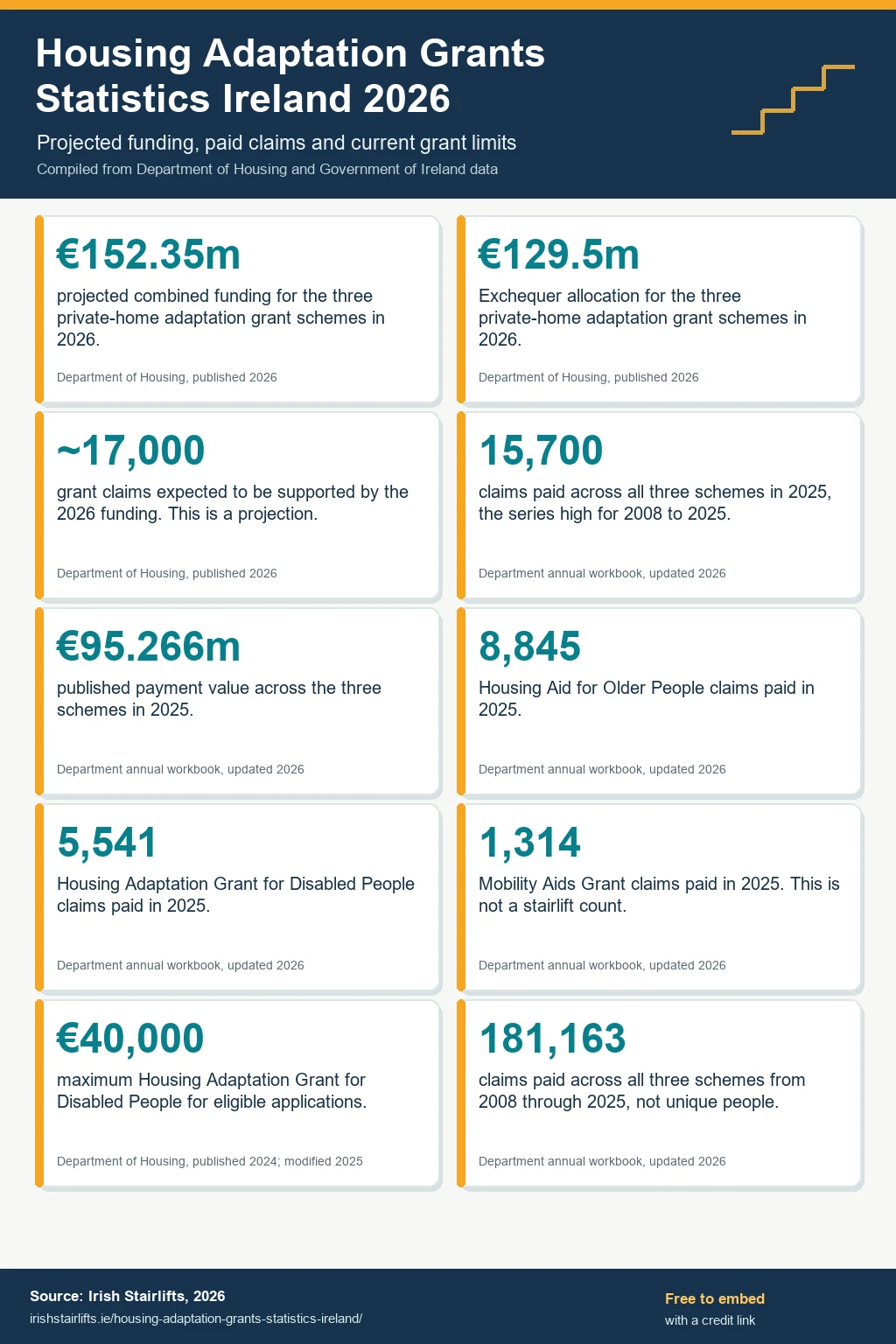
- Projected combined funding for Ireland’s three private-house adaptation grant schemes reached €152,352,941 in 2026, including council contributions, according to the Department of Housing’s 2026 allocation release.
- The Exchequer provided €129.5 million of that 2026 funding, the Department of Housing reported.
- The projected combined funding was expected to support approximately 17,000 grant claims in 2026, according to the March 2026 funding announcement.
- About 8,000 claims were expected across the Housing Adaptation Grant for Disabled People and the Mobility Aids Grant in 2026, according to the Budget 2026 disability summary.
- Approximately 9,000 Housing Aid for Older People claims were expected in 2026, the same Budget 2026 summary stated.
- A total of 15,700 claims were paid across the three schemes in 2025, based on the Department’s annual claims workbook.
- The published value of those 2025 payments was €95.266 million, calculated from the three scheme totals in the annual claims workbook.
- Housing Aid for Older People accounted for 8,845 paid claims in 2025, according to the Department’s 2008-to-2025 series.
- The Housing Adaptation Grant for Disabled People accounted for 5,541 paid claims in 2025, the same national series recorded.
- Mobility Aids Grants accounted for 1,314 paid claims in 2025, with a published payment value of €5.137 million in the Department’s annual data.
Housing adaptation funding available in 2026
The national Exchequer allocation for Housing Adaptation Grants for Older People and Disabled People is €129.5 million in 2026. Projected local-authority contributions add €22,852,941, bringing the projected combined total to €152,352,941.
The Exchequer allocation was €30 million higher than the previous year’s allocation. This is an increase in the funding made available rather than a year-end measure of how much councils have paid out.
The Government expects the 2026 funding to support approximately 17,000 claims across the three schemes. Its Budget 2026 disability summary divides that projection into about 8,000 claims across the Housing Adaptation Grant for Disabled People and Mobility Aids Grant, plus around 9,000 Housing Aid for Older People claims.
These are expected claims for 2026. They should not be described as applications received, grants approved, claims paid or adaptations completed. Final delivery figures may differ from the original projection.
The combined total applies to grants for eligible work in private houses. Budget 2026 also provided a separate allocation for adapting existing social homes, but that programme uses a different funding stream and delivery measure. Combining the two would overstate the money available through the three private-house schemes covered here.
Housing adaptation claims paid in 2025
Ireland’s local authorities paid 15,700 claims across the three private-house schemes in 2025. This total comes from adding the three scheme counts in the Department of Housing’s annual workbook.
The corresponding payment values totalled €95.266 million. The workbook reports €40.795 million under Housing Aid for Older People, €49.334 million under the Housing Adaptation Grant for Disabled People and €5.137 million under the Mobility Aids Grant.
For comparison, 15,198 claims were paid in 2024, with a published payment value of €82.678 million. Paid claims therefore increased by 502, or 3.3%, while the annual payment value rose by €12.588 million, or 15.2%, between 2024 and 2025.
The payment-value comparison uses figures published in thousands of euro. The percentage is calculated from those rounded national values, so it should not be presented with more than one decimal place.
The difference between growth in claim numbers and growth in payment value should be treated carefully. It may reflect the mix of work, the value of approved projects, revised grant limits and the timing of council payments. The aggregate workbook does not isolate those possible influences, so the figures establish the change but not its cause.
How the three grant schemes compare
Housing Aid for Older People
Housing Aid for Older People was the largest scheme by claim count in 2025. It recorded 8,845 paid claims, representing 56.3% of all claims paid across the three schemes, based on the Department’s annual statistics.
The published value of Housing Aid for Older People payments was €40.795 million in 2025. This grant supports necessary repairs or improvements for eligible older people living in poor housing conditions. The payment total does not indicate how many older people nationally need repairs or how many applications were unsuccessful.
For broader demographic and housing context, see our older people living alone in Ireland statistics.
Housing Adaptation Grant for Disabled People
The Housing Adaptation Grant for Disabled People recorded 5,541 paid claims in 2025. Its payments were valued at €49.334 million, equal to 51.8% of the published value across all three schemes.
This scheme had fewer paid claims than Housing Aid for Older People but a higher total payment value. That difference is consistent with its higher maximum grant and its scope, which can include substantial work such as extensions, accessible bathrooms, ramps, stairlifts and through-floor lifts. It does not mean that every claim involved one of those works.
Mobility Aids Grant
The Mobility Aids Grant recorded 1,314 paid claims with a published value of €5.137 million in 2025. It is intended for a basic suite of works addressing mobility needs and can cover adaptations such as grab rails, ramps, accessible showers, fixed-track hoists and stairlifts.
The 1,314 figure is not a stairlift-installation count. The national workbook does not divide Mobility Aids Grant payments by the type of work completed, so it cannot show how many grants funded stairlifts.
How housing adaptation claims have changed since 2008
The Department’s annual series begins in 2008. Across the 18 years from 2008 through 2025, it records 181,163 paid claims across the three schemes. The published payment values sum to approximately €994.7 million over the same period.
These are multi-year totals. They must not be described as annual figures or as 181,163 unique people, because the aggregate workbook does not identify individual recipients or show whether any household received support in more than one year.
The 15,700 claims paid in 2025 were the highest annual total in the published 2008-to-2025 series. This wording is narrower than “highest ever” because the current dataset starts in 2008 and previously published values may be revised.
Payment values across the full period are nominal amounts. The approximately €994.7 million total has not been adjusted for inflation, construction costs or changes to grant ceilings, so it is useful as a cumulative administrative figure rather than a measure of constant purchasing power.
Housing adaptation funding by local authority
The 2026 allocation release provides an Exchequer amount, projected council contribution and projected combined total for each of Ireland’s 31 local authorities. Dublin City had the largest projected combined total at €15,377,122, according to the Department’s local-authority table.
Cork County followed with €9,842,712. South Dublin was allocated a projected combined €7,597,223, Fingal €7,187,016, and Limerick City and County €6,719,386.
Leitrim had the smallest projected combined allocation at €1,781,660. This does not show that one council offers better or worse access than another. Raw allocations are influenced by population, expected demand, existing commitments and administrative decisions, and the national table does not provide a per-capita or needs-adjusted comparison.
Cork City and Cork County have separate allocations, as do Dublin’s four local-authority areas and Galway City and County. Combining neighbouring councils without a clear reason can hide differences in administration and local demand.
The allocation table is most useful for showing where national funding is assigned at the start of the year. A proper comparison of local delivery would also need applications, approvals, paid claims, waiting times and population or need measures for the same period. Those indicators are not included consistently in the national 2026 release.
Current maximum grant amounts
These are national figures. To see what the current rates mean for a single household, use the grant calculator.
The revised scheme took effect for applications submitted from 1 December 2024. The Department’s announcement of the revised grants raised the maximum Housing Adaptation Grant for Disabled People from €30,000 to €40,000.
The maximum Housing Aid for Older People Grant increased by €2,700, from €8,000 to €10,700. The maximum Mobility Aids Grant increased by €2,000, from €6,000 to €8,000.
The revised regulations also increased household-income thresholds by 25%. The programme funding split changed from 80% Exchequer and 20% council funding to 85% Exchequer and 15% council funding.
Maximum figures are ceilings rather than standard awards. The amount available to an applicant depends on the relevant scheme, household income, the approved cost and the local authority’s assessment. Work should not be presented as grant-funded until written approval has been received from the council.
What allocations, drawdowns and paid claims mean
The national Exchequer allocation was €99.5 million in 2025, while Exchequer drawdown reached €95,265,662.28. That drawdown was equivalent to 95.7% of the allocation, calculated from the national totals in the Department’s allocation and drawdown workbook.
An allocation is funding made available. A drawdown is Exchequer funding drawn down by local authorities. A paid claim is a payment recorded under one of the three schemes. None of those measures is the same as the number of applications submitted, approved projects waiting for work or completed adaptations.
The March 2026 funding announcement says that councils “processed” 15,700 claims in 2025. The annual workbook independently totals 15,700 “claims paid” for that year. Because the sources use different administrative labels, this page uses the workbook’s claims-paid terminology for the detailed scheme analysis and preserves “processed” when referring directly to the ministerial release.
What the statistics say about stairlift grants
Stairlifts are included among the works that may be supported under the Housing Adaptation Grant for Disabled People and the Mobility Aids Grant. The national statistics nevertheless cover every eligible type of work, from ramps and accessible showers to hoists, extensions and repairs.
For that reason, the national claim totals cannot be converted into a number of stairlifts funded. They also cannot show how many stairlift applications were approved, refused or waiting for assessment.
Applicants who need practical information about eligibility, documentation and obtaining a quotation can read the Irish Stairlifts guide to home-accessibility grants. The local authority makes the grant decision, and applicants should confirm the current requirements with their own council before beginning work.
Grant claims measure funding activity, while our home accessibility needs statistics describe adaptation needs recorded in ALONE’s Q1 2026 assessments
How we compiled these statistics
We reviewed the Department of Housing’s primary statistics and Government of Ireland funding publications on 25 August 2026. The core administrative series are the national allocation and drawdown workbook for 2014 to 2025 and the annual claims-paid workbook for 2008 to 2025. Both files were updated by the Department on 24 August 2026.
Current funding comes from the Department’s 9 March 2026 allocation release. The split of expected 2026 claims comes from the Budget 2026 disability summary. Current grant ceilings and programme funding shares come from the official announcement of the revised scheme, which applies to applications submitted from 1 December 2024.
Calculated figures are derived only when the source fields use compatible definitions and periods. Percentages are rounded to one decimal place. Payment values from the annual workbook retain its €1,000 source precision, while all projections remain labelled as expected or projected.
The compilation covers the Republic of Ireland’s private-house grant schemes. It does not include the separate funding stream for adaptation works to existing social homes, and it does not treat claims as unique recipients or completed stairlift installations.
How Ireland compares with the EU
Housing policy remains a national responsibility, and grant schemes across Europe use different eligibility, funding and reporting rules. A direct ranking of national grant budgets would therefore be misleading. Harmonised Eurostat housing indicators provide a more reliable way to place the Irish figures in context.
People in Ireland are unusually likely to live in houses. In 2024, 90% of people in Ireland lived in a house, the highest share in the EU, compared with 51% across the EU, according to Eurostat’s Housing in Europe 2025 edition. This housing pattern provides useful context for home adaptations, although it does not show how many Irish homes contain stairs or require accessibility work.
Ireland also had one of the EU’s highest levels of under-occupied housing. Eurostat reported that 67% of people in Ireland lived in an under-occupied home in 2024, compared with 33% across the EU. Cyprus was the only member state with a higher share, at 70%. Eurostat identifies older individuals or couples remaining in the family home after children move out as a common cause of under-occupation. The statistic does not establish mobility need, but it helps explain why adapting an existing home can matter alongside moving to a smaller property.
Harmonised EU-SILC data provide a separate affordability comparison for people with disabilities. Eurostat approximates disability as some or severe limitation, because of health problems, in carrying out usual activities for at least six months. In 2024, 10.4% of people aged 16 and over with a disability in the EU lived in households where housing costs reached at least 40% of disposable income, compared with 3.0% in Ireland, according to Eurostat’s disability housing-conditions report, updated in July 2026. These figures cover people in private households and generally exclude people living in institutions.
These measures contextualise Ireland’s €152.35 million in projected 2026 funding, but they do not show that Ireland’s grant system is more or less generous than another country’s. A valid programme comparison would require harmonised information on eligibility, applications, approvals, payments, work types and population need.
How Irish Stairlifts helps
Irish Stairlifts supplies and installs straight, curved and reconditioned stairlifts throughout Ireland. The team can assess a staircase, explain suitable options and provide a detailed quotation that an applicant can include with a grant application where required.
Irish Stairlifts does not approve grants or guarantee that an application will succeed. The relevant local authority assesses eligibility and proposed works. Customers should wait for written council approval before treating a project as grant-funded or starting installation.
A quotation can describe the proposed stairlift, installation requirements and cost, but it is only one part of the application process. Medical certification, an occupational therapist’s assessment or other supporting documents may also be required depending on the scheme and council. Applicants should follow the current form and instructions issued by their local authority.
Related Irish Stairlifts statistics
Housing adaptations form part of a wider picture of mobility, safety and independence at home. Our roundup of falls among older people in Ireland statistics brings together current TILDA, NOCA and CSO figures while keeping survey estimates, hospital data and population projections separate.
For national context on the population that may experience difficulty moving around the home, see our mobility disability statistics for Ireland.
Related Post
categories
- Accessible Bathrooms 20
- Grants & Funding 8
- ISB Mobility 6
- Mobility Aids 42
- Outdoor & Independence Solutions 44
- Seating Solutions 10
- Stairlifts & Home Lifts 36
- Statistics 9