
Family Carers Statistics Ireland 2026: 299,128 People Provided Regular Unpaid Care

Sources reviewed 14 October 2026 · Estimated reading time: 11 minutes. Human written and fact checked against each named source.
In Census 2022, 299,128 people in Ireland reported regularly providing unpaid personal help or support. This 2026 roundup brings that national baseline together with newer figures on who provides care, weekly caring hours, support payments, carer wellbeing and projected demand.
The dates differ because each source is released on its own schedule. The central population count comes from Census 2022, Healthy Ireland interviewed people from October 2024 to April 2025, the grant figures cover payments issued in June 2026, ESRI’s newest projections extend to 2040, and the latest suitable harmonised Eurostat comparison measures 2019.
Throughout this article, a “Census carer” means a person who said they regularly provided unpaid personal help or support to a family member, neighbour or friend with a long-term illness, health issue, disability or problems related to old age. That count is not interchangeable with Healthy Ireland survey respondents, Carer’s Support Grant recipients, ESRI’s estimates of people receiving family care, or respondents to the State of Caring survey.
Key family carers statistics at a glance
- The 2022 Census counted 299,128 people who regularly provided unpaid personal help or support in Ireland.
- The Census carer count rose by 53%, from 195,263 in 2016 to 299,128 in 2022.
- Women accounted for 181,592 carers, or 61% of the Census total, while men accounted for 117,536, or 39%.
- Almost two-thirds of carers, 64%, were aged between 40 and 64.
- Twenty-nine per cent of Census carers reported providing 43 hours or more of care each week.
- The Census recorded 4,759 carers aged under 15, equal to 2% of all carers counted.
- In the Healthy Ireland survey, 17% of women and 11% of men identified as carers.
- ESRI estimated that 123,802 people aged 50 and over received family care in 2022.
- ESRI projects that the number of family-care recipients aged 50 and over could rise by 49% to 58% by 2040.
- More than 147,000 carers were due to receive the €2,000 Carer’s Support Grant in June 2026.
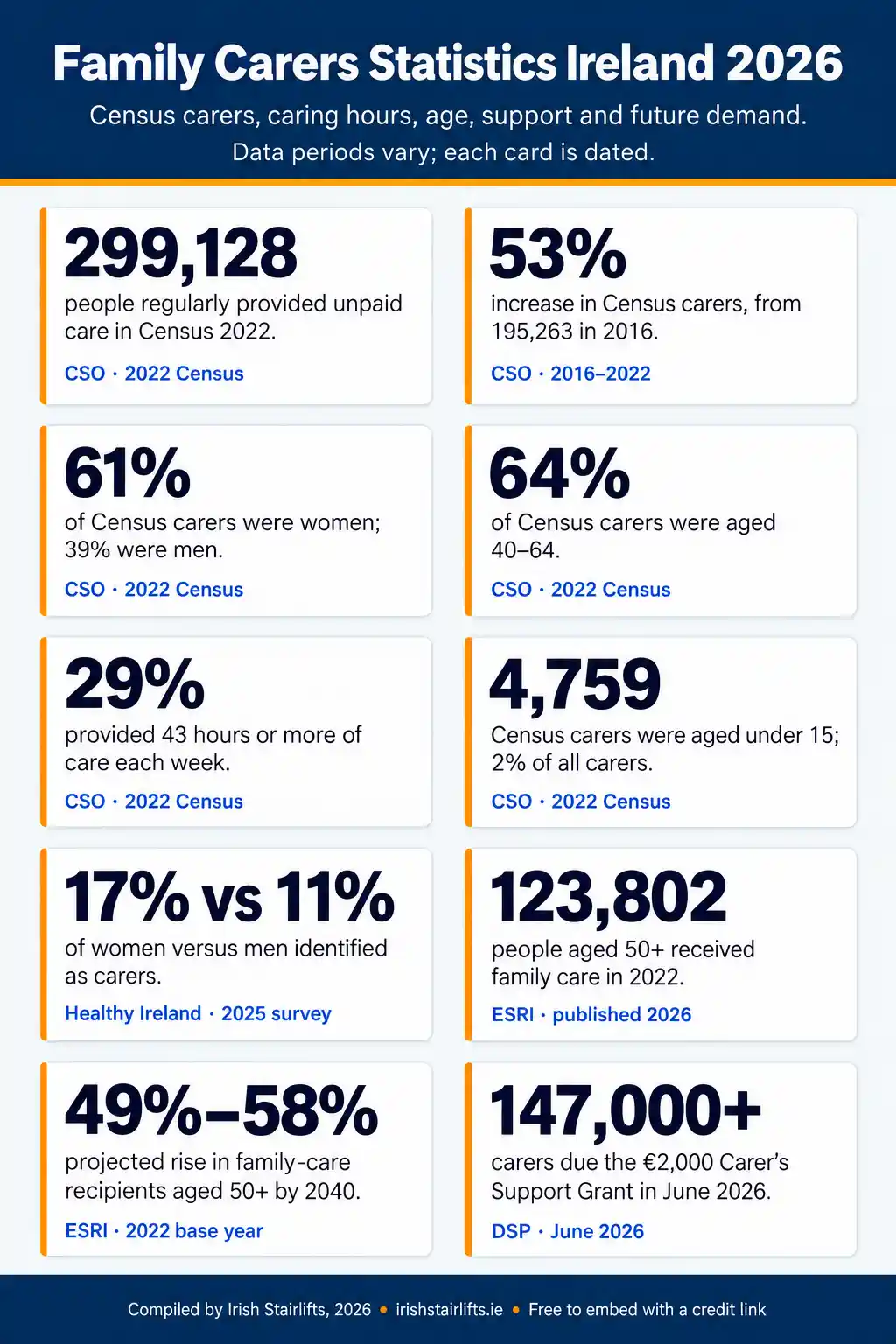
Family Carers Statistics Infographic
The infographic below summarises ten of the headline figures. It may be reused with a credit link to this page.
Family Carers Statistics Ireland 2026, compiled by Irish Stairlifts. Free to embed. Please credit Irish Stairlifts with a link to this page: https://irishstairlifts.ie/family-carers-statistics-ireland/
How many family carers are there in Ireland?
The strongest national count comes from Census 2022. It recorded 299,128 people who said they regularly provided unpaid personal help or support to a family member, neighbour or friend with a long-term illness, health issue, disability or problems related to old age. That represented 6% of the population, compared with 4% in both 2011 and 2016.
The total increased from 195,263 in 2016 to 299,128 in 2022. The CSO expressed this as a 53% rise. These figures describe people captured by the Census question, so they should not be treated as interchangeable with estimates produced from broader definitions of family care.
Other current sources answer different questions. Healthy Ireland uses a representative telephone survey of people aged 15 and over. Social protection statistics count recipients of a particular payment. Family Carers Ireland surveys people who currently identify as family carers. Each source is useful, but none should be added to the Census number to create a larger national total.
Who provides unpaid care?
Women provided most unpaid care recorded by Census 2022. The CSO counted 181,592 female carers and 117,536 male carers, meaning women represented 61% of the total and men represented 39%.
Age also shaped the carer profile. Sixty-four per cent of carers were aged 40 to 64, and people aged 65 and over made up a further 15%. This concentration in middle and later life matters when considering how caring may overlap with paid work, parenting, a person’s own health needs and planning for retirement.
The newer Healthy Ireland Survey 2025 shows a similar sex difference using a different measure. Seventeen per cent of women and 11% of men in the survey identified as carers. The highest reported rates among women were 28% at ages 45 to 54 and 26% at ages 55 to 64.
Women made up 60% of all carers in the Healthy Ireland survey and 65% of parent-carers. Mid-life women accounted for 27% of adult carers and 55% of parent-carers. These survey percentages help describe who is providing care, but they are not Census headcounts.
How many hours do carers provide?
Caring commitments vary greatly. In Census 2022, 46% of carers reported providing up to 14 hours of care a week. At the other end of the distribution, 29% provided 43 hours or more. The share in the highest category had risen from 21% in 2016.
Women were more likely to be in the highest-hours group. Thirty-one per cent of female carers reported 43 hours or more each week, compared with 26% of male carers. This is a difference in the distribution of reported hours and does not explain why individual caring arrangements differ.
The Census categories describe hours of care rather than employment status. A person providing 43 hours or more should not automatically be described as a “full-time carer”, because the Census also records many carers as being in paid work.
The 2026 State of Caring survey found much heavier commitments among its own respondents. Seventy-four per cent reported more than 90 hours of care a week, and 67% reported more than 120 hours. These are striking findings, but they apply to the 2,930 people who completed the Family Carers Ireland survey and should not be presented as national prevalence rates.
Young carers, work and economic status
Census 2022 recorded 4,759 carers aged under 15, equal to 2% of all carers counted. Twelve per cent of these young carers reported 43 hours or more each week. The highest-hours share had doubled from 6% in 2016.
Among carers aged 15 and over, 167,794 were working. That was 57% of carers in this age range, up from 51% in 2016 and 49% in 2011. “Working” is the Census principal economic status and does not mean that every person worked full-time.
Four per cent of carers aged 15 and over were unemployed in 2022, compared with 10% in 2011. A further 16% were looking after the home or family, down from 20% in 2011. These categories describe economic status alongside caring and should not be confused with whether someone was counted as a carer.
There were also regional differences. The share of the local population recorded as carers ranged from about 5% in Dublin City to 7% in Mayo. As the published county percentages are rounded, they are best used to show the broad range rather than to build a precise league table.
Who receives family care?
Healthy Ireland found that 69% of carers supported someone aged 65 or over. Thirty-eight per cent cared for someone aged 81 or over.
The recipient profile differed by the age of the carer. Seventy-six per cent of carers aged 45 and over supported someone aged at least 65, compared with 58% of carers younger than 45. This comparison describes the age profile of care relationships rather than the intensity or type of support provided.
ESRI’s family-care research, published in October 2026, estimated that 123,802 people aged 50 and over received family care in 2022. Receipt increased steeply with age, from 6% among people aged 70 to 74 to 43% among those aged 85 and over.
These figures concern recipients aged 50 and over. They are not an estimate of the total number of carers and do not include every care relationship in the country.
Financial pressure, wellbeing and respite
The State of Caring 2026 survey offers a current view of the pressures reported by engaged family carers. Seventy-one per cent of its respondents said they found it difficult to make ends meet.
Access to respite was another concern. Three-quarters of respondents said they had never received respite. Read with the reported caring hours, this finding illustrates the pressure described by survey participants, but it cannot be converted into a national total without a nationally representative denominator.
Healthy Ireland also found a wellbeing difference among mid-life women. Fifty-two per cent of mid-life women carers reported good or very good sleep, compared with 61% of mid-life women generally. This is a descriptive association and does not establish that caring caused the difference.
All State of Caring percentages on this page refer to the 2,930 survey respondents, who cared for at least 4,042 children and adults. The sample may differ from the wider carer population, so the findings should not be converted into national totals.
Support payments and future demand
In June 2026, the Department of Social Protection announced that more than 147,000 carers would receive the annual Carer’s Support Grant. The payment was €2,000 for each eligible person being cared for, and the total payment run was expected to be in the region of €336 million.
More than 18,000 recipients were providing care for two or more people and were due to receive a payment for each eligible person. These grant payment figures are administrative records. They do not measure every carer because payment eligibility and scheme rules apply.
Demand for family care is expected to rise as Ireland’s population ages. ESRI projects that the population aged 65 to 84 will grow by almost 60% between 2022 and 2040, while the population aged 85 and over will more than double.
Across the ESRI scenarios, the number of people aged 50 and over receiving family care is projected to increase by 49% to 58% by 2040. This is a projection rather than an observed future result. The range should be preserved because it reflects different assumptions rather than one certain outcome.
Ireland compared with the EU
The latest suitable harmonised Eurostat comparison uses 2019 European Health Interview Survey data. It measures people aged 15 and over living in private households who provided informal care or assistance at least once a week.
On that measure, 12.6% of people in Ireland provided informal care at least weekly, compared with 17.0% across the EU-27. Among women, the rates were 14.4% in Ireland and 19.1% in the EU-27. Among people aged 55 to 64, the equivalent figures were 19.0% and 25.0%.
The Eurostat care dataset is valuable because the Irish and EU figures use a harmonised definition, population and period. It is historical context, not a 2026 rate, and it should not be directly compared with the Census 2022 prevalence figure or Healthy Ireland’s 2025 survey without explaining the different questions and years.
Method and sources
This roundup was compiled in October 2026 from six primary producers: the CSO, the Department of Health’s Healthy Ireland Survey, ESRI, the Department of Social Protection, Family Carers Ireland and Eurostat. Every statistic selected for publication was checked against the producer’s release page or official dataset.
The national baseline is Census 2022, published by the CSO in September 2023. Healthy Ireland 2025 was published in November 2025 and is based on telephone interviews with a representative sample of 7,556 people aged 15 and over between October 2024 and April 2025. Its estimates are survey results, not administrative counts.
ESRI’s 2026 publication uses a 2022 base year and projects need to 2040 using Healthy Ireland, the Census Longitudinal Dataset, TILDA and the Hippocrates model. Projections are reported as ranges and are not described as outcomes that will definitely occur.
The Department of Social Protection figures relate only to the June 2026 Carer’s Support Grant payment run. Family Carers Ireland’s findings describe respondents to its 2026 State of Caring survey. Eurostat’s harmonised comparison comes from EHIS wave 3 and measures 2019, the newest suitable period available in the selected dataset.
No figures from these sources were added together. Rounded percentages were not converted into precise population totals, and associations were not described as causes.
How Irish Stairlifts Can Help and Further Irish Statistics
Family-care statistics describe unpaid support, but they do not show whether a particular home is accessible or whether any one product is suitable. Where stairs limit a person’s use of their home, Irish Stairlifts can assess the property and explain appropriate stairlift options. Any recommendation should be based on the individual and the home, not on age, Census status or receipt of a carer payment alone.
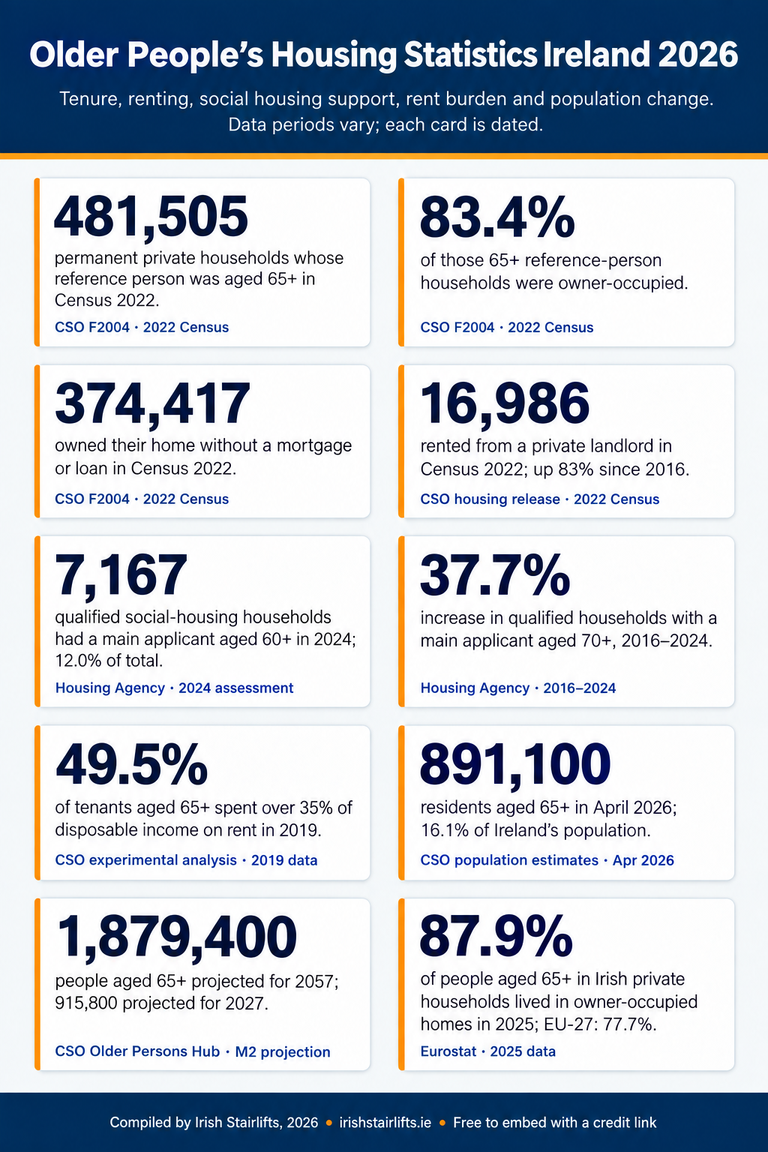
Irish Stairlifts can also prepare an itemised quotation where one is required for a local-authority grant application. Households considering accessibility work can use the home adaptation calculator to understand which scheme may apply, but work should not begin until written approval has been received. For related national evidence on funding allocations and maximum awards, see our housing adaptation statistics.
Related Post
categories
- Accessible Bathrooms 20
- Grants & Funding 8
- ISB Mobility 6
- Mobility Aids 42
- Outdoor & Independence Solutions 44
- Seating Solutions 10
- Stairlifts & Home Lifts 36
- Statistics 9