
Osteoporosis Statistics Ireland 2026: Nearly 1 in 5 Adults 50+ Reported a Diagnosis

Sources reviewed 24 November 2026 · Estimated reading time: 12 minutes. Human written and fact checked against primary source.
Osteoporosis can remain unnoticed until a low-impact fracture occurs, so the figures used to describe it depend heavily on what is being measured. National survey evidence, clinical bone-density records, fracture audits and European models each show a different part of the picture in Ireland.
This roundup was prepared in 2026, but its statistics cover several periods. The newest national survey evidence comes from TILDA Wave 6 data collected from 2020 to 2023, while the newest fracture-liaison and hip-fracture audits both cover 2025. The comparable Ireland and European prevalence estimates use a harmonised 2019 model.
Key osteoporosis statistics in Ireland
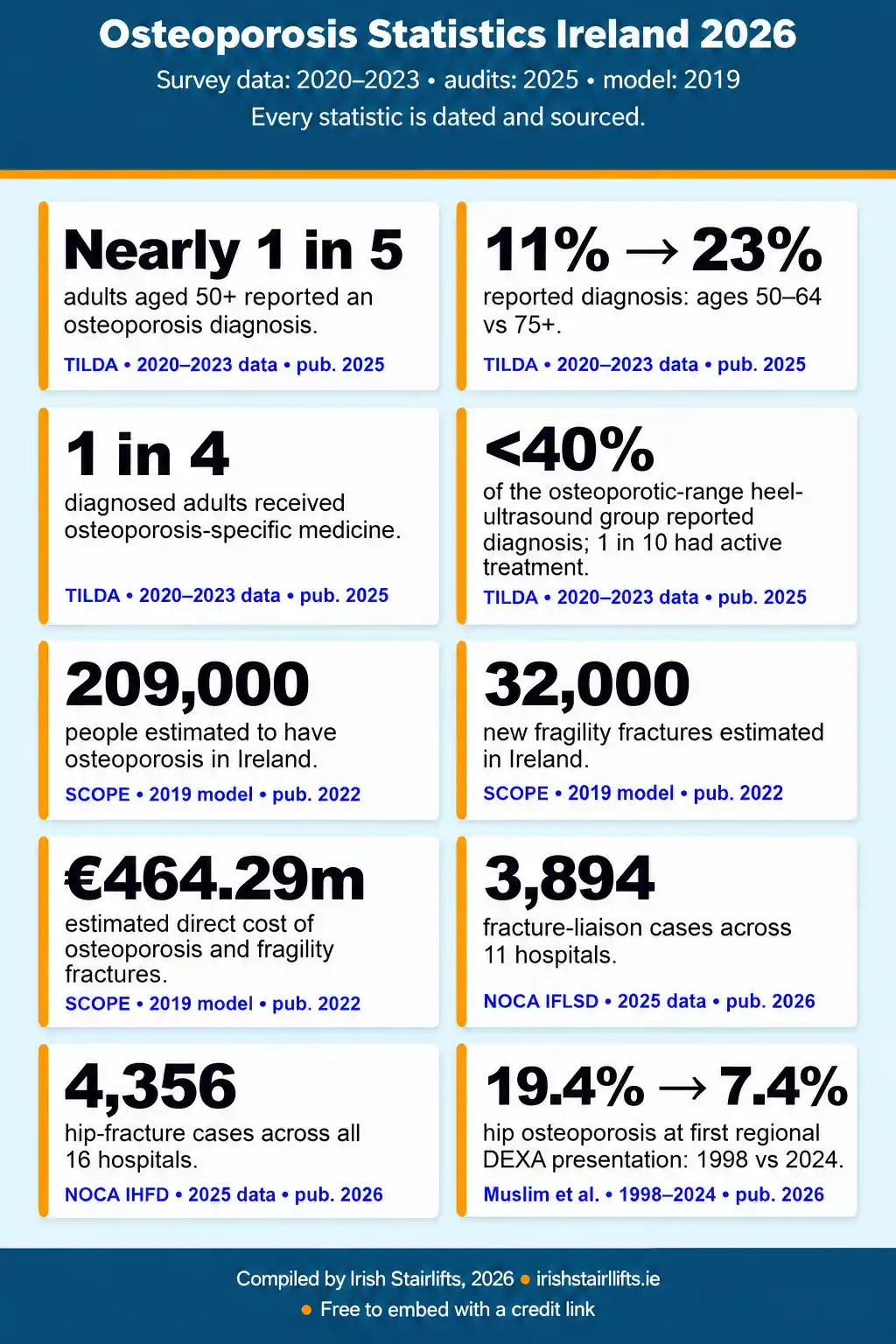
- Nearly 1 in 5 adults aged 50 and over reported an osteoporosis diagnosis in TILDA Wave 6, according to the national ageing study.
- Reported diagnosis increased from 11% among people aged 50 to 64 to 23% among those aged 75 and over, the TILDA findings show.
- Only one-quarter of diagnosed adults were prescribed an osteoporosis-specific medicine in the same Wave 6 report.
- Among adults whose heel ultrasound was in the osteoporotic range, fewer than 40% reported a diagnosis and only 1 in 10 were receiving active treatment, according to TILDA Wave 6.
- An estimated 209,000 people in Ireland had osteoporosis in 2019, almost 80% of them women, in the harmonised European SCOPE model.
- SCOPE estimated 32,000 new fragility fractures in Ireland during 2019, equivalent to 89 per day, in its country comparison.
- Irish fracture-liaison services recorded 3,894 cases across 11 hospitals during 2025, identifying 29% of the estimated non-hip fragility-fracture population at participating hospitals, the NOCA audit records.
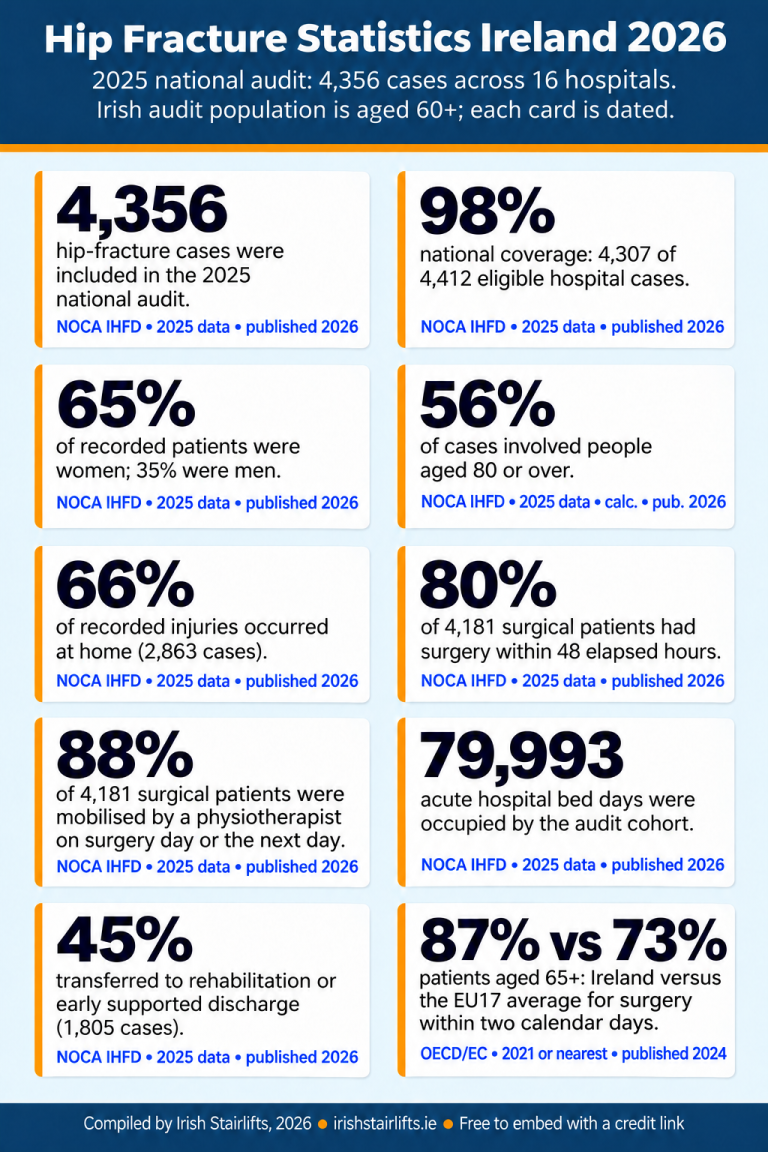
- 4,356 hip-fracture cases were recorded in the 2025 national audit, which achieved 98% coverage of eligible hospital cases, according to the Irish Hip Fracture Database.
- Regional first-presentation DEXA records showed crude hip osteoporosis falling from 19.4% in 1998 to 7.4% in 2024, although this was a clinical referral cohort rather than a national survey, the 26-year study found.
- The estimated direct cost of osteoporosis and fragility fractures was €464.29 million in 2019, according to the SCOPE analysis.
Osteoporosis Statistics Ireland 2026 Infographic
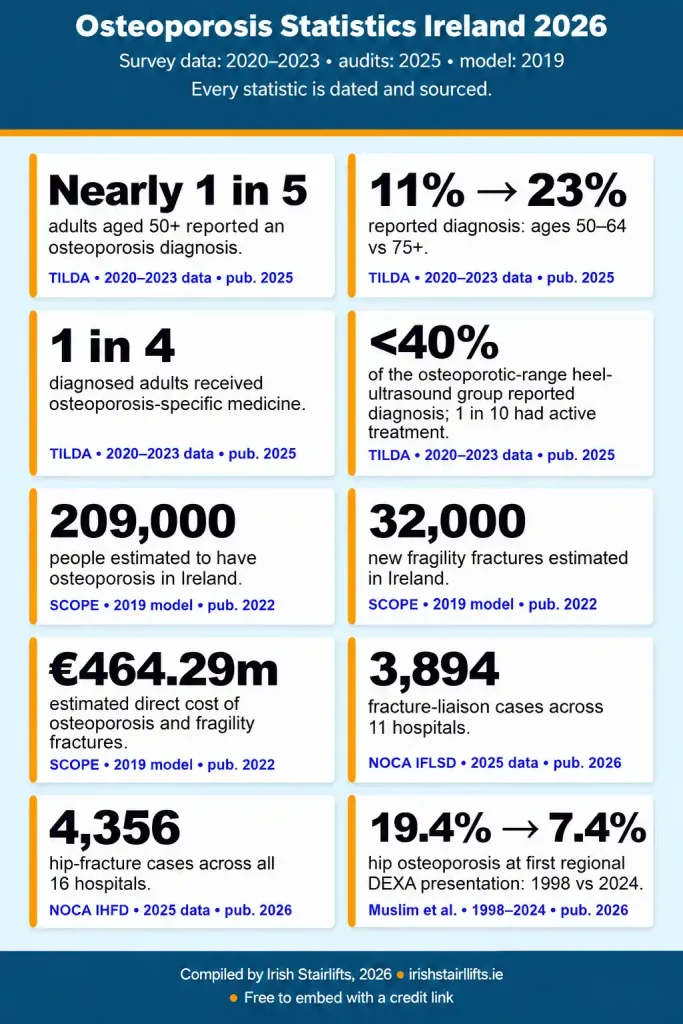
Free to embed. Please credit Irish Stairlifts with a link to this page: https://irishstairlifts.ie/osteoporosis-statistics-ireland/
What the osteoporosis figures measure
There is no single live national register counting everybody with osteoporosis. TILDA asks nationally representative adults aged 50 and over whether a doctor has diagnosed them and also uses heel ultrasound as an objective bone measure. This makes it useful for identifying the gap between measured risk, reported diagnosis and treatment, but heel ultrasound is not the same test as a central DEXA scan.
The SCOPE study uses World Health Organization bone-mineral-density criteria within a harmonised European model. Its 209,000 estimate applies to Ireland’s total population in 2019 and should not be compared directly with TILDA’s diagnosis rate among adults aged 50 and over.
Clinical audits answer another question. The NOCA fracture-liaison database follows people identified by participating services after non-hip fragility fractures, while the Irish Hip Fracture Database covers hospital care for people aged 60 and over with hip fracture. These datasets describe patients who reached specific services, not the prevalence of osteoporosis in the general population.
Diagnosis rises with age
Nearly one in five adults aged 50 and over reported an osteoporosis diagnosis at TILDA Wave 6. The proportion increased steadily across the published age groups, from 11% among people aged 50 to 64, to 18% among those aged 65 to 74, and 23% among adults aged 75 and over, the Wave 6 report shows.
These are self-reported diagnoses rather than a new national DEXA screening result. They show how common a known diagnosis was within the surveyed age groups, while the objective heel-ultrasound results show that some people with low bone measurements had not reported being diagnosed.
Among participants whose heel ultrasound was in the osteoporotic range, fewer than 40% reported an osteoporosis diagnosis. Only one in ten were receiving active osteoporosis treatment, according to the same TILDA analysis. The result points to a substantial diagnosis and treatment gap within that objectively measured subgroup, but it should not be converted into a national patient count.
Osteoporosis treatment remains uneven
Only one-quarter of adults who reported an osteoporosis diagnosis were prescribed an osteoporosis-specific medicine at Wave 6. The reported treatment rate declined across the age bands: 33% at ages 50 to 64, 29% at ages 65 to 74 and 21% at age 75 and over, the TILDA treatment figures show.
Calcium and vitamin D prescribing was more common. It reached 57% of diagnosed adults, ranging from 54% in the youngest age group to 60% among those aged 75 and over. These supplements and osteoporosis-specific medicines are different treatment measures and should not be presented as interchangeable.
The gap was also visible after a recent fracture. Nearly 3% of Wave 6 participants had experienced a new hip, wrist or spine fracture since their previous interview, and almost 90% of those fractures were fall-related. Only 38% of the recent-fracture group reported an osteoporosis diagnosis, fewer than 10% were prescribed anti-resorptive treatment and fewer than 40% received calcium and vitamin D, the fracture findings record.
More than 43% of adults in the recent-fracture subgroup were prescribed at least one falls-risk-increasing drug. That is an association within the medication review. It does not establish that a medicine caused any individual fall or fracture.
Fragility fractures and their estimated cost
The harmonised European SCOPE model estimated that Ireland had 32,000 new fragility fractures in 2019. That is equivalent to 89 fractures per day or 3.7 per hour, based on the published country model. The estimated fracture rate was 20.6 per 1,000 people, which was 6.1 per 1,000 higher than in 2010.
SCOPE put the 2019 direct cost at €464.29 million. This consisted of €290.84 million for incident fractures, €135.72 million for continuing disability associated with earlier fractures and €37.73 million for assessment and treatment. The total excludes the separate monetary value assigned to lost quality-adjusted life years.
The model estimated fracture-associated mortality at 115 deaths per 100,000 people aged 50 and over in Ireland, compared with 116 per 100,000 across EU27+2. This is mortality associated with a fracture event, not a count of death certificates listing osteoporosis as the underlying cause.
What the 2025 fracture-liaison audit found
Eleven hospitals contributed 3,894 fracture-liaison cases for 2025, compared with 10 hospitals and 3,335 cases in 2024. Participating services identified 29% of the estimated non-hip fragility-fracture population, so the total is not a complete national count. Women accounted for 82% of cases, and the median age was 72 for both women and men, the NOCA national report records.
72% of identified patients were assessed by a fracture-liaison practitioner within 90 days of fracture, up from 71% in 2024. Among patients who required a DEXA scan, 36% received it within 90 days, compared with 33% in 2024. The scan-timing percentage applies only to patients assessed as requiring DEXA, not to every case in the audit.
Anti-osteoporosis medicine was recommended for 62% of identified patients, compared with 57% in 2024. Among patients who were prescribed medication, half received follow-up monitoring 12 to 16 weeks after fracture, up from 48% in the previous year’s audit.
Among patients who had experienced a previous fracture, 34% were already receiving anti-osteoporosis treatment when they presented. The figure does not show why any individual was or was not treated, but it describes the secondary-prevention gap among people identified by participating services.
79% of identified patients received or were referred for a falls-risk assessment, up from 70% in 2024. Among patients referred or advised to undertake strength-and-balance exercise who also received a 16-week follow-up call, 24% had started the programme, compared with 20% in 2024.
Bone-health care after hip fracture
The Irish Hip Fracture Database recorded 4,356 cases during 2025 across all 16 trauma-receiving hospitals. The audit achieved 98% coverage when its hospital records were compared with eligible HIPE cases, according to the 2025 national report.
Among 4,171 patients discharged alive, 92%, or 3,850 people, received a bone-health assessment. Of those assessed, 58% started bone-health medicine during admission and 17% continued medicine prescribed before admission. A quarter were not receiving bone-health medicine at discharge, including patients awaiting DEXA, awaiting outpatient assessment or recorded as not requiring appropriate medication at that point.
A specialist falls assessment was completed for 90%, or 3,755 of the 4,171 patients. The audit defines this as a systematic assessment covering falls history, the index fall, future risk factors and medication review, followed by a documented risk-reduction plan. It is therefore a more specific measure than general advice about falls.
What 26 years of Mid-West DEXA records show
A 2026 peer-reviewed study examined 66,681 first DEXA scans completed at University Hospital Limerick and St Camillus Hospital between 1998 and 2024. The cohort’s mean age was 61.4, and 80.7% were recorded as female, according to the regional registry study.
Crude osteoporosis prevalence at first presentation fell from 19.4% to 7.4% at the hip and from 30.2% to 8.4% at the lumbar spine between 1998 and 2024. After adjustment for age and sex, the odds of osteoporosis fell by 4.0% per calendar year at the hip and 4.8% per year at the spine. The adjusted hip estimate was OR 0.960 with a 95% confidence interval of 0.957 to 0.964. The spine estimate was OR 0.952 with a 95% confidence interval of 0.949 to 0.955.
The study concerns people referred for a first clinical scan within one regional service. Changes in referrals, scanning technology and the characteristics of patients attending may influence the findings. The authors used age standardisation and sensitivity analyses, but the results still should not be described as a fall in national population prevalence or as proof that one intervention caused the change.
Future fracture pressure
SCOPE projected that Ireland’s population aged 50 and over would grow by 38.0% between 2019 and 2034, compared with 11.4% across EU27+2. Its demographic model projected annual osteoporotic fractures rising by 19,000, from 32,000 in 2019 to 51,000 in 2034, in the Ireland country chapter.
That 2034 figure is a projection, not an observed total. It should also be read beside the newer regional DEXA evidence, which found improving bone measurements among people presenting for assessment. Population ageing and changing bone health can move in different directions, and neither dataset on its own supplies a complete national forecast.
Ireland compared with Europe
SCOPE estimated that 3.7% of Ireland’s total population had osteoporosis in 2019, compared with an average of 5.6% across EU27+2. EU27+2 means the 27 European Union member states plus the United Kingdom and Switzerland. Because both values come from the same period and harmonised model, this is the most defensible like-for-like prevalence comparison available in the sources reviewed.
The same model estimated a treatment gap of 32% among eligible women in Ireland, equal to 49,000 of 153,000 women characterised as at risk. The EU27+2 average was 71%, according to the SCOPE service analysis. These are modelled 2019 estimates rather than current prescription records, so they provide historical international context rather than a 2026 league table.
How we compiled these statistics
Irish Stairlifts compiled this reference from primary and first-party publications reviewed on 24 November 2026. The national survey evidence is from TILDA Wave 6, whose latest data were collected from 2020 to 2023. Non-hip fracture-service figures come from NOCA’s Irish Fracture Liaison Service Database report published in 2026 and covering 2025. Hip-fracture care comes from the Irish Hip Fracture Database report published in 2026 and covering 2025.
The 26-year trend uses a peer-reviewed regional DEXA registry covering 1998 to 2024. European context and national modelled burden use the SCOPE country study published in 2022 with a 2019 reference period. Survey estimates, clinical referrals, administrative audits, modelled estimates and projections are kept separate throughout.
The year in the title is the roundup year. It does not mean every figure was measured in 2026. Irish Stairlifts is the compiler of this roundup, not the original research authority behind the statistics. TILDA, the HSE, NOCA, the study authors and the International Osteoporosis Foundation remain the named authorities for their respective evidence.
How Irish Stairlifts can help at home
Osteoporosis does not automatically mean that somebody needs a stairlift, and a stairlift does not diagnose, treat or prevent osteoporosis or fractures. Decisions about treatment, rehabilitation and safe mobility should involve the person’s healthcare professionals.
After a fracture or a change in mobility, stairs may become one practical part of a wider home assessment. Where a person can transfer to and from the seat safely, Irish Stairlifts can assess the staircase and explain straight, curved and reconditioned stairlift options. Suitability depends on the individual, the home and the plan agreed with family and relevant professionals.
Related Irish statistics
These related reference pages cover connected aspects of falls, fractures, ageing and home accessibility:
- Hip fracture statistics explain the current national hospital audit in more detail.
- Falls among older people cover fall prevalence, injuries and prevention evidence.
- Ageing population statistics provide demographic context for future service demand.
- Home accessibility statistics examine housing features and reported adaptation needs.
Related Post
categories
- Accessible Bathrooms 22
- Grants & Funding 8
- ISB Mobility 6
- Mobility Aids 43
- Outdoor & Independence Solutions 45
- Seating Solutions 10
- Stairlifts & Home Lifts 38
- Statistics 15