
Concrete, Aluminium or Portable Ramps: Which Is Best for Your Home?
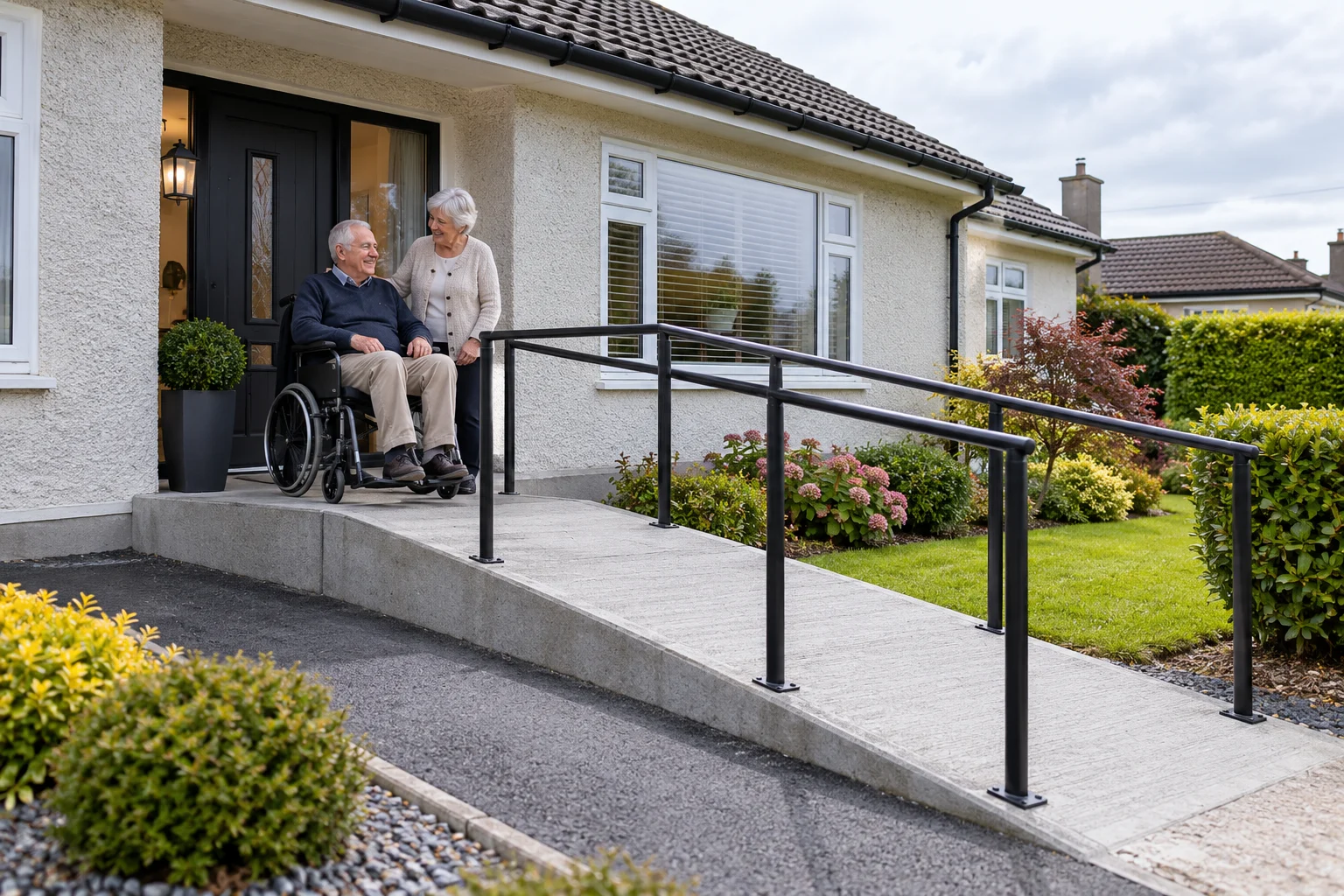

There is no single best ramp for every home. Portable ramps suit small steps and short-term or occasional use. Modular aluminium ramps go in quickly and can be taken away again. A concrete ramp built in place is the most permanent, solid and low-maintenance option, and usually the best choice when someone will be using the ramp every day for years. The right answer depends on how high the step is, how much space you have and how long you will need it.
Key takeaways
- Portable and threshold ramps are best for small rises, visits and temporary needs, not for a steep or long approach.
- Modular aluminium ramps are quick to fit and can be removed, but look more like equipment than part of the house.
- A concrete ramp is built to suit your house, lasts for decades and needs very little upkeep.
- The gentler the slope, the more length you need: 1:20 is the comfortable target and 1:12 is the steepest generally used.
- Whatever the material, look for a non-slip surface, a level platform at the door and rails on any open side.
Concrete, aluminium and portable ramps compared
This table gives a side-by-side view. We have left out prices because they depend so much on the height, length and shape of the ramp, but the main cost drivers are listed.
| Portable / threshold ramp | Modular aluminium ramp | Concrete ramp built in place | |
|---|---|---|---|
| How permanent | Not fixed; lifted in and out or left at a door sill | Semi-permanent; bolted together and can be removed | Permanent part of the house |
| What drives the cost | Length and weight rating | Total length, number of platforms and rails | Length, height, platform size, groundwork and rails |
| Look and visual impact | Small, can be stored away | Industrial look, stands out on the front of a house | Can be finished to sit with the house and garden |
| Maintenance | Keep clean, check for wear | Check fixings and surface; can get slippery with leaves or algae | Very little; occasional sweep and repaint of rails |
| Slip resistance | Depends on surface; some are smooth | Usually a textured or ribbed deck | Brush-finished for grip in wet weather |
| Rises it suits | Door sills and one small step | One or several steps, if there is room | Any rise where there is room for the length |
| Speed | Ready straight away | Usually fitted quickly | Takes longer: ground prep, pour and curing |
When a portable or threshold ramp is enough
Portable ramps for steps are a good fit when the need is small or short. Think of:
- A raised door sill or a single low step at the back door.
- Bringing a parent home for a visit or for Christmas.
- A short spell after an operation or injury.
- Getting a wheelchair in and out of a car or a friend’s house.
They are not the answer for a steep approach or several steps. A short ramp over a high step is too steep to push a wheelchair up safely and can be frightening coming down. Check the weight rating covers the user and the chair together, and make sure the ramp sits firmly and can’t slide.
Modular aluminium ramps
Modular ramps come in sections with platforms and rails that bolt together. They are useful when you need something quickly, when you are renting, or when the need may not be permanent. They can be taken down and reused.
The downsides are mainly how they look and how they wear on an Irish front garden. A long aluminium run with rails across the front of a house is very visible, and a metal deck under trees can get slippery in autumn and winter. They also need a reasonably firm, level base.
Concrete ramps built in place
A concrete ramp is built to measure for your doorway, your ground levels and your garden. It is the option we build, because for someone using a ramp every day it is the most solid and the least fuss over the years. Our concrete ramps include:
- Brush-finished concrete, so the surface grips in wet weather.
- A level turning platform at the top, so the door can be opened without rolling backwards.
- Steel rails and edgings on any open sides, painted with anti-rust paint in a colour you choose.
- A fall of 1:20 where space allows, and as steep as 1:12 where space is limited.
Because it is built for the house, a concrete ramp can turn corners, run along the front wall or combine with a few steps and rails for family members who prefer to walk. Our steps and outdoor rails are often fitted at the same time.
Gradient, in plain terms
A gradient of 1:12 means the ramp rises 1 unit for every 12 units of length. So a rise of 30 cm needs 3.6 metres of ramp at 1:12, or 6 metres at 1:20. The gentler slope is much easier to push or self-propel, but it needs more room.
In Ireland, Technical Guidance Document M of the Building Regulations gives the reference figures most people use. It treats a gradient of 1:20 or steeper as a ramp, says ramps should be as shallow as practical, and sets 1:12 as the steepest, on short flights with level landings in between. TGD M is mainly written for new buildings, so for an existing home it is a guide rather than a rulebook. For more on planning the slope and layout, see our guide to wheelchair ramps at home.
Which one should you choose?
- Measure the height from the ground to the door threshold. This tells you how long the ramp needs to be.
- Look at how much straight run you have in front of the door, and whether the ramp can turn.
- Decide how long it is needed: weeks, months or years.
- Think about who will use it: a self-propelling wheelchair user needs a gentler slope than someone being pushed or walking with a frame.
- If an OT is involved, ask for their recommendation and keep a copy for any grant application.
As a rough guide: short-term or a small sill, go portable; medium-term or you need it this week, consider modular aluminium; long-term and used daily, a concrete ramp usually works out best. If you are also thinking about access through the rest of the house, our guide to disabled access at home is a good next read.
Frequently asked questions
Is a concrete wheelchair ramp better than aluminium?
For daily long-term use, concrete is usually more solid, less slippery when finished properly and needs less upkeep. Aluminium is better when you need something fast or temporary, or may want to remove it later.
Are portable ramps safe for steps?
For a single low step or a door sill, a good portable ramp is fine. For higher steps the ramp ends up too steep to use safely, so a longer fixed ramp is the better choice.
What gradient should a home ramp be?
Aim for 1:20 where space allows. Where space is tight, 1:12 is generally the steepest used, with level resting platforms. We will measure and advise at the survey.
Can a grant help with the cost of a ramp?
Council grants for people with a disability can cover adaptations such as ramps, usually with an OT assessment and written approval before work starts. See our grants information page.
Talk to us
We build bespoke concrete ramps, steps and rails all over Ireland. Book a free home survey and we will measure the rise, look at the space and tell you honestly which kind of ramp suits your home. Request a free quotation or call 045 892 696.
Related Post

categories
- Accessible Bathrooms 22
- Grants & Funding 8
- ISB Mobility 6
- Mobility Aids 42
- Outdoor & Independence Solutions 45
- Seating Solutions 10
- Stairlifts & Home Lifts 38
- Statistics 14