
Winter Safety at Home for Older People: A Practical Checklist
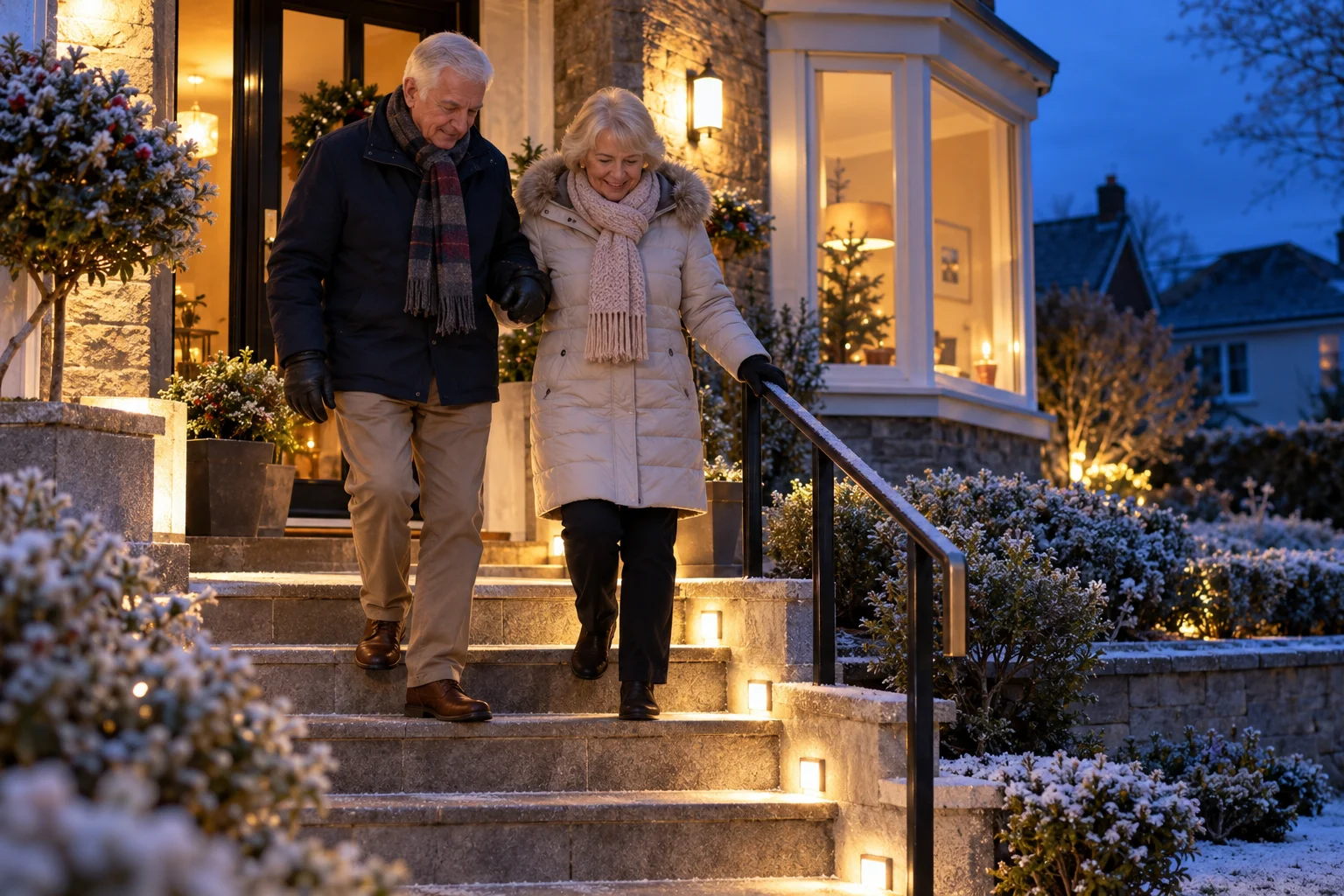

Winter at home brings three main risks for older people in Ireland: falls in the dark and on frosty steps, getting too cold indoors, and being cut off during storms and power cuts. Most of these can be reduced with a few jobs done in October or November: better lighting, rails and grit for the outside steps, a plan for heating, a power-cut kit and someone checking in regularly. This checklist is written for older people and for the sons and daughters who look out for them.
Key takeaways
- Light the stairs, landing and the path to the door well, and use night lights for trips to the bathroom.
- Put rails on every outside step and keep a bucket of grit or salt by the door before the first frost.
- Check whether Fuel Allowance or the Household Benefits Package applies, and keep at least one room properly warm.
- Prepare for power cuts: torch, charged phone, and a note of the ESB Networks emergency number.
- Arrange regular check-ins with family, neighbours or a befriending service.
Light the way: stairs, landing and paths
From November, it is dark by late afternoon. Many falls happen on the stairs or between the bedroom and the bathroom at night.
- Make sure there is a light switch at the top and the bottom of the stairs, and that bulbs are bright enough to see the edge of each step.
- Plug-in night lights on the landing and in the bathroom take the guesswork out of night-time trips.
- Keep a torch by the bed and by the front door.
- Outside, a sensor light over the front and back doors means no fumbling for keys on a wet step.
Outdoor steps, rails and gritting
Front steps that are fine in summer can be lethal with frost, wet leaves or moss. Before the weather turns:
- Sweep leaves off steps and paths, and clear green algae from shaded areas.
- Fit a rail on at least one side of every set of outside steps, ideally both. Our outdoor steps and rails are made for Irish weather.
- Keep a bag of grit or rock salt and a small scoop just inside the door, so it is there on the first icy morning.
- Ask a neighbour or family member to grit the steps when frost is forecast, rather than going out yourself in the early morning.
- Wear shoes or boots with a good grip outside, and keep slippers for indoors.
If the steps themselves are the problem, a gentle concrete ramp with rails may be safer all year round.
Keeping warm without the worry
Cold homes are hard on older people, and heating bills cause real stress. A few practical points:
- Heat the rooms you use, and keep at least the living room and bedroom warm.
- Close curtains at dusk and use draught excluders on doors.
- Layers of light clothing, a hot water bottle or electric blanket used safely, and hot meals and drinks through the day all help.
- If moving between a warm room and a cold hall makes you rush the stairs, slow down and take the rail.
Help with heating costs
Two supports are worth checking. Fuel Allowance is a means-tested payment for people aged 66 or over, or under 66 on a qualifying social welfare payment, and it is €38 a week for 28 weeks in 2026, with the 2026/2027 season starting the week of 28 September. The Household Benefits Package, for people aged 70 and over (or younger in some cases), includes an electricity or gas allowance and a free TV licence. Both have conditions, so read the full details on Citizens Information. Our post on grants and supports for pensioners covers these and more.
Ready for storms and power cuts
Winter storms bring power cuts, sometimes for a day or more in rural areas. A little preparation makes a big difference.
Power-cut checklist
- A torch or battery lantern in each main room, with spare batteries. Avoid candles where possible.
- A mobile phone kept charged, plus a small power bank.
- The ESB Networks emergency number, 1800 372 999, written by the phone. Outages and restoration times are shown on ESB Networks PowerCheck.
- A flask for hot drinks, warm blankets, and food that doesn’t need cooking.
- If someone relies on electrically powered medical equipment, ask the electricity supplier to put them on the vulnerable customer register, which brings priority support and text alerts about outages.
What about the stairlift?
Our stairlifts run on batteries that charge from an ordinary plug socket, so they keep working in a power cut. Leave the lift parked at its charging point so the batteries stay topped up. Our post on stairlifts with battery backup explains how it works.
Preventing falls indoors
Falls are a serious risk for older people, and dark, cold days add to it. Our falls among older people statistics page has the figures. Indoors, the basics matter most:
- Remove loose rugs and trailing cables, especially on the route from bed to bathroom.
- Grab rails beside the toilet and in the shower.
- Stand up slowly after sitting, particularly in a warm room.
- Keep everyday items at waist height so there is no climbing or bending low.
- If the stairs are becoming a struggle, deal with it before winter rather than after a fall.
Checking in on neighbours and family
Dark evenings and bad weather mean fewer visitors, and people who live alone can go days without seeing anyone. Agree a simple routine: a daily phone call, a text at the same time each morning, or a neighbour who looks for the curtains being opened.
ALONE runs a National Support and Referral Line for older people on 0818 222 024, seven days a week from 8am to 8pm, and offers befriending and support. Many areas also have a Community Alert group, run by Muintir na Tíre in partnership with An Garda Síochána, which focuses on community safety and looking out for vulnerable neighbours.
Get the stairlift serviced before winter
The worst time to find a fault is during a cold snap when engineers are busy and the stairs are the only way to bed. Book a service in autumn: the engineer checks the batteries, safety sensors, seatbelt and rail. Our guide on regular stairlift maintenance explains what is involved, and if something does go wrong, our after-care engineers usually reach you within 24 hours.
Your winter checklist at a glance
| Task | Done? |
|---|---|
| Bright bulbs on stairs and landing, night lights fitted | |
| Sensor lights over outside doors | |
| Rails on all outside steps; leaves and moss cleared | |
| Grit or salt by the door | |
| Fuel Allowance / Household Benefits Package checked | |
| Torch, power bank and 1800 372 999 by the phone | |
| Stairlift serviced and parked on charge | |
| Daily check-in arranged |
Frequently asked questions
Will my stairlift work in a power cut?
Yes. Our stairlifts run on batteries charged from the mains, so they keep working when the power goes. Keep the lift parked on its charging point so the batteries are full.
How can I keep an elderly parent safe in winter if I live far away?
Set up a daily call or text, give a neighbour a key, make sure grit and torches are in place, and register them with services like ALONE. We are also happy to deal by email with family abroad about rails or a stairlift.
What should I do if an older neighbour seems to be struggling?
Call in, check they are warm and have food, and if you are worried, contact their family, their GP or ALONE’s support line. In an emergency, ring 112 or 999.
Talk to us
If the stairs or front steps are a worry this winter, we can call out for a free home survey and fit rails or a straight stairlift quickly, often the same or next day. Request a free quotation or call 045 892 696.
Related Post
categories
- Accessible Bathrooms 22
- Grants & Funding 8
- ISB Mobility 6
- Mobility Aids 43
- Outdoor & Independence Solutions 45
- Seating Solutions 10
- Stairlifts & Home Lifts 38
- Statistics 15