
Mobility Disability Statistics Ireland 2026: 349,155 People Reported Difficulty With Basic Physical Activities in Census 2022

Last updated: September 2026. Human written and fact checked against each named source.· 11-minute read
Mobility difficulties affect how people move around their homes, take part in everyday activities and remain connected with work, education and community life. This 2026 roundup brings together the most relevant Irish figures available, led by Census 2022 data published by the Central Statistics Office in 2023 and supported by Eurostat comparisons for walking or climbing steps.
The year in the title refers to when this article was compiled and updated. It does not mean that every statistic measures events in 2026.
Key mobility disability statistics at a glance
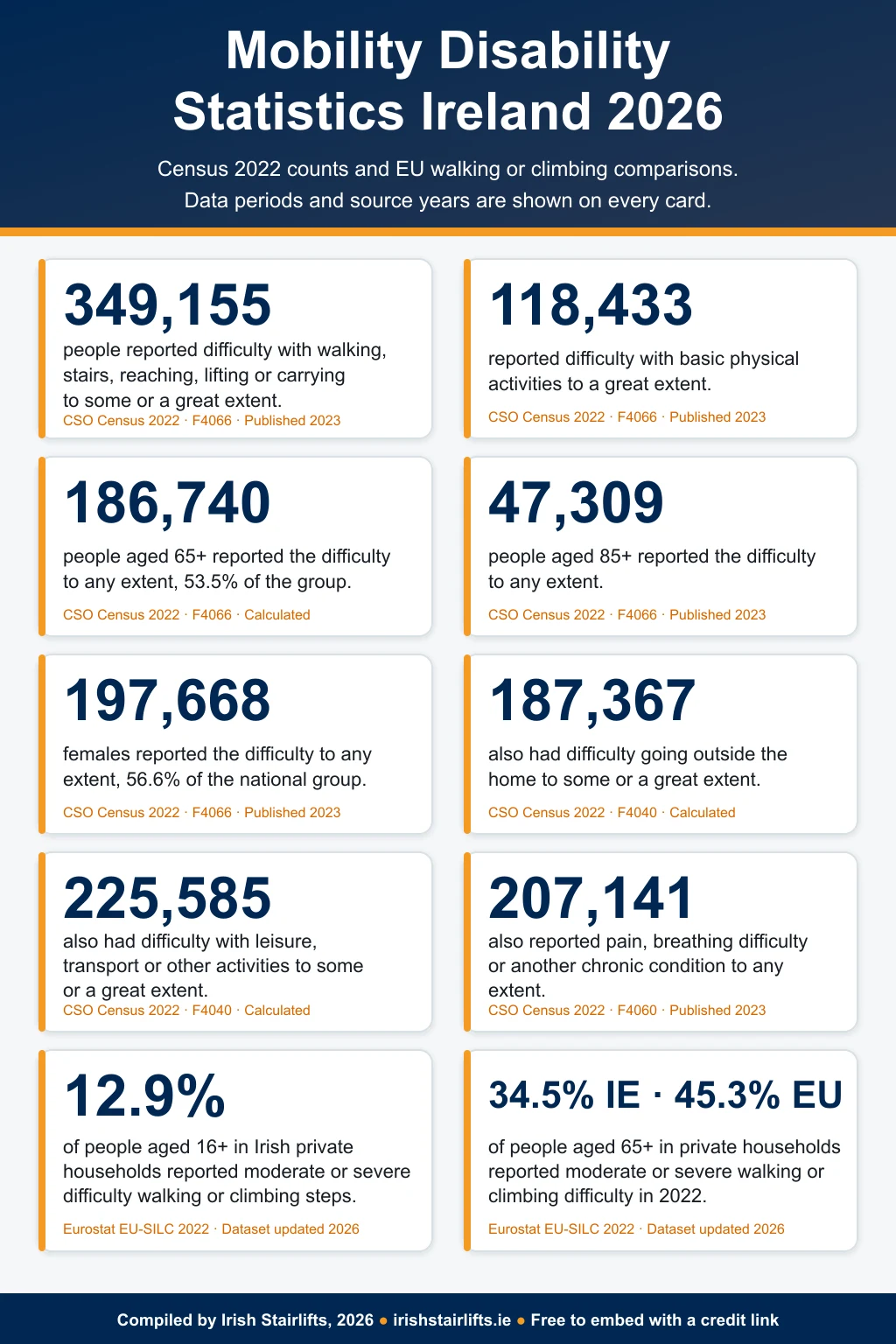
- 349,155 people experienced difficulty with basic physical activities such as walking, climbing stairs, reaching, lifting or carrying in Census 2022.
- The 349,155 people represented just under 7% of Ireland’s population and 31% of people with at least one long-lasting condition or difficulty, the CSO reported in 2023.
- 118,433 people experienced difficulty with basic physical activities to a great extent in the CSO’s Census 2022 table.
- 197,668 females and 151,487 males experienced the difficulty to any extent, according to CSO table F4066.
- More than half of the group, 186,740 people or 53.5%, were aged 65 or over, based on the published age bands in CSO table F4066.
- The largest age-group count was 47,309 people aged 85 or over in the Census 2022 data.
- 187,367 people with a basic physical-activity difficulty also had difficulty going outside the home to some or a great extent, calculated from CSO table F4040.
- 225,585 people in the group also had difficulty participating in activities such as leisure or using transport to some or a great extent, based on CSO table F4040.
- Eurostat found that 12.9% of people aged 16 or over in Irish private households reported moderate or severe difficulty walking or climbing steps in 2022, compared with 18.3% across the EU in the Eurostat dataset.
- Among people aged 65 or over, the corresponding Eurostat figures were 34.5% in Ireland and 45.3% across the EU in the 2022 EU-SILC data.
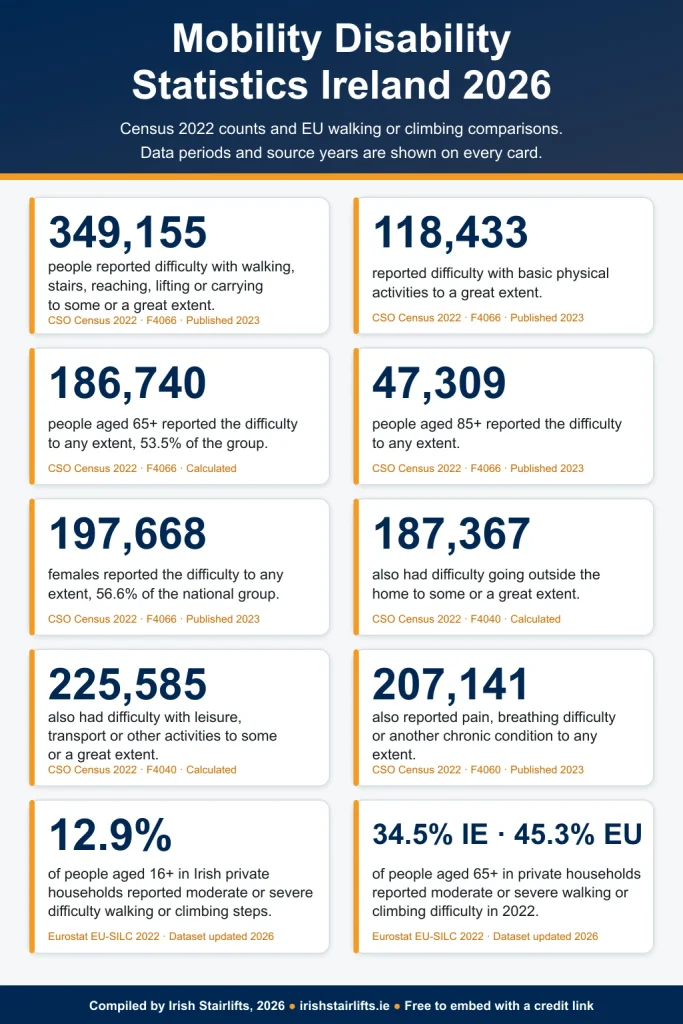
Free to embed with a credit link: https://irishstairlifts.ie/mobility-disability-statistics-ireland/
What the Irish mobility statistic measures
The headline national figure comes from the disability questions in Census 2022. The CSO counted people who experienced difficulty with basic physical activities such as walking, climbing stairs, reaching, lifting or carrying. A total of 349,155 people reported this difficulty to some or a great extent in the CSO’s Profile 4 release, which was published on 28 September 2023.
This category is broader than difficulty using stairs. It combines several forms of physical activity, so the figure cannot be interpreted as the number of people who specifically struggle with stair climbing. It is also not a clinical diagnosis. It records how respondents described a long-lasting condition or difficulty in the census.
The 349,155 people represented just under 7% of the total population. They also represented 31% of everyone who experienced at least one long-lasting condition or difficulty to any extent, according to the same CSO publication. People can report more than one condition, which means the CSO’s disability categories overlap and cannot be added together to produce a national total.
The Census 2022 questions changed substantially from those used in earlier censuses. For that reason, the 2022 count should not be presented as a direct increase or decrease from Census 2016. The figure is best used as a current benchmark for the revised census measure.
Of the 349,155 people in the category, 230,722 experienced the difficulty to some extent and 118,433 experienced it to a great extent, according to CSO table F4066. The great-extent group accounted for 33.9% of everyone reporting the difficulty, while 66.1% reported it to some extent.
The distinction matters because an any-extent statistic combines people with different levels of difficulty. The census count describes a broad population, from people reporting some difficulty with one or more basic physical activities to those reporting a great level of difficulty. Copy that uses only the total should retain the phrase “to any extent” or explain that the figure includes both response levels.
The severity breakdown also helps place later daily-life figures in context. A person can report a physical-activity difficulty to some extent while reporting a related everyday limitation to a great extent, or the reverse. The tables describe reported experiences rather than a single severity score applied across every activity.
Mobility difficulty by age and sex in Ireland
Age is one of the clearest patterns in the census data. The CSO reported that the number of people experiencing difficulty with basic physical activities began to rise again from age 30 onwards. For every age group over 20, more females than males recorded the difficulty in the Census 2022 Profile 4 analysis.
Summing the five published age bands from 65 to 69 through to 85 or over gives 186,740 people aged 65 or over with the difficulty to any extent in CSO table F4066. This was 53.5% of the 349,155-person group. It is a composition figure, meaning it shows how many people with the difficulty were older. It is not the percentage of Ireland’s entire population aged 65 or over who experienced the difficulty.
Among the older age bands, the CSO recorded 33,087 people aged 65 to 69, 34,561 aged 70 to 74, 37,244 aged 75 to 79 and 34,539 aged 80 to 84 with the difficulty to any extent in the same census table.
The highest count was among people aged 85 or over. In this open-ended age
group, 47,309 people experienced the difficulty to any extent, including 22,214 who experienced it to a great extent, the CSO data shows. Across the three age bands from 75 onwards, the combined any-extent count was 119,092, or 34.1% of everyone in the basic physical-activity category.
The age-band counts should not be treated as age-specific prevalence rates. Each age band contains a different number of residents, and the 85-or-over category covers more than five years. The published counts are still useful for showing where a large share of the population affected by physical-activity difficulty sits.
The census recorded 197,668 females and 151,487 males experiencing difficulty with basic physical activities to any extent, according to CSO table F4066. Females therefore represented 56.6% of the group, while males represented 43.4%.
These figures describe the sex composition of people who reported the difficulty. They are not age-standardised prevalence comparisons. Ireland has more females in its oldest age groups, where physical difficulties are more common, so the raw count difference should not be presented as proof of a biological or social cause.
How physical-activity difficulties affect daily life
The census data connects basic physical-activity difficulty with several everyday activities. Among the 349,155 people in the group, 171,366 also experienced difficulty dressing, bathing or getting around inside the home to some or a great extent. This total combines 96,732 people reporting some difficulty with 74,634 reporting great difficulty in CSO table F4040.
Grant claims measure funding activity, while our home accessibility needs statistics describe adaptation needs recorded in ALONE’s Q1 2026 assessments.
Difficulty outside the home was even more common. A combined 187,367 people reported difficulty going outside the home to some or a great extent, based on 94,166 some-extent and 93,201 great-extent responses in the same CSO table. That combined total represented 53.7% of everyone reporting a basic physical-activity difficulty.
The widest recorded effect concerned participation in other activities, including leisure or using transport. In total, 225,585 people with a basic physical-activity difficulty also reported this participation difficulty to some or a great extent in CSO table F4040. This represented 64.6% of the group.
Within that total, 122,083 people experienced difficulty participating in other activities to a great extent. The CSO highlighted that this equalled 35% of everyone reporting a basic physical-activity difficulty.
Work and education were also affected. A combined 170,054 people reported difficulty working at a job or business or attending school or college to some or a great extent, calculated from 52,673 some-extent and 117,381 great-extent responses. This is a reported everyday-activity measure, not an employment or unemployment rate.
Co-occurring conditions and labour-force participation
People can experience more than one long-lasting condition or difficulty. The most common additional category among people with a basic physical-activity difficulty was pain, breathing difficulty or another chronic illness or condition. The CSO counted 207,141 people with this combination to any extent in table F4060, equivalent to 59.3% of the basic physical-activity group.
A further 109,121 people reported difficulty learning, remembering or concentrating. The same census table recorded 87,949 people with deafness or hearing impairment and 84,807 with blindness or vision impairment alongside a basic physical-activity difficulty.
The CSO also recorded 75,365 people with a psychological or emotional condition or mental health issue and 43,713 people with an intellectual disability in this group, according to table F4060. These categories overlap, so adding their counts would count some people more than once.
Labour-force participation was particularly low among people who experienced difficulty with basic physical activities to a great extent. For people aged 15 or over in this group, the participation rate was 8% in the CSO’s Disability and Everyday Living analysis. The participation rate includes people working, unemployed or looking for a first regular job. It is not the same as the employment rate.
How Ireland compares with the EU
Eurostat offers a narrower comparison based specifically on difficulty walking or climbing steps. In 2022, 12.9% of people aged 16 or over in Irish private households reported moderate or severe difficulty with this activity. Across the EU, the corresponding figure was 18.3% in the live Eurostat ilc_hch19 dataset, accessed on 28 August 2026.
Severe difficulty walking or climbing steps was reported by 4.2% of people aged 16 or over in Ireland, compared with 5.8% across the EU, the same Eurostat dataset shows. Eurostat combines “a lot of difficulty” and “cannot do at all” within its severe category.
The age gradient remains clear in this comparison. Among people aged 65 or over, 34.5% in Ireland reported moderate or severe difficulty walking or climbing steps, compared with 45.3% across the EU in the 2022 EU-SILC figures.
The Eurostat and CSO figures should not be directly combined. Eurostat covers people aged 16 or over living in private households and asks about walking or climbing steps. The census covers all ages and combines walking, stair climbing, reaching, lifting and carrying. Eurostat also excludes people living in institutions and collective households, where activity limitations may be more common.
The Irish percentages are lower than the EU figures in this dataset, but the comparison is not age-standardised. It does not establish that Ireland has better accessibility, healthier residents or a lower underlying disability burden after differences in population structure and survey implementation are considered.
How we compiled these statistics
We reviewed primary data from the Central Statistics Office and Eurostat on 28 August 2026. The national counts come from Census 2022 Profile 4 and the related CSO PxStat tables F4066, F4040 and F4060, all released in 2023. The international comparisons come from Eurostat’s 2022 EU-SILC basic-activity dataset.
Where this page combines published age bands or adds the CSO’s some-extent and great-extent cells, the result is described as calculated. Percentages derived from CSO counts were rounded to one decimal place. We kept the data period separate from the source publication year and did not use earlier census figures as a direct trend because the disability questions changed for Census 2022.
The Eurostat comparison uses the live dataset values available on the review date. Eurostat’s supporting Statistics Explained publication used an older extract and displayed a slightly different EU walking figure, so the current data table and access date are stated here. The underlying figures may be revised by the source body.
Related Irish statistics
Mobility difficulties can intersect with fall risk, activity restriction and the ability to move around the home. Our related roundup on falls among older people in Ireland brings together national prevalence estimates, major-trauma data and hip-fracture figures with their original sources and data periods.
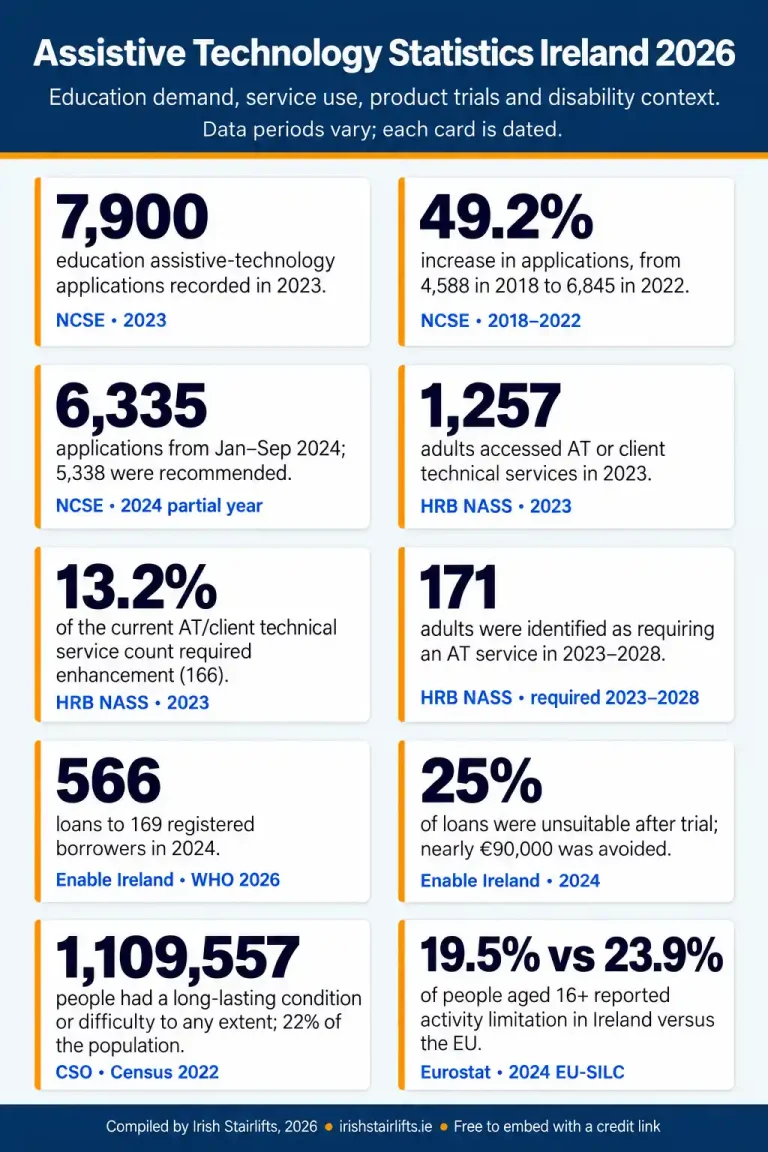
For wider evidence on devices and services used across education, disability support and everyday life, see our assistive technology statistics.
How Irish Stairlifts helps
Statistics cannot determine which mobility solution is appropriate for an individual home. For practical examples of equipment used in everyday life, see our four disability aids guide. Irish Stairlifts supplies straight and curved stairlifts throughout Ireland and can assess the layout of a staircase, explain suitable product options and provide installation and after-care information. You can explore the company’s straight and curved stairlift range or arrange a free site survey for advice based on the property and the user’s requirements.
For household context around these older age groups, see our older people living alone in Ireland statistics.
Related Post
categories
- Accessible Bathrooms 20
- Grants & Funding 8
- ISB Mobility 6
- Mobility Aids 42
- Outdoor & Independence Solutions 44
- Seating Solutions 10
- Stairlifts & Home Lifts 37
- Statistics 10