
Older People Living Alone in Ireland Statistics 2026: 44% of People Aged 85+ in Private Households Lived Alone in Census 2022

Last updated August 2026 · 11-minute read · Human written and fact checked against each named source.
Living alone is a normal and positive choice for many older people, but it also affects how Ireland plans housing, income supports, digital services and practical help at home. The figures matter because both the number of older residents and the share reaching advanced ages are increasing.
This is a 2026 roundup, not a claim that every statistic measures 2026. The most detailed living-alone figures come from Census 2022, while newer income, poverty and internet-use estimates relate to 2025 surveys. Future population figures are official projections rather than observed outcomes.
Key statistics at a glance
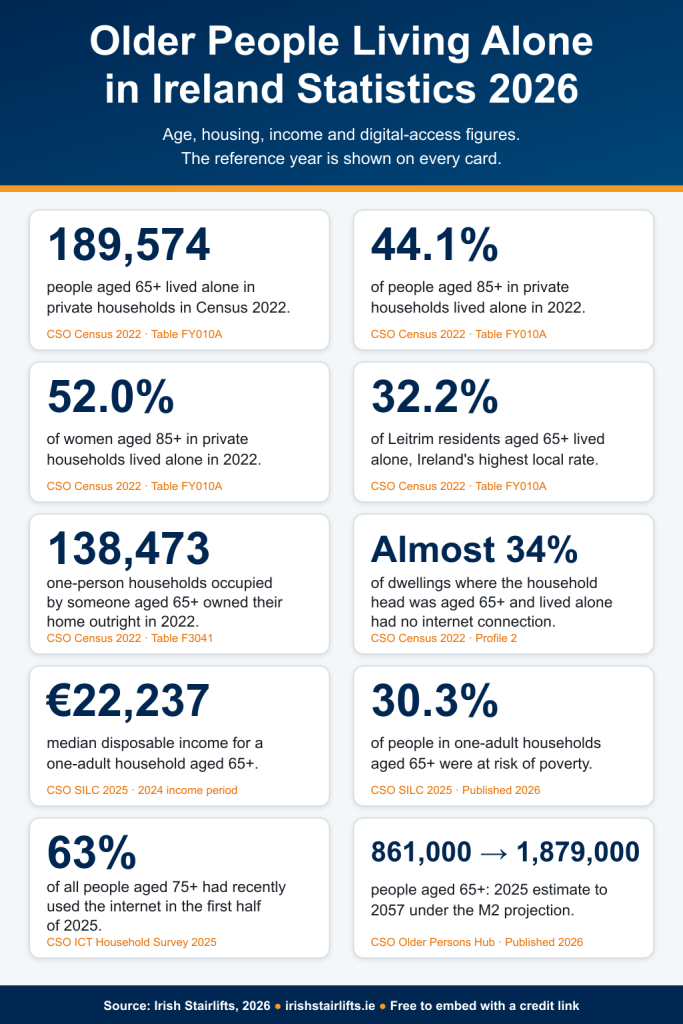
- In Census 2022, 189,574 people aged 65 and over lived alone in private households, according to CSO PxStat table FY010A.
- Among people aged 85 and over in private households, 44.1% lived alone in Census 2022.
- More than half of women aged 85 and over, 52.0%, lived alone in Census 2022.
- Leitrim had the highest rate among the 31 local-authority areas in the CSO table, with 32.2% of residents aged 65 and over living alone in Census 2022.
- 138,473 one-person households occupied by someone aged 65 and over owned their home without a mortgage or loan in Census 2022.
- Almost 34% of dwellings headed by a person aged 65 or over who lived alone had no internet connection in Census 2022.
- The median nominal household disposable income for a one-adult household aged 65 or over was €22,237 in SILC 2025, with income referring to 2024, according to the CSO income table.
- In SILC 2025, 30.3% of people in one-adult households aged 65 or over were at risk of poverty, the CSO reported.
- In the first half of 2025, 63% of all people aged 75 and over had recently used the internet, according to the CSO ICT Household Survey.
- Under the CSO’s M2 projection scenario, Ireland’s population aged 65 and over could reach 1,879,000 in 2057, according to the Older Persons Information Hub.
Free to embed. Please credit Irish Stairlifts with a link to this page: https://irishstairlifts.ie/older-people-living-alone-in-ireland-statistics/
The number of older people living alone in Ireland
The main national benchmark comes from the CSO’s Census 2022 household tables. They count people living alone in private households, so they do not include residents of nursing homes or other communal establishments.
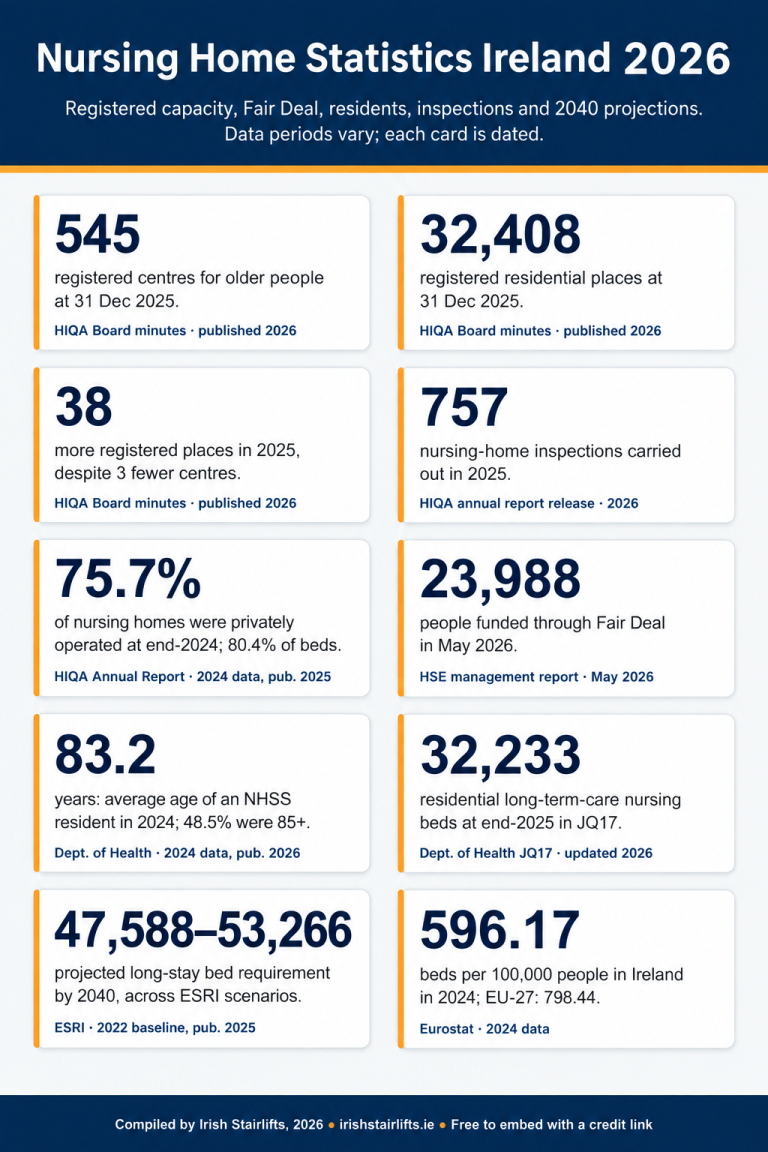
Because these living-alone totals exclude communal establishments, our nursing home capacity figures provide separate context on r
egistered residential places and the age profile of Fair Deal residents
In Census 2022, 189,574 people aged 65 and over lived alone. That represented 25.9% of everyone aged 65 and over living in private households.
The total becomes smaller as the age threshold rises, but the proportion living alone increases. There were 144,366 people aged 70 and over living alone, equivalent to 28.9% of that age group in private households.
Among people aged 75 and over, 100,209 lived alone. They made up 33.1% of everyone aged 75 and over in private households.
The CSO recorded 60,856 people aged 80 and over living alone, representing 38.9% of that age group. Among people aged 85 and over, 30,072 lived alone, and the share reached 44.1%.
These age categories overlap. The figure for people aged 85 and over is contained within the figures for each lower threshold, so the counts should not be added together.
How living alone changes with age and sex
Women were more likely than men to live alone at both age thresholds available in the selected CSO table. Among men aged 65 and over in private households, 21.3% lived alone in Census 2022. The equivalent rate among women aged 65 and over was 30.2%.
The difference was wider at older ages. Among men aged 85 and over, 32.1% lived alone. Among women in the same age group, the rate was 52.0%.
The Census figures describe living arrangements, not support needs. A person who lives alone may have frequent family contact, paid care, community support or no regular assistance. The data also cannot show whether living alone is a preference or the result of bereavement, separation, housing circumstances or another factor.
Marital-status data provides some additional context for people aged 70 and over, although being single and living alone are not the same thing. Among people aged 70 and over in one-person private households, 84,758 were widowed, 34,825 were single, and 19,410 were separated or divorced in Census 2022.
A further 5,373 people aged 70 and over who lived alone reported being married or in a same-sex civil partnership. The Census table does not establish why a spouse or partner was not resident in the same household, so no reason should be inferred from the figure.
How the number has changed and where rates are highest
The number of people aged 65 and over living alone has increased across the last three censuses covered by the CSO series. There were 136,295 people aged 65 and over living alone in Census 2011, rising to 156,799 in Census 2016 and 189,574 in Census 2022.
The increase in the count does not mean the percentage of older people living alone rose at the same pace. Population growth and changes in the size of the older population affect the total, which is why counts and rates need to be reported separately.
There was also substantial variation across the 31 local-authority areas in the CSO table. Leitrim had the highest rate, with 32.2% of people aged 65 and over in private households living alone. Fingal had the lowest rate at 20.1%.
Areas with the largest numbers were not always those with the highest rates. Dublin City had 22,654 residents aged 65 and over living alone. Cork County had 13,559 residents aged 65 and over living alone. Cork City is a separate local-authority area in the underlying table.
Local figures can help journalists, local authorities and community organisations identify where large numbers of older people live in one-person households. They do not provide a direct measure of loneliness, disability, unmet care needs or demand for a particular home adaptation.
Housing circumstances of older people living alone
Home ownership was the most common tenure among one-person households occupied by someone aged 65 or over in Census 2022. The CSO recorded 138,473 such households as owner-occupied without a mortgage or loan. Another 7,346 were owner-occupied with a mortgage or loan, while 30,204 were rented.
Ownership does not show whether a home is warm, affordable, accessible or suited to a resident’s mobility. It indicates tenure only. Likewise, the aggregated rented figure should not be divided into private, local-authority or other landlord types without using a table that provides that breakdown.
For a wider national view of tenure, renting and social housing among older households, see our older people’s housing statistics.
Dwelling type adds another part of the picture. In Census 2022, 84,579 one-person households occupied by someone aged 65 and over were detached houses. A further 14,318 were flats or apartments in purpose-built blocks.
These categories do not establish whether a dwelling has more than one storey, contains a staircase or provides lift access. They should therefore be used to describe housing circumstances rather than to estimate how many residents need a stairlift or another adaptation.
ALONE’s service assessments offer a different view of reported adaptation needs, covered in our home accessibility needs statistics.
Digital connectivity is another aspect of living independently at home. The CSO reported that almost 34% of dwellings headed by a person aged 65 or over who lived alone had no internet connection in Census 2022. The source uses the word “almost”, so the figure should not be presented as a more precise 34.0% result.
Living arrangements do not measure disability, so these figures should be considered alongside separate Irish mobility disability statistics from Census 2022.
Income, poverty and deprivation
The newest financial evidence comes from the CSO’s Survey on Income and Living Conditions 2025, published in March 2026. SILC 2025 income figures refer to income received from January to December 2024, rather than income earned during 2025 or 2026.
The median nominal household disposable income for a household composed of one adult aged 65 or over was €22,237 in SILC 2025. After adjusting for inflation using 2019 prices, the median real household disposable income was €18,616.
Income alone does not capture every financial pressure. SILC also measures relative income poverty and whether people experience specified forms of deprivation.
In SILC 2025, 30.3% of people in households composed of one adult aged 65 or over were at risk of poverty. Being at risk of poverty means having equivalised disposable income below 60% of the national median. This is a survey estimate and should not be converted into a national headcount using the Census living-alone total.
The enforced-deprivation rate for the same household group was 18.3%. Enforced deprivation means experiencing two or more of the 11 deprivation items used by the CSO because the household cannot afford them.
The consistent-poverty rate was 9.6% for people in one-adult households aged 65 or over. Consistent poverty identifies people who were both at risk of poverty and experiencing enforced deprivation. These related measures should not be added together because their populations overlap.
Digital access among older people
Census 2022 provides a figure specifically for older household heads living alone, while the newer ICT Household Survey reports internet use by age. The age-based survey figures cover all people aged 75 and over, not only those who live alone, so they provide context rather than a direct update to the Census living-alone measure.
In the first half of 2025, 63% of people aged 75 and over had used the internet within the previous three months.
At the other end of the measure, 34% of people aged 75 and over had never used the internet in the first half of 2025.
Among recent internet users aged 75 and over, 77% used the internet daily. The denominator matters because this does not mean 77% of everyone aged 75 and over was online every day.
These figures show that digital participation has increased while a substantial offline group remains. Services intended for older residents should therefore avoid assuming that every person can access forms, information or support through an online channel.
Ireland’s ageing population and future context
Ireland’s estimated usual-resident population aged 65 and over was 861,000 in April 2025. This is the whole population aged 65 and over, not the number living alone.
The CSO’s long-term projections indicate how the size of the older population could change under different assumptions. Under the moderate-net-migration M2 scenario, the population aged 65 and over could reach 1,879,000 in 2057.
The 2057 figure is a projection based on Census 2022 and the assumptions of the M2 scenario. It is not an observed outcome or a promise that the population will follow that exact path. It nevertheless provides useful planning context for housing, healthcare, community support and home-adaptation services.
An expanding older population does not mean the number living alone will increase at the same rate. Household formation, health, migration, housing availability, care options and personal preference can all influence future living arrangements.
How we compiled these statistics
We reviewed the sources for this page on 24 August 2026 and linked every numerical claim to a primary CSO release or PxStat table. Living-alone counts, rates, county figures, housing tenure, dwelling type and marital status come from Census 2022 Profile 3. The dedicated household internet figure comes from Census 2022 Profile 2.
Income, poverty and deprivation figures come from SILC 2025, published on 11 March 2026. Its income reference period is January to December 2024, while deprivation questions were collected during 2025. Newer internet-use figures come from the ICT Household Survey carried out in the first half of 2025.
Population context comes from the CSO Older Persons Information Hub updated in April 2026. We treat the April 2025 population estimate as an estimate and the 2057 M2 figure as a scenario projection. We do not turn survey percentages into administrative counts, add overlapping age groups or treat living alone as a measure of loneliness or support needs.
How Irish Stairlifts helps
Living alone does not mean that a person needs a stairlift. For someone who can transfer safely into a seated lift but finds climbing stairs difficult, however, a professionally assessed stairlift can help them retain access to different floors of their home.
Irish Stairlifts supplies straight and curved stairlifts across Ireland, with a free site survey and options for different staircase layouts. A home assessment can establish whether a stairlift is appropriate, how it can be positioned and what alternatives may need to be considered. A stairlift does not replace healthcare, personal assistance or community support.
For the service side of remaining at home, our Irish home support statistics bring together HSE hours, recipients and waiting-list figures.
Related statistics
For additional evidence about mobility and home safety, see our roundup of falls among older people in Ireland statistics.
Related Post
categories
- Accessible Bathrooms 20
- Grants & Funding 8
- ISB Mobility 6
- Mobility Aids 42
- Outdoor & Independence Solutions 44
- Seating Solutions 10
- Stairlifts & Home Lifts 36
- Statistics 9