
Outdoor Stairlifts in Ireland: What to Know Before You Buy
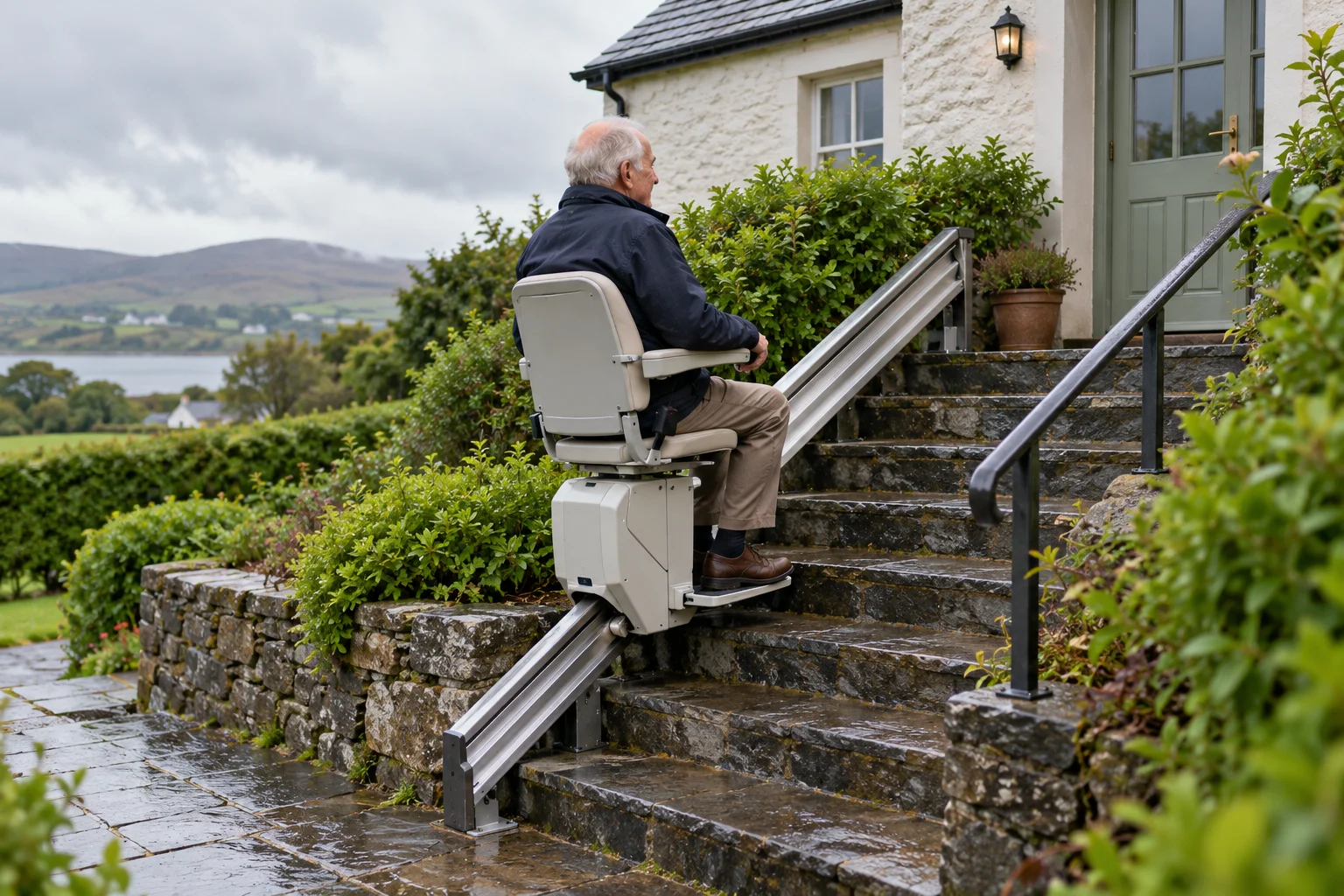

An outdoor stairlift is a stairlift built to live outside, on garden steps, the steps up to a front door or an external stairway. It makes sense when the steps are too many or too steep for a ramp, and when the person can still sit and transfer to a seat safely. In Ireland the big questions are the weather, the ground the rail sits on and whether there is room at the top and bottom. Every outdoor job is different, so outdoor stairlifts are priced after we survey the steps.
Key takeaways
- An outdoor stairlift for steps suits long or steep flights where a ramp would be far too long or simply would not fit.
- For two or three steps, a concrete ramp, half steps or a good pair of rails is often the simpler answer.
- Wheelchair users who cannot transfer to a seat usually need a platform lift instead.
- Outdoor models are built to cope with rain, with covers and protected controls. Ask how the lift is protected when it is parked.
- A survey checks the number of steps, the gradient, landing space, power and the ground. Price follows the survey.
When an outdoor stairlift makes sense
We usually suggest an outdoor stairlift in situations like these:
- Steep garden steps between the house and the road, common on hillside sites around the country.
- A long flight to the front door, where the house sits well above or below the footpath.
- Houses on a slope where the back garden, the clothes line or the car is down a set of steps.
- External stairs to an upstairs flat or apartment, if the owner or management company agrees.
- Someone who can walk short distances indoors but finds steps, especially going down in the wet, frightening.
It is less suitable where the person cannot get on and off a seat safely, where a wheelchair needs to come too, or where the steps are only a short rise. In those cases one of the alternatives below is likely to be better value.
Outdoor stairlift or something else?
Before committing, compare the main ways of dealing with outside steps:
| Option | Best for | Things to weigh up |
|---|---|---|
| Outdoor stairlift | Longer or steep flights; people who can sit and transfer | Needs landing space and power; priced after a survey |
| Concrete ramp | Short rises, wheelchair users, walkers | Needs a lot of length: we recommend a 1:20 fall where space allows, as steep as 1:12 where it is tight |
| Half steps and rails | People who can still manage steps with support | Lowest cost; no power; relies on the person staying steady |
| Platform lift | Wheelchair users who cannot transfer | Larger footprint; carries the person in the chair |
A ramp is the classic answer for a few steps at the door. Ours are bespoke, brush-finished anti-slip concrete with a level turning platform at the top, as described on our concrete ramps page. The catch is length: a 1:20 fall means 20 metres of ramp for every metre of height. On a steep site that eats the whole garden, and that is when a lift starts to make sense.
If the person can still manage steps with a little help, half steps and outdoor rails may be all that is needed. For wheelchair users who cannot transfer, look at platform lifts instead.
Built for Irish rain
An outdoor stairlift spends its life in wind, rain and the odd frost, so it is built differently from an indoor model. Without getting into any one model’s specification, here is what to look for and ask about:
- A weather cover that goes over the chair when it is parked. Get into the habit of using it.
- Protected controls, sealed against rain, with a key switch so neighbours’ children cannot play with it.
- Materials that resist rust on the rail and fixings.
- A seat that dries quickly or can be wiped down before use.
- Remote call controls at the top and bottom, so the chair can be sent where it is needed and parked under cover.
- Battery power, charged from the mains, so a power cut does not leave someone stranded halfway.
Most of the general safety points, such as seat belts, safety sensors and a swivel seat, are the same as indoors. Our guide to stairlift safety features covers them.
What we check at the survey
Outdoor surveys take a little longer than indoor ones. We look at:
- The number of steps and the overall rise, from the bottom to the top landing.
- The gradient and shape of the flight. Straight runs are simpler. Bends, turns or changes in pitch mean a made-to-measure rail.
- Landing space at the top and bottom so the person can get on and off safely, ideally on level, firm ground.
- A power socket nearby, usually an outdoor socket fitted by an electrician, to keep the battery charged.
- Ground conditions. The rail needs a sound base. Loose slabs, crumbling concrete or soft ground may need repair first.
- Gates, paths and drainage, so the chair has a clear run and water does not pool where people step off.
- Who else uses the steps, such as the postman, visitors or family, so the parked chair is not in the way.
We then give a written price for that set of steps. If you want a feel for indoor stairlift prices first, our guide to stairlift costs in Ireland sets out what we charge for straight and curved models.
Looking after an outdoor stairlift
Outside, a stairlift works harder, so a little care pays off:
- Keep the cover on when it is not in use.
- Brush leaves, grit and moss off the rail and steps regularly, especially in autumn.
- In frosty weather, grit the landing areas, not the rail itself.
- Use it regularly so the battery stays charged and any fault shows up early.
- Book regular servicing. Outdoor parts are exposed to more wear than indoor ones.
If anything goes wrong, our engineers are usually with you within 24 hours, and extended warranty packages of 4, 5 and 10 years are available.
Can a grant help?
Possibly. The council grants for older and disabled people cover adaptations that help someone get around their home. Citizens Information lists stair-lifts and ramps among the work the Mobility Aids Grant can cover. Whether an outdoor lift qualifies in your case is a decision for your local county council, usually based on an OT assessment. Remember that no work can start before written approval. Our grants information page explains the schemes.
Frequently asked questions
Will an outdoor stairlift work in the rain?
Yes. Outdoor models are designed for wet weather. Using the cover when parked and drying the seat before sitting down keeps it comfortable and reliable.
Can an outdoor stairlift go round a corner?
Yes, on many sites. A flight with a bend or a change in direction needs a made-to-measure rail, which we confirm at the survey.
Does it need planning permission?
We cannot give a blanket answer for every property. For a listed building, an apartment block or a shared stairway, check with the council or the management company before ordering.
How much does an outdoor stairlift cost?
It depends on the length, the shape of the steps and the groundwork needed, so we price outdoor stairlifts after surveying the steps. The survey is free.
Talk to us
If steps outside the house are keeping someone indoors, we can come out, look at them with you and tell you plainly whether a lift, a ramp or rails is the better fit. Book a free home survey through our quotation form or call us on 045 892 696. Family abroad can deal with us by email, and our showroom in Clane, Co Kildare, is open by appointment.
Related Post
categories
- Accessible Bathrooms 20
- Grants & Funding 8
- ISB Mobility 6
- Mobility Aids 42
- Outdoor & Independence Solutions 44
- Seating Solutions 10
- Stairlifts & Home Lifts 37
- Statistics 10