
Shower Chair, Stool or Wall-Mounted Seat: Which Is Right for You?
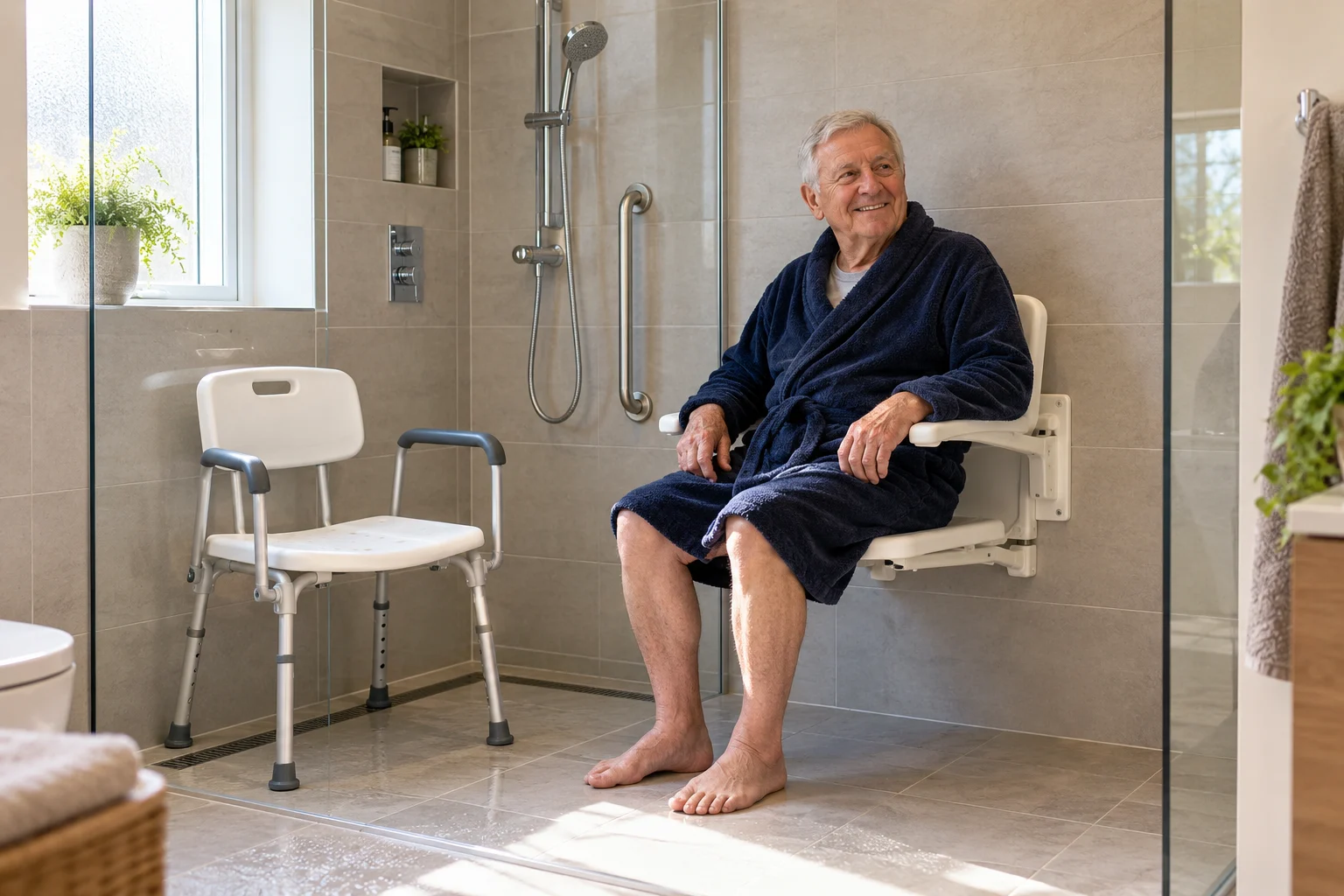

When it comes to a shower chair vs a shower stool vs a wall-mounted seat, the right choice depends on how much support the person needs, how much space the shower has and whether you can drill the wall. A chair with a back and arms gives the most support. A stool is compact and simple. A wall-mounted seat folds out of the way and leaves the floor clear, but it needs a solid wall. This guide helps you match the seat to the person and the bathroom.
Key takeaways
- Choose a chair with a back and arms if the person tires easily, has poor balance or needs help standing up.
- A stool suits someone who is fairly steady and just needs to sit down to wash, or a small shower tray.
- Wall-mounted seats fold away and keep the floor clear, which suits shared bathrooms and wet rooms, but they need a solid wall and proper fixing.
- Measure the shower floor and check the seat height before you buy. Feet flat, knees roughly level with the hips is a good rule.
- Always check the maximum user weight on the product itself, and check fixings and feet regularly.
At a glance: the three types compared
| Free-standing chair | Stool | Wall-mounted seat | |
|---|---|---|---|
| Stability | Good, with four feet and a wide base | Good on a level floor; less to lean on | Very good once properly fixed |
| Space needed | Most | Least | None when folded up |
| Back and arm support | Usually a back, often arms | None, or a small handle | Options with back and arms |
| Folds away | Some fold for storage | Small enough to move aside | Yes, folds up against the wall |
| Needs fixing to the wall | No | No | Yes, into a solid wall or proper backing |
| Shower tray | If the tray is big enough | Yes, good for small trays | Yes, if the wall suits |
| Bath | Only bath-specific seats | Not usually | No |
| Wet room or level-access shower | Yes | Yes | Yes, ideal |
For a bath, a bath board or bath seat is a different product. If climbing into the bath is the problem, it is usually time to look at a level-access shower instead.
Free-standing chairs
A free-standing chair has four legs, a seat and usually a back, and often arms. It is the most supportive option you can simply put in the shower without any fitting. The arms give something to push on when standing up, and the back lets the person rest while they wash. Our free-standing shower chair is a good example.
Best for: someone recovering from surgery, someone with poor balance or low stamina, and anyone renting or unable to drill the walls.
Watch out for: the footprint. In a small tray the chair may leave too little room for feet, or for a carer to help.
Shower stools
A stool is a seat on legs with no back. It takes up very little room and is easy to lift in and out. Some have a cut-out or handle to help with washing and moving. We stock a range of stools alongside our chairs.
Best for: someone who is fairly steady but cannot stand for long, and small shower trays.
Watch out for: the lack of a back and arms. If the person sways or needs to push up from something, a stool alone is not enough.
Wall-mounted seats
A wall-mounted seat is fixed to the shower wall and folds up when not in use. That keeps the floor clear for other people in the house, and it suits wet rooms and walk-in showers very well. There are several styles:
- A simple wall-mounted folding shower seat, for people who just need somewhere to sit.
- A wall-mounted seat with back, arms and legs, where the legs add support down to the floor.
- A padded wall-mounted seat with back and arms, for extra comfort on longer showers.
Best for: long-term use, shared bathrooms, wet rooms and level-access showers.
Watch out for: the wall. A wall-mounted seat must be fixed into solid masonry, or into studs or a timber backing behind plasterboard. If the wall cannot take it, choose a free-standing chair. You can browse every option in our shower chairs and seats.
How to choose a shower seat: height, weight and measuring
Seat height
Have the person sit on a kitchen chair and measure from the floor to the back of the knee. That is close to the seat height they need. With the right height, their feet sit flat on the floor and their knees are roughly level with their hips, which makes standing up easier. Many free-standing chairs and stools have adjustable legs.
As a reference point, the 2022 Technical Guidance Document M shows a tip-up seat at 480 mm above the floor in its example of an accessible shower room for public buildings, with shower controls between 750 mm and 1000 mm. These figures are for public buildings, not homes, so treat them as a guide only.
Weight capacity
Every seat has a maximum user weight. It varies by model, so check the product specification and leave a sensible margin. For a wall-mounted seat, the limit also depends on the wall and the fixings.
Measuring the shower
- Measure the width and depth of the shower floor or tray.
- Check where the drain is. Chair feet should not sit on or block it.
- Measure the space in front of the seat for the person’s feet, and for a carer if one helps.
- Check that the shower controls and handset can be reached from the seat.
- For a wall-mounted seat, check the wall type and that pipes or cables are not in the way.
Using a seat in a level-access shower
A level-access shower, with no step and no tray lip, is the easiest place to use any of these seats. A free-standing chair can be pushed in without lifting, and a wall-mounted seat folds down where it is needed. Many families fit a level-access shower as a long-term fix, often with a fold-down seat and grab rails. Our walk-in showers page explains how it works. Citizens Information lists an accessible shower among the works the Mobility Aids Grant can cover, which may help with the cost.
Safety checks
- Non-slip feet: make sure all four rubber feet are in place and not worn. Replace them if they split.
- Level legs: on a sloped wet room floor, adjust the legs so the seat sits level and does not rock.
- Drain the legs: water can collect inside hollow legs. Tip the chair to drain it and let it dry between uses.
- Check fixings: wall-mounted seats should be checked for any movement every few months.
- Clean regularly: soap and mould build up on seats and under feet.
- Rails within reach: a grab rail beside the seat helps with standing up.
Frequently asked questions
Is a shower chair or a shower stool safer?
For someone with poor balance, a chair with a back and arms is usually safer because it gives support on more sides. A stool suits people who are steadier on their feet.
Wall-mounted vs free-standing shower seat: which is better?
Wall-mounted seats fold away and do not move once fitted, but they need a suitable wall. Free-standing seats need no fitting and can be moved, but they take up floor space.
Can I fit a wall-mounted seat to a plasterboard wall?
Not to plasterboard alone. It must be fixed into studs or a solid backing, or into masonry. If in doubt, have it fitted professionally.
Can a shower seat be used in a bath?
Not usually. Baths need a bath board or a bath seat designed to sit on or in the bath.
Talk to us
Not sure which seat suits your bathroom? We can advise, and if a level-access shower makes more sense we can survey for that too. Book a free home survey through our quotation form or call us on 045 892 696. Family abroad can deal with us by email, and our showroom in Clane, Co Kildare, is open by appointment.
Related Post


categories
- Accessible Bathrooms 22
- Grants & Funding 8
- ISB Mobility 6
- Mobility Aids 42
- Outdoor & Independence Solutions 44
- Seating Solutions 10
- Stairlifts & Home Lifts 37
- Statistics 12