Stroke Statistics Ireland 2026: 6,581 Principal-Diagnosis Hospital Cases in 2024

Sources reviewed 18 November 2026 · Estimated reading time: 12 minutes · Human written and fact checked against each named source
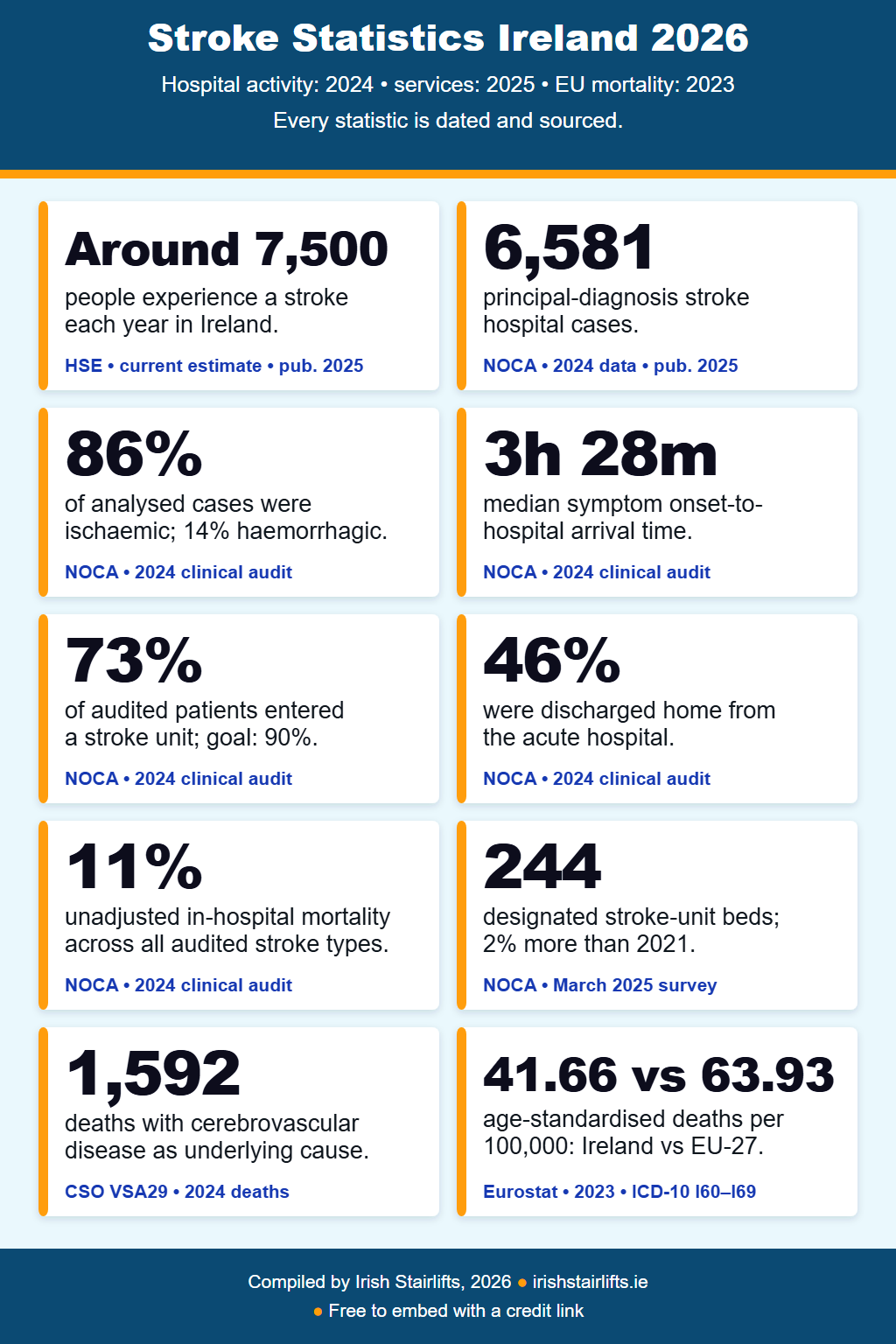
Stroke affects thousands of people in Ireland each year and can change mobility, communication, independence and the support a person needs after leaving hospital. The HSE estimates that around 7,500 people experience a stroke annually, while the newest published national clinical audit recorded 6,581 principal-diagnosis hospital cases in 2024.
Those figures measure different things and should not be treated as a contradiction. This roundup was prepared in 2026, but its newest hospital activity and mortality figures cover 2024, its organisational data describe services in 2025, and its comparable European mortality rates cover 2023.
Key stroke statistics at a glance
- The HSE estimates that around 7,500 people experience a stroke each year in Ireland and that about 90,000 live with disability or other effects of stroke, according to its stroke awareness campaign.
- Irish acute hospitals recorded 6,581 cases with a principal diagnosis of stroke in 2024, according to the national stroke audit.
- NOCA analysed care for 6,156 patients, with national audit coverage of 94.9% across the 24 participating hospitals in the 2024 clinical data.
- 86% of analysed cases were ischaemic and 14% were haemorrhagic in the national case mix.
- Men represented 58% of audited patients and had an average age of 70, while women represented 42% and averaged 74 in the patient demographics.
- The median time from symptom onset to hospital arrival was 3 hours 28 minutes, and 57% of cases with usable timing data arrived within 4.5 hours in the emergency care findings.
- 73% of audited patients were admitted to a stroke unit, below the 90% target stated in the stroke unit indicators.
- 46% of audited patients were discharged home, including 11% discharged with Early Supported Discharge, according to the hospital outcomes.
- Unadjusted in-hospital mortality was 11% across all audited stroke types, with separate rates of 8% for ischaemic cases and 31% for haemorrhagic cases in the outcome table.
- In 2023, the age-standardised cerebrovascular-disease death rate was 41.66 per 100,000 in Ireland, compared with 63.93 across the EU-27 in the Eurostat dataset.
Stroke Statistics Ireland 2026 Infographic
How many strokes are recorded in Ireland?
The HSE uses an estimate of around 7,500 people experiencing stroke each year and estimates that about 90,000 people live with disability or other effects of stroke. These are deliberately approximate national figures in the HSE’s public awareness material. The page does not publish a calculation method beside them, so the qualifiers “around” and “about” must remain attached.
Hospital activity provides a different view. The NOCA report recorded 6,581 cases with a principal diagnosis of stroke across the 24 acute hospitals providing stroke care in 2024. NOCA analysed additional clinical information for 6,156 patients after applying its inclusion and exclusion criteria.
The report also gives a broader hospital count of 6,882 cases with either a principal or hospital-acquired diagnosis of stroke. This was 13% higher than the comparable 6,089 cases in 2021. It should not be substituted for the 6,581 principal-diagnosis total because the definitions differ. The increase is descriptive and does not, on its own, identify a cause.
Audit coverage was 94.9%, based on 6,532 INAS records among 6,882 eligible HIPE cases. Coverage measures how completely clinical audit data were captured. It does not mean that the audit included 94.9% of every stroke occurring in the community.
Stroke type, age and sex
Among the 6,156 analysed cases, 86% were ischaemic strokes, equal to 5,274 patients, while 14% were haemorrhagic strokes, equal to 882 patients. These proportions describe the hospital audit cohort and should not be extended to people who were not admitted or did not meet the audit criteria.
Men made up 58% of audited patients and women made up 42%. The average age was 70 for men and 74 for women in the NOCA demographic profile. The report found that 33% of male patients were aged 65 or younger, compared with 23% of female patients.
These figures show the composition of the audited patient group. They are not age-standardised stroke rates for all men and women in Ireland. A higher share or count in one group cannot be interpreted as an individual risk without suitable population denominators and adjustment for age.
Arrival times and emergency treatment
For patients with usable timing data, the median interval from the onset of symptoms to hospital arrival was 3 hours 28 minutes. A total of 1,956 patients, or 57%, arrived within 4.5 hours of symptom onset in the emergency care analysis. Symptom-onset fields had the highest level of missing data, so that percentage should not be applied to the full audit cohort.
Once patients reached hospital, 53% were reviewed by a medical team within 10 minutes, up from 48% in 2021. A total of 50% received brain imaging within 60 minutes, compared with 48% in 2021. These measures describe hospital processes after arrival, not the complete interval between the beginning of symptoms and treatment.
Among ischaemic audit cases, 531 patients, or 11%, received thrombolysis. Of patients who received it and had the relevant timing information, 52% were treated within 60 minutes of arrival. A further 497 ischaemic cases, or 10%, received thrombectomy. Eligibility depends on stroke type, timing, imaging and clinical circumstances, so neither treatment percentage should be presented as the share of all patients who should have received the intervention.
This article is a statistical reference, not medical advice. The HSE advises calling 112 or 999 immediately when stroke is suspected and explains the FAST signs in its national campaign.
Stroke-unit care and clinical checks
Stroke-unit access is a central quality measure in the national audit. In 2024, 73% of audited patients were admitted to a stroke unit, up from 70% in 2021 but below the 90% goal cited in the NOCA indicators. Patients spent 69% of their acute-hospital stay in a stroke unit, also below the 90% goal.
Admission to a stroke unit and the share of a hospital stay spent there are separate measures. A patient may enter a stroke unit for part of the admission while spending other days elsewhere in the hospital.
Clinical checks also varied. 81% of audited patients received a swallow screen, an increase from 68% in 2021. The separate rate for screening within four hours should not be used as a trend because the underlying data element changed in 2024. The report found that 83% received new or altered antithrombotic therapy on the same or next day, while 91% of relevant patients with atrial fibrillation were prescribed anticoagulants for secondary stroke prevention.
Rehabilitation and multidisciplinary assessment
The audit recorded high referral levels for several rehabilitation disciplines. 88% of patients were assessed by a stroke nurse specialist, 93% were referred to physiotherapy, and 90% were referred to occupational therapy. A further 67% were referred to speech and language therapy in the multidisciplinary results.
Referral does not show how much treatment a patient received or whether everyone needed the same service. The report separately noted that 29% were assessed by a dietitian, 24% by a medical social worker and 5% by a psychologist. Those percentages should not be used as estimates of how common nutritional, social or psychological needs are among stroke survivors.
The figures nevertheless show that stroke care involves more than an acute medical intervention. Assessment and rehabilitation can involve nursing, physiotherapy, occupational therapy, communication support, nutrition, social work and psychological services, depending on individual needs.
Length of stay, discharge and hospital outcomes
The average acute-hospital stay was 17 days in 2024. Patients spent an average of 13 days in a stroke unit, according to the outcome indicators. These averages describe the acute episode and do not follow the complete pathway through later rehabilitation, another hospital or community services.
At acute-hospital discharge, 46% of patients went home. This included 11% discharged through Early Supported Discharge, a pathway that allows suitable patients to continue specialist rehabilitation at home. A further 7% were discharged to long-term care. Destination at the end of the acute episode does not necessarily describe where a person lives later.
Unadjusted in-hospital mortality was 11% across all audited stroke types. The separate rates were 8% for ischaemic stroke and 31% for haemorrhagic stroke. These figures describe deaths during the audited hospital episode. They are not 30-day or one-year mortality rates, and they are not adjusted for age, severity or other differences in case mix. The two stroke-type rates should therefore not be compared as if the patient groups were otherwise identical.
Stroke-service capacity and staffing
All 24 hospitals providing acute stroke care had a dedicated stroke unit in the 2025 organisational survey. Two hospitals provided a 24/7 thrombectomy service. Across the system, there were 244 designated stroke-unit beds, only 2% more than the 239 recorded in 2021, while the broader hospital stroke count had risen 13% by 2024.
The reporting periods differ, with admissions measured in 2024 and beds surveyed in 2025. They can provide service context, but they should not be turned into a direct bed-per-admission calculation without a matched time period and information about occupancy and patient flow.
The organisational audit found staffing below recommended levels in every listed discipline. The deficits were 31% for nursing, 48% for physiotherapy, 54% for occupational therapy, 23% for speech and language therapy, 65% for dietetics, 74% for psychology and 76% for medical social work. These are gaps against recommended staffing levels, not vacancy rates and not the percentage of patients who received no care.
Cerebrovascular deaths in Ireland
Final CSO data show that 1,592 deaths occurring in 2024 had an underlying cause within the cerebrovascular-disease group, ICD-10 I60 to I69. The total comprised 725 male and 867 female deaths. It was calculated by summing the detailed codes in CSO table VSA29, with no rounding.
Cerebrovascular diseases include strokes and related cerebrovascular causes. The 1,592 total should not be labelled as the number of people who experienced stroke, the number admitted to hospital or a count of everyone who died after ever having a stroke. Cause-of-death statistics record the underlying cause assigned through the death-registration system.
Ireland in EU context
Eurostat provides a matched mortality indicator for comparing Ireland with the EU-27. In 2023, the age-standardised death rate for cerebrovascular diseases was 41.66 per 100,000 residents in Ireland and 63.93 per 100,000 across the EU-27, based on the same Eurostat measure.
Both figures cover residents of all ages and both sexes, use ICD-10 I60 to I69, and are adjusted to a standard age distribution. That makes them more comparable than raw national death counts. The indicator still measures mortality from the broader cerebrovascular-disease group, not stroke incidence, hospital admissions or quality of care. It does not establish Ireland’s rank among EU countries, and the difference should not be attributed to one policy, treatment or population characteristic.
Methodology and sources
This roundup was prepared on 18 November 2026 from primary data published by NOCA, the HSE, the CSO and Eurostat. The main clinical source was NOCA’s report published on 5 November 2025. Its clinical audit covers patients discharged from qualifying public acute hospitals between 1 January and 31 December 2024. Its organisational survey covers all 24 hospitals providing acute stroke care in March 2025.
NOCA included ischaemic and haemorrhagic stroke patients in hospitals with at least 80% coverage and more than 25 annual stroke admissions. National clinical-audit coverage was 94.9%. The audit follows care to acute-hospital discharge and does not describe the full later recovery pathway. Its hospital outcomes are administrative audit results rather than survey estimates and do not have sampling margins of error.
The HSE’s annual incidence and post-stroke impact totals are approximate headline estimates, so this page retains “around” and “about”. CSO mortality data refer to deaths occurring in 2024 and classify the underlying cause. The CSO cerebrovascular total was calculated from the detailed I60 to I69 cells. Eurostat supplies the matched 2023 age-standardised death rates for Ireland and the EU-27.
The publication year in the title is not presented as the data year. Estimated incidence, hospital admissions, analysed audit cases, people living with effects, registered deaths and age-standardised mortality rates remain separate measures throughout.
How Irish Stairlifts helps
Stroke statistics cannot determine whether a stairlift or any other home adaptation is suitable for a particular person. A return home after stroke may involve reviewing mobility, stairs and access barriers as part of a wider assessment led by the person, their family and relevant professionals.
Irish Stairlifts supplies straight and curved models and can assess a staircase, explain available features and provide installation and after-care information. Readers considering home access can explore the company’s stairlift options in Ireland. A stairlift is not a medical treatment and should not replace clinical care, rehabilitation or professional advice about individual mobility needs.
Related Irish statistics
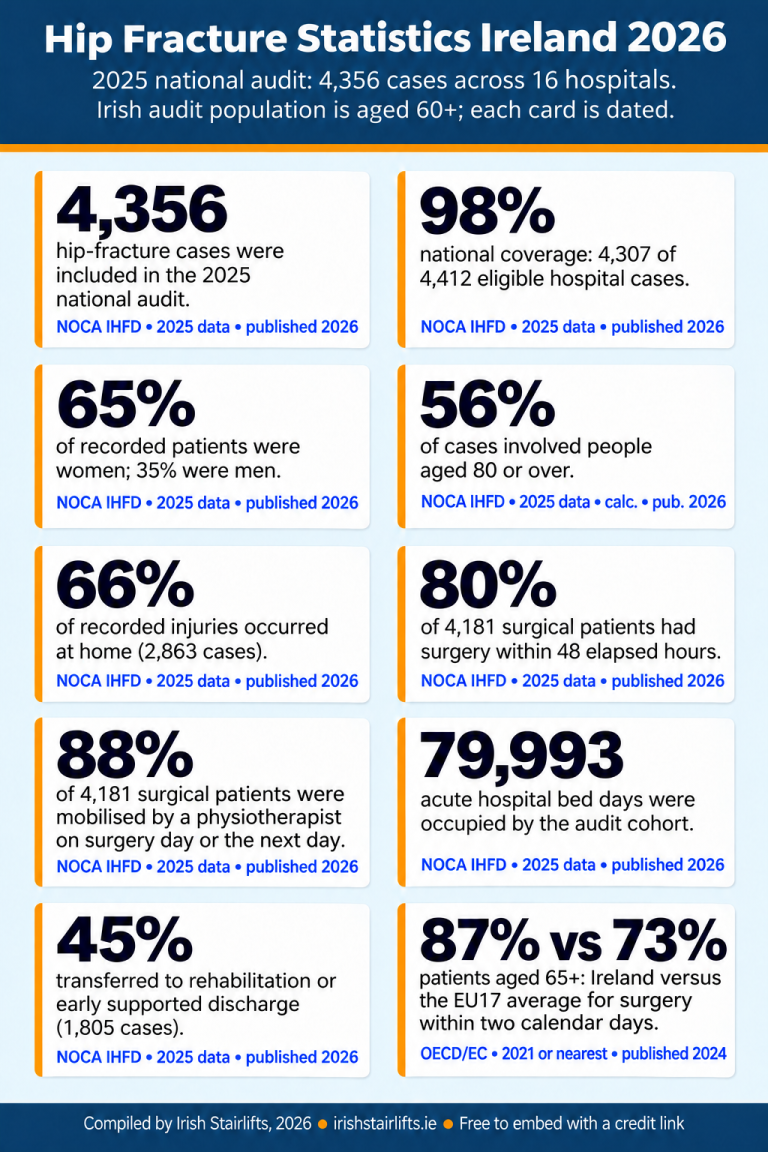
For wider national evidence on walking, climbing stairs and basic physical activities, see our mobility disability statistics. Readers exploring hospital injury and rehabilitation can also review the separate Irish hip-fracture statistics. Each roundup uses its own source definitions, populations and data periods, so their figures should not be combined into a single total.
Related Post
categories
- Accessible Bathrooms 22
- Grants & Funding 8
- ISB Mobility 6
- Mobility Aids 42
- Outdoor & Independence Solutions 45
- Seating Solutions 10
- Stairlifts & Home Lifts 38
- Statistics 14