
Where to Put Grab Rails: A Room-by-Room Guide for Irish Homes
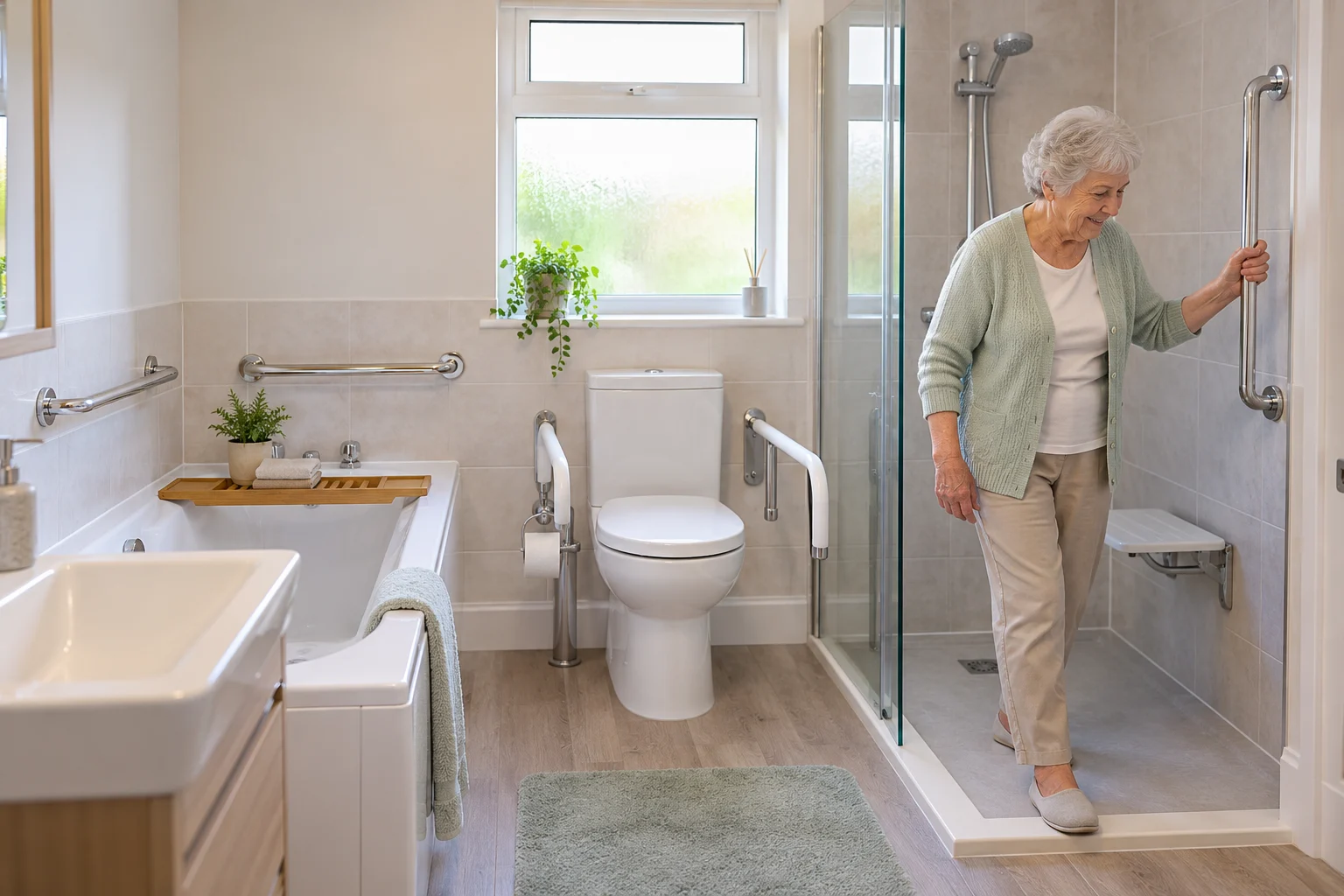

Where to put grab rails depends on one thing above all: where the person’s hands naturally go when they sit down, stand up or step. In most Irish homes that means beside the toilet, at the shower or bath, on the stairs and at the front and back door steps. The right grab rail height is measured to the person, not taken from a chart, which is why an occupational therapist (OT) is worth involving. This guide goes room by room so you know what to look for.
Key takeaways
- Put rails where the person pushes up, pulls up or steadies themselves. Watch them move before you drill.
- Vertical rails help with pulling up and steadying; horizontal rails help with pushing up and lowering down; angled rails sit in between.
- Part M of the Building Regulations sets rail heights for accessible toilets in public buildings, not for private homes. It is a useful reference point, nothing more.
- A rail is only as strong as its fixing. Plasterboard needs proper fixings or a timber pattress behind it.
- Where there is no wall beside the toilet, a hinged drop-down rail with a support leg can do the job.
Vertical, horizontal or angled?
Before deciding where, decide which type. Each one helps with a different movement.
| Type | Helps with | Typical place |
|---|---|---|
| Vertical | Pulling up from sitting and steadying while standing | Beside the toilet, at the shower entrance, by a door |
| Horizontal | Pushing up from sitting and lowering down; leaning while standing | Side wall of the toilet, along the bath, inside the shower |
| Angled | A mix of pull and push as the person rises | Beside the toilet or along the bath |
| Hinged (drop-down) | Push support on the open side, folding away when not needed | Toilets with no side wall, or where a carer needs access |
Length matters too. A longer rail gives more choice of hand position, which suits people of different heights in the same house.
Toilet
The toilet is where most people want a rail first. Ask the person to sit on the toilet and show you where they reach when standing up. Mark that spot.
- Side wall: a horizontal or angled rail at a comfortable push height, starting a little in front of the pan.
- Vertical rail: slightly in front of the pan, for pulling up and steadying once standing.
- Open side: if there is no wall, a hinged rail such as our hinged support rail with leg folds up out of the way when not needed.
For reference, the 2022 edition of Technical Guidance Document M shows horizontal grab rails at 680 mm above the floor in a wheelchair accessible toilet in a public building, with grab rails at least 600 mm long. It also says the wall and fixings should be able to take the load of someone pulling themselves up. TGD M does not set grab rail heights for private homes, so treat these as a starting point and let the OT adjust them for the person.
If standing from the toilet is still hard with rails, a raised seat or one of our toilet seats and frames may help as well.
Shower
- At the entrance: a vertical rail on the wall just inside or beside the opening, to hold while stepping in and out.
- Inside: a horizontal rail on the wall the person faces or leans on while washing.
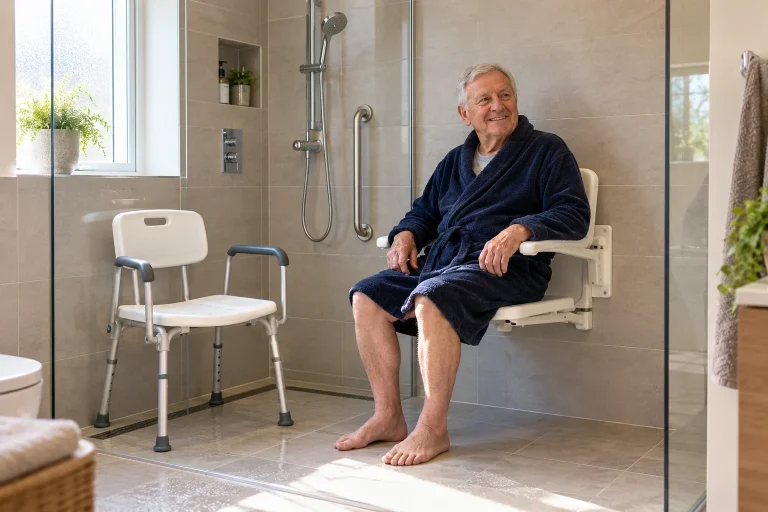
- Near a shower seat: a rail within easy reach of the seat, for standing up after sitting to wash.
Keep rails clear of the shower controls and the screen or curtain. Wet hands slip, so choose rails with a textured or ribbed grip.
Bath
Getting in and out of a bath is one of the hardest jobs for many older people. Common positions are:
- A vertical rail on the wall at the tap end or the entry side, to hold while stepping over the side.
- A horizontal or angled rail along the long wall, to push on while lowering down and getting up.
If climbing over the bath side is no longer safe, rails will only help so much. Our guide to making a bathroom easier to use looks at the next steps, from bath boards to a level-access shower.
Stairs
Most Irish stairs have one banister. A second handrail on the wall side means the person can hold on with both hands going up and coming down, and it gives support on the strong side whichever direction they are going.
- Run it the full length of the flight, starting before the first step and continuing past the last.
- Match the height of the existing banister so both feel the same.
- Choose a round rail that is easy to grip all the way round.
TGD M gives 900 mm to 1000 mm above the pitch line for handrails on stepped approaches to public buildings, which is a useful guide for comparison. When stairs become too much even with two rails, a stairlift is the usual next step.
Front and back door steps
Outside steps are often forgotten until someone slips on a wet night. A rail on one or both sides of the steps, fixed into masonry or set into the ground, makes a big difference. A short vertical rail beside the door frame helps while unlocking the door and stepping over the threshold. Choose rails made for outdoor use that will not rust. Our steps and outdoor rails service covers this, including half steps where the existing ones are too high.
Fixing rails safely
A grab rail that pulls out of the wall is worse than none at all. Whatever you choose:
- Find out what the wall is. Solid block or brick takes standard heavy-duty fixings. Plasterboard on its own will not hold a person’s weight.
- On plasterboard, fix into the timber or metal studs, use fixings made for the job, or have a timber pattress (a backing board) fitted behind the board.
- On tiles, drill carefully to avoid cracking and seal the holes in wet areas.
- Check for pipes and cables before drilling.
- Test it by pulling firmly once fitted, and check it again every few months.
If in doubt, have a competent tradesperson or our team fit it. Grab rails are among the works listed under the Mobility Aids Grant, according to Citizens Information, so if larger adaptations are planned it is worth including them in the application.
Frequently asked questions
What is the right grab rail height?
There is no single height for every home. It depends on the person’s height, the toilet or bath height and how they move. An OT will measure and mark the positions. Part M figures for public buildings, such as 680 mm for horizontal rails beside an accessible toilet, are a reasonable starting point.
Should a grab rail be vertical or horizontal?
Vertical for pulling up and steadying, horizontal for pushing up and lowering down. Beside the toilet many people benefit from one of each, or an angled rail.
Can I put a grab rail on a plasterboard wall?
Not on the plasterboard alone. It needs to be fixed into studs, with suitable fixings, or onto a timber pattress behind the board.
Do I need an OT before fitting grab rails?
Not to buy and fit simple rails privately, but OT advice gets the positions right, and an OT assessment is usually needed if you are applying for a council grant.
Talk to us
Browse our range of grab rails, or if you would like help deciding where they should go, we are happy to advise. Book a free home survey through our quotation form or call us on 045 892 696. Family abroad can deal with us by email, and our showroom in Clane, Co Kildare, is open by appointment.
Related Post


categories
- Accessible Bathrooms 22
- Grants & Funding 8
- ISB Mobility 6
- Mobility Aids 42
- Outdoor & Independence Solutions 44
- Seating Solutions 10
- Stairlifts & Home Lifts 37
- Statistics 12