
Can a Stairlift Be Fitted to Any Stairs? Narrow, Steep and Awkward Staircases
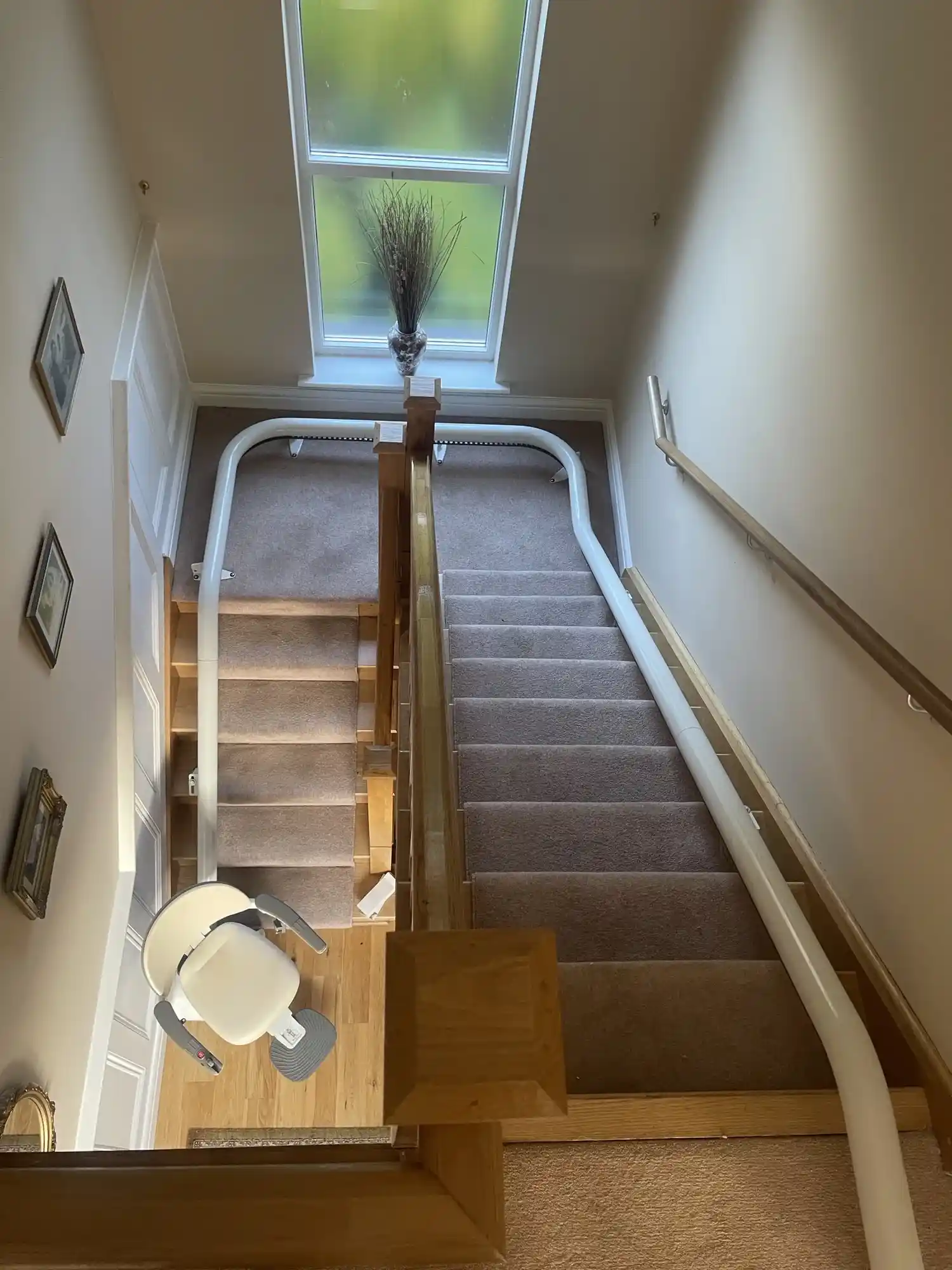

Almost any staircase in an Irish home can take a stairlift. The rail fixes to the stair treads, not the wall, so the age of the house, the wall construction and the finish on the stairs rarely matter. What decides it is the width of the stairs, the shape of the staircase, and how much room there is at the top and the bottom. This guide goes through each of those, with the models we fit and the figures that matter, so you know before the survey whether narrow, steep or awkward stairs are a problem. They usually are not.
Key takeaways
- Stairlifts fit straight, curved, L-shaped, U-shaped and spiral staircases, and staircases with a half-landing. The rail is made to the shape of the stairs.
- As a rule of thumb most straight stairlifts need a clear stair width of around 70 cm (28 inches). Slimmer configurations and curved rails go narrower. We measure and confirm at the free survey.
- Steep stairs are fine. The Access BDD Flow X curved stairlift is rated for inclines up to 72 degrees, far steeper than any normal domestic staircase.
- A door at the foot of the stairs is solved with a hinged or powered folding rail, or a rail that starts on the first step.
- Weight capacities run from 125 kg on the Flow X to 160 kg (25 stone) on the Ergo range.
- Straight stairlifts are usually fitted in a few hours with no structural work. Curved rails are made to measure and take two to five weeks.
How wide do the stairs need to be?
This is the question we are asked most, and the honest answer is that it depends on the model and on who is using it. As a working rule, a straight stairlift needs a clear width of around 70 cm, measured across the tread from the wall to the inside of the banister at the narrowest point. Plenty of older Irish terraces and cottages come in under that, and we still fit them, because the figure moves with the chair. The Ergo chair has a space-saver backrest that sits closer to the wall to give more knee room, the Acorn is a slimline unit that folds flat, and the Ergo Ultimate has an Active Power Swivel that turns the seat during travel to get past a newel post or a pinch point on a narrow staircase.
What matters as much as the width is what is left when the lift is parked. On every model we fit the seat, the arms and the footplate fold away, so the rest of the household walks past on the stairs as normal. If you want a number before we visit, measure the tread at its narrowest point and tell us, along with a photo of the stairs from the bottom. We will tell you on the phone whether it is a straightforward job.
Narrow staircases: what we fit
- Ergo Straight: slim foldaway design, foldaway arms, chair and footplate, adjustable backrest and armrests, 160 kg capacity. The powered footplate means no bending to fold it.
- Acorn 130 Straight: slimline, fixes to the stairs not the wall, folds away when not in use, optional hinged rail at the bottom.
- Access BDD HomeGlide: comfortable fold-away seat, quick installation, 23 stone capacity, optional power folding hinge track.
- Ergo Curve and Ergo Ultimate: for narrow stairs with a turn. Space-saver backrest as standard, and on the Ultimate the Active Power Swivel that adjusts the seat during travel to clear obstacles on narrow staircases.
- Access BDD Flow X: the curved lift customers with tight, twisting stairs ask for by name. Complete automatic folding, an adjustable footrest, and a short-footrest option that brings the chair depth down from 720 mm to 620 mm.
A typical narrow-stairs enquiry we get: eleven steps, a small quarter landing with the hot press and bathroom doors opening onto it, then four more steps, in a house where the stairs are noticeably narrow. That is a curved rail through the landing, and it is a routine job. Another: a narrow staircase with two 90 degree turns in Galway city, where the family had already worked out the Flow X would suit. They were right.
Standing and perch stairlifts for very narrow stairs
An occupational therapist will sometimes recommend a perch or standing stairlift for a very narrow or very steep staircase, or for a tall person who finds bending the knees hard. The user leans against a small padded seat rather than sitting, which needs less room in front of the chair. Whether one suits depends on the stairs, the headroom and the person, so tell us at the survey if it has been suggested and we will advise on the options.
Steep stairs
Most Irish house stairs sit between 35 and 42 degrees. A steep cottage or converted-attic staircase might be 50 degrees or more. None of that troubles a modern stairlift: the Flow X is rated for inclines up to 72 degrees, and the seat stays level throughout because the chair is mounted to the rail, not the steps. What we do check on steep stairs is the headroom at the top, the run-off space at the bottom, and whether a swivel seat is needed so the user gets off facing the landing rather than the drop. A powered swivel is standard on the HomeGlide Extra and the Ergo range and takes that worry away.
Stairs with a turn, a landing or a half-landing
If the stairs bend, turn or have a landing, you need a curved stairlift. One continuous rail is made to measure for your staircase and carries the chair around the turn and across the landing without a break, so the user never has to get off and on again. L-shaped, U-shaped and dog-leg stairs, quarter and half landings, and spiral staircases are all fitted this way. Because the rail is made for the house, curved lifts cost more than straight ones and take two to five weeks from the deposit. Reconditioned curved stairlifts from 4,500 euro use a brand new rail with a tested pre-owned seat and motor.
If only the last few steps turn, ask about a straight rail with a first-step start. The Ergo Ultimate starts on the first step, which avoids an intrusive rail across the hall or a hinge at the foot of the stairs.
Space at the top and bottom
- A door at the foot of the stairs. The rail normally runs past the bottom step so the user gets on from the floor. If that blocks a door, a hinged rail (manual or powered) folds the bottom section up out of the way, or a first-step start keeps the rail on the stairs entirely.
- A narrow hall or a hallway that crosses the stairs. The chair parks folded, and a remote call station lets you send the lift up or down out of the way.
- The landing at the top. The user needs room to swivel and step off onto the landing. A powered swivel seat helps where the landing is tight.
- Power. The lift runs on batteries that charge from a normal socket near the stairs, so it keeps working in a power cut.
Wooden, concrete, carpeted and outdoor stairs
The rail fixes to the treads with brackets, so timber, concrete and carpeted stairs are all fine, and so are plasterboard walls and timber-frame houses, because nothing is fixed to the wall. Carpet stays down. For garden or porch steps there are weatherproof outdoor models, and where the outdoor steps are the real problem we often rebuild them with deeper treads and handrails, or build a ramp, instead. See our steps and rails and wheelchair ramp pages.
Weight limits
- Ergo Straight: 160 kg (25 stone).
- Ergo Curve: 120 kg as standard, with an upgrade to 160 kg. The powered swivel and footplate are rated to 160 kg.
- Ergo Ultimate: 160 kg (25 stone).
- Access BDD HomeGlide and HomeGlide Extra: 23 stone (about 146 kg).
- Access BDD Flow X: 125 kg (275 lb).
The capacity has to exceed the weight of the person using it. If you are near a limit, say so when you enquire and we will steer you to the right model rather than the cheapest one.
What the free survey checks
- The clear width at the narrowest tread, and the shape of the staircase.
- Headroom at the top and run-off space at the bottom.
- Doors, radiators, newel posts and anything else near the rail line.
- The pitch of the stairs and whether a swivel seat is needed.
- Where the charging socket will go.
- What the occupational therapist has recommended, if there is a report, so the quote matches it for a grant application.
A straight stairlift is usually fitted within a few hours, often on the same or the next visit because we carry them in stock. Nothing structural is changed, and the rail can be removed later leaving only small bracket holes in the treads. Surveys and quotes are free anywhere in Ireland.
Frequently asked questions
Can a stairlift be fitted to a narrow staircase?
Yes, in nearly every case. Around 70 cm of clear width is the usual rule of thumb for a straight lift, and slimmer chairs, space-saver backrests and swivelling seats take it lower. Send us the width at the narrowest point and a photo and we will tell you.
Is there a standing stairlift for narrow stairs?
Standing and perch stairlifts exist and are sometimes recommended by an occupational therapist for very narrow or steep stairs, or for tall users. They need less depth in front of the chair but more headroom. Tell us at the survey if one has been suggested.
How steep can the stairs be?
Steeper than any normal house has. The Flow X is rated to 72 degrees, and a domestic staircase is usually 35 to 42 degrees. The seat stays level throughout.
Can a stairlift go around a landing or a corner?
Yes. That is what a curved stairlift is: one rail made to the shape of your stairs, carrying the chair around the turn and across the landing in one trip. It takes two to five weeks to make.
What is the minimum stair width for a stairlift?
There is no single figure across all models. Around 70 cm is a safe rule of thumb for a straight lift, and we have fitted narrower. Measure the tread, not the staircase opening, and measure at the tightest point.
What weight can a stairlift take?
From 125 kg on the Flow X to 160 kg (25 stone) on the Ergo Straight, Ergo Ultimate and the upgraded Ergo Curve. The HomeGlide takes 23 stone.
Does a stairlift work in a power cut?
Yes. The lift runs on batteries that charge at the parking points, so it keeps working through an outage.
Not sure if your stairs will take a stairlift?
Send a photo of the stairs from the bottom and the width at the narrowest tread through the form below, or call 045 892 696. We can give a rough price on the phone for a straight lift and book a free survey anywhere in Ireland for anything with a turn.
Related reading: Straight stairlifts, Curved stairlifts, Stair lift prices in Ireland, Stairlift installation and Straight stairlift rental.
Recent Irish Stairlifts installations
Examples of curved stairlifts fitted to bends, landings and complex staircases:
- curved stairlift installation in Kilcullen, Kildare
- Platinum twin-rail curved stairlift in Dublin 15
- curved stairlift installation in Rathcoole, Dublin 24
- curved stairlift installation in Tullamore, Offaly
- curved stairlift installation in Dublin 16

Take the First Step to Independence
Trusted Mobility & Grant Experts Since 1999
Book Your Free Home AssessmentISB Mobility Showroom – Clane
Unit C5/C6 Clane Business Park
Kilcock Road, Clane, Co. Kildare
Eircode: W91 NF86
045 892 696 | 0818 818 500
showroom@irishstairlifts.ie
Mon–Thu: 9am–5pm | Fri: 9am–4pm
Related Post
categories
- Accessible Bathrooms 20
- Grants & Funding 8
- ISB Mobility 6
- Mobility Aids 42
- Outdoor & Independence Solutions 44
- Seating Solutions 10
- Stairlifts & Home Lifts 36
- Statistics 9