
Managing the Stairs After a Hip or Knee Replacement
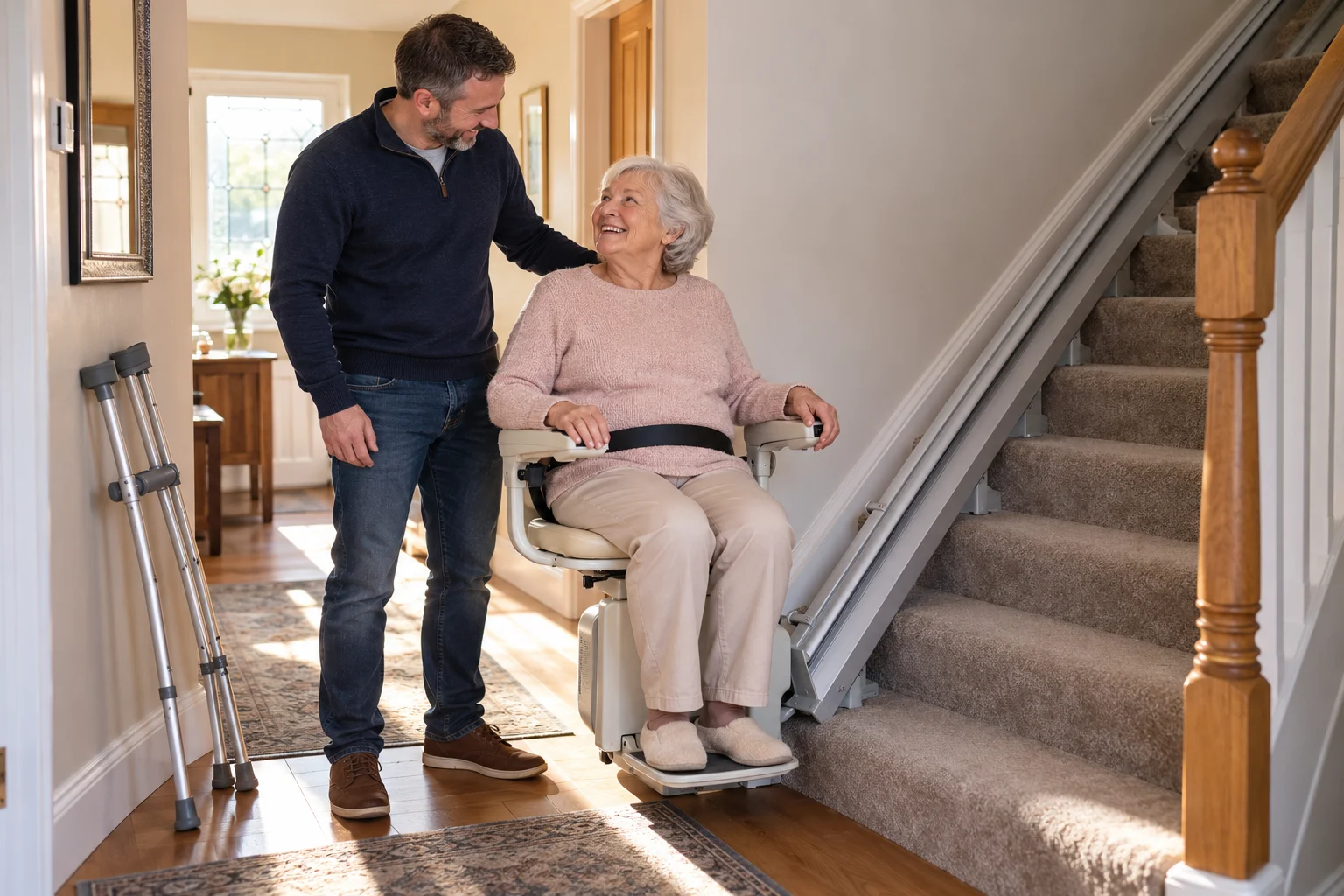

Most people do manage the stairs after a hip or knee replacement, but the first few weeks take planning. Your physiotherapist will usually teach you a simple rule before you go home: lead with your good leg going up and your operated leg going down, one step at a time, holding a rail. If your stairs are steep, you live alone or you had trouble with them before the operation, it is worth sorting out the house before you go in, and for some people a stairlift for the recovery period or longer makes life a lot easier.
This guide is practical, not medical. Your surgeon, physiotherapist and occupational therapist (OT) know your case, so always follow what they tell you.
Key takeaways
- The usual rule on stairs is “up with the good, down with the bad”, one step at a time with a rail, but follow the exact method your physio shows you.
- Plan the house before surgery: where you will sleep, how you will reach a toilet, and which chair you can get up from easily.
- A stairlift can make sense if the stairs were already a struggle, if you live alone, or if a slow recovery is expected.
- For a short recovery, renting a straight stairlift on a monthly plan or buying a reconditioned one can cost far less than a new lift.
- The seat, arms and footplate fold away, so the rest of the family can still use the stairs as normal.
What you are usually taught about stairs
Before you leave hospital, a physiotherapist will normally practise the stairs or a step with you. Cappagh’s own booklet for knee replacement patients lists “to manage stairs if necessary” as one of the physio goals, and says most knee patients go home when they can walk without help and manage steps.
The method most hospitals teach is easy to remember. Patient leaflets from the NHS (for example this easy-read guide to going upstairs after a hip replacement) set it out like this:
- Use the banister or rail if there is one, and take one step at a time.
- Going up: step up with the leg that did not have the operation, then bring the operated leg up to the same step, followed by the stick or crutch.
- Going down: put the stick or crutch down a step first, then step down with the operated leg, then bring the other leg down to the same step (see the matching guide for coming downstairs).
Physios often shorten this to “up with the good, down with the bad”. Your physio may change the method if you have only one rail, two crutches, a weight limit on your leg or a very steep staircase, so use theirs, not ours.
Planning the house before your operation
Cappagh’s hip replacement booklet makes a point worth repeating: with good planning most people manage well at home, and if you are worried you won’t cope, organise help before you come into hospital. The hospital OT can advise you on aids and setting up your home. A few things to sort out in advance:
Where you will sleep
If the only toilet is upstairs, sleeping downstairs may not help much. If there is a downstairs toilet, a bed in the front room for the first few weeks means you only face the stairs when you choose to. Talk it through with the family before the date comes through.
Rails and a second banister
A second stair rail on the open side gives you something to hold with both hands. Rails at the front door step and back door are just as important, because those are the steps you can’t avoid. Our steps and outdoor rails are built for exactly that.
Toilet and seating
Getting on and off a low toilet is hard after a hip or knee operation. A raised seat or a height-adjustable toilet frame helps, and the Cappagh booklet notes that raised toilet seats can be bought from many suppliers. Pick out a firm chair with arms that you can stand up from easily, and move rugs and clutter off the route from bed to bathroom.
When a stairlift makes sense
Plenty of people never need one. Others find that the stairs, not the new joint, are what stop them getting back to normal. The table below is a simple way to think about it.
| Your situation | What often works |
|---|---|
| Stairs were fine before surgery, good support at home, straightforward recovery expected | Rails, a bed downstairs for a while, and your physio exercises |
| Recovery could take a few months, you live alone, or the only toilet is upstairs | A stairlift for the recovery period (rented or reconditioned) |
| Stairs were already a struggle, the other hip or knee also needs doing, or you have other conditions | A stairlift you keep for the long term |
If you are not sure, ask your OT or physio whether the stairs are likely to be a short-term problem or a longer one. That answer usually decides whether to rent or buy.
Renting or buying for a recovery period
Renting a straight stairlift
If you expect to need help for a few months, you can rent a straight stairlift on a monthly plan. It is fitted in the same way as a purchased lift and taken out when you no longer need it. Because we keep straight lifts in stock, it can usually be delivered and fitted the same day or the next day, and the fitting itself takes a few hours. That means it can be in place before you come home, or arranged quickly if recovery is slower than planned.
Buying reconditioned
If you think you may need it for longer, or a second joint is on the way, a reconditioned straight stairlift starts from €1,400 + VAT. A new straight stairlift supplied and installed with a 2-year warranty starts from €2,300 + VAT. Curved staircases need a lift made to measure, which takes 2 to 5 weeks from the deposit, so start early if your stairs turn a corner.
Grants
Council grants such as the Mobility Aids Grant can help with the cost of a stairlift, but an OT assessment is usually needed, no work can start before written approval, and customers tell us the process takes 6 to 12 months. That is usually too slow for a recovery, which is why many families rent or buy privately first. See our guide to grants for home adaptations for the details.
The rest of the family can still use the stairs
A common worry is that a stairlift will block the stairs for everyone else. It doesn’t. The rail is fixed to the stair treads, not the wall, and the seat, arms and footplate fold up when not in use, so the lift sits neatly at the top or bottom. As a rule of thumb a straight stairlift needs around 70 cm of clear width, which we confirm at the free home survey. Our post on foldable stairlifts explains how much room they take up.
Frequently asked questions
How soon after a hip replacement can I use the stairs?
Most people practise the stairs with a physiotherapist before they leave hospital. How often you use them at home, and when you can stop leading with the good leg, is for your physio or surgeon to decide.
Is it safe to use a stairlift after a knee or hip operation?
Many people use one during recovery, but check with your OT or physio first, especially about getting on and off the seat and any movement limits you have been given. We can talk through seat height and swivel options at the survey.
Can the stairlift be fitted before I come home from hospital?
Usually, yes. Straight stairlifts are kept in stock and can often be fitted the same day or the next day after the survey, so a family member can arrange it while you are in hospital.
What happens to a rented stairlift when I am back on my feet?
When you no longer need it, we remove it. The rail is fixed to the treads, so there is no damage to the walls to repair.
Talk to us
If you have an operation date, or a parent does, we can call out for a free home survey and have a straight stairlift ready for the day you come home. Request a free quotation or call us on 045 892 696. We are happy to deal by email with family members living abroad.
Related Post
categories
- Accessible Bathrooms 22
- Grants & Funding 8
- ISB Mobility 6
- Mobility Aids 42
- Outdoor & Independence Solutions 44
- Seating Solutions 10
- Stairlifts & Home Lifts 38
- Statistics 13